
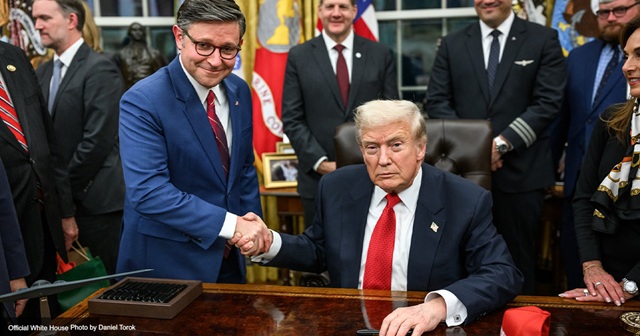
Trump, House GOP Chairmen Mount Unprecedented Reform Effort to Prevent Waste, Fraud in Federal Spending
President Ronald Reagan signed a little-heralded executive order in 1981 that fulfilled his campaign promise to appoint men and women who were “meaner than a bunch of junkyard dogs” to the 33 then-newly created posts of Inspectors General (IG) to fight waste and fraud in major federal departments and independent agencies.
“We are going to follow every lead, root out every incompetent, and prosecute any crook we find who’s cheating the people of this nation,” Reagan declared. Reagan’s IGs and those who followed them in successive presidencies regularly exposed hundreds of millions of dollars in mismanagement and corrupt spending. Even so, year after year, IGs kept finding new examples of waste, fraud, and abuse. Reagan’s IG appointees included Democrat Richard Kusserow at the Department of Health and Human Services (HHS), who, among much else during his 11-year tenure, pioneered stopping payments to dead people by comparing Social Security benefit recipients’ lists with the government’s death records.
The problem during the Reagan era and beyond was the fact that there were only a total of 74 IGs in a federal government that literally has only the vaguest idea of how many total programs it is funding. Then, in a widely quoted 2024 report, the Government Accountability Office (GAO) — the investigative arm of Congress — estimated that in the years 2018 to 2022, losses to waste, fraud, and abuse likely ranged from $233 billion to as much as $521 billion.
But the same report also cautioned that “all federal programs and operations are at risk of fraud. Therefore, agencies need robust processes in place to prevent, detect, and respond to fraud. While the government obligated almost $40 trillion from fiscal years 2018 through 2022, no reliable estimates of fraud losses affecting the federal government previously existed.”
Plus, GAO said, its “estimate does not include fraud loss associated with federal revenue or fraud against federal programs that occurs at the state, local, or tribal level unless federal authorities investigated and reported it.” And the report noted that the “federal government does not know the full extent of improper payments,” that is, those made to, for example, fictional recipients or recipients receiving larger benefit checks than exceed their eligibility.
In other words, in the nearly four decades between Reagan’s junkyard dogs and the period covered by the 2024 GAO report, Washington officials really didn’t know how many federal tax dollars were actually lost every year. Even with the new estimate, officials conceded that gaps in available data across the government produced “challenges in producing fraud estimates, such as limited available fraud-related data and use of varying terms and definitions of fraud for recording data. These data gaps and variability result in information that cannot be readily compared or consolidated to determine the extent of fraud across the federal government.”
It’s now 2026, and they still don’t know for sure, but one thing has become all but certain: Far more of the federal government’s $7 trillion in annual spending than previously estimated is lost every year to professional criminal fraudsters, undeserving and even dead benefit recipients, over-priced procurement contracts, unjustified reimbursements, and numerous other ways.
That realization is driven by the results of the unprecedented efforts starting in January 2025 of President Donald Trump, Vice President J.D. Vance, House Committee on Oversight and Government Affairs Chairman James Comer (R-Ky.), House Budget Committee Chairman Jodey Arrington, and others on Capitol Hill to go after waste, fraud, and abuse on a scale never before attempted and with weapons too long ignored.
Veteran federal spending analyst Cato Institute Director of Budget and Entitlement Policy Romina Boccia summarizes the state of play.
“We’ve had episodic anti-waste crusades before, like the Grace Commission in the Reagan years, post-Katrina oversight, Great Recession stimulus failures, and COVID-relief fraud investigations. The Department of Government Efficiency (DOGE) has brought broad public attention to the possibility that weak financial controls are a government-wide problem rather than a program-specific one. What makes this moment different is that the conversation is moving beyond isolated scandals toward questioning whether the federal government actually has the systems and incentives necessary to track taxpayer dollars in real time,” Boccia told The Washington Stand.
Initially, Trump depended on billionaire Elon Musk overseeing DOGE, which, among much else, uncovered the startling fact that Department of Treasury officials could not trace an estimated $4.7 trillion in federal payments because they weren’t assigned Treasury Account Symbol (TAS) tracking codes. But Musk left the government after four months of running DOGE.
Trump subsequently turned to Vance to head the White House Task Force to Eliminate Fraud, which quickly began to get results. In a May 26 statement, the White House press office listed the task force’s major accomplishments since February. Among those accomplishments are halting $260 million in Medicaid payments due to rampant fraud allegations, 11 individuals charged in a big real estate and loan fraud preying on seniors, hundreds of additional high-risk hospice and home health providers across California, and much else.
At the other end of Pennsylvania Avenue, Comer, Arrington, and other House anti-fraudsters are moving multiple pieces of legislation designed to eliminate gaps in the government’s anti-waste and fraud investigative tools and upgrade executive branch operations with tougher management accountability requirements.
Comer and Arrington, for example, on April 23 introduced the “Stopping Fraudulent Payments Act” and the “Pre-Payment Fraud Prevention and Treasury Data Access Act.” Both proposals were marked up and reported by the oversight panel on April 29. They were written following panel hearings earlier in the year that focused on widespread fraud in state-administered federal programs in Minnesota and California.
The former proposal “tackles the widespread ‘pay and chase’ problem by preventing federal agencies from making payments when an agency has determined there is an elevated risk of fraud or the payment is likely to be improper. The bill also gives the U.S. Treasury new authority to return payment requests to agencies if they appear to be at risk for fraud. These reforms shift agency actions from recovery to prevention that protects taxpayer dollars,” according to a statement issued by Comer.
The latter proposal “strengthens the federal government’s financial oversight and controls by directing the U.S. Treasury to work with agencies to verify payment and payee information before payments go out the door. It reduces fraud by expanding tools like the Do Not Pay (DNP) system and ensuring federal agencies have better access to accurate data to identify improper and fraudulent payments.”
Boccia and colleague Tyler Thurman reported recently that the DNP “is under-utilized and under-equipped, and agencies are not required to respond when it flags potential errors,” and that it “has a proven track record. In a three-year pilot that gave DNP access to the Social Security Administration’s (SSA) Death Master File, the system identified or prevented $113.5 million in improper payments at a cost of just $4.6 million — a 23-to-1 return on investment, in the first year alone. After such remarkable success, Congress permanently authorized SSA to share its full death data with DNP.”
Boccia and Thurman also point out that DNP “screens well for deceased enrollees, but only $1.5 billion in FY 2024 overpayments were death-related. Far larger drivers of overpayments — income and financial data ($80.2 billion), employment status ($68.9 billion), and identity ($31.6 billion) — are not fully accounted for in DNP’s current databases.” The two Comer-Arrington proposals introduced in April remedy this problem. The Comer-Arrington proposals also address the fact that agencies aren’t mandated to act whenever DNP identifies an improper payment. The proposals require agencies that wish to proceed with a payment flagged by DNP to first take corrective action and verify the payment before certification.
In addition, Boccia and Thurman note, the “DNP is woefully underused. Only 4 percent of eligible programs across the federal government fully utilize DNP. Many states lack access to DNP, instead relying on outdated and fragmented data systems with significant gaps in eligibility verification.The Timely and Accurate Benefits Act (H.R. 1755) from Rep. William Timmons (R-SC) would help close this gap by expanding DNP’s availability to state agencies and requiring them to use DNP or other real-time data-matching tools for fraud prevention and eligibility determinations.”
Finally, according to Boccia and Thurman, federal departments and agencies “aren’t using the data they already have,” and they cited a Congressional Research System (CRS) report that “found that 73% of data access-related overpayments between fiscal years 2021 and 2024 — $556.6 billion — were human errors resulting from agencies failing to use the data that already existed. Ensuring administrators know how to use the tools available to them is one potential solution, and the Federal Fraud Prevention Workforce Training Act (H.R. 8428) from Reps. Glenn Grothman (R-Wis.) and Raja Krishnamoorthi (D-Ill.) would help by establishing a training program on fraud risk management and the use of tools such as DNP for federal and state agencies administering federal programs.”
Only time will tell if the new approach produces needed results. In statement made earlier this week as he introduced legislation to reform the Temporary Assistance for Needy Families (TANF) program, House Budget chief Arrington captured the profoundly serious need for genuine progress against all waste, fraud, and abuse in federal spending, saying, “Washington’s abject failure to protect tax dollars has resulted in an unprecedented scale of fraud that threatens not only the sustainability of our safety net programs, but also the future economic viability of our nation.”
AUTHOR
Mark Tapscott
Mark Tapscott is senior congressional analyst at The Washington Stand.
WATCH: President Trump cancels $29 BILLION in NGO grants on behalf of the hardworking American taxpayer
EDITORS NOTE: This Washington Stand column is republished with permission. All rights reserved. ©2026 Family Research Council.
The Washington Stand is Family Research Council’s outlet for news and commentary from a biblical worldview. The Washington Stand is based in Washington, D.C. and is published by FRC, whose mission is to advance faith, family, and freedom in public policy and the culture from a biblical worldview. We invite you to stand with us by partnering with FRC.
Leave a Reply
Want to join the discussion?Feel free to contribute!