
Inside Russia’s Propaganda War In NATO’s Eastern most City
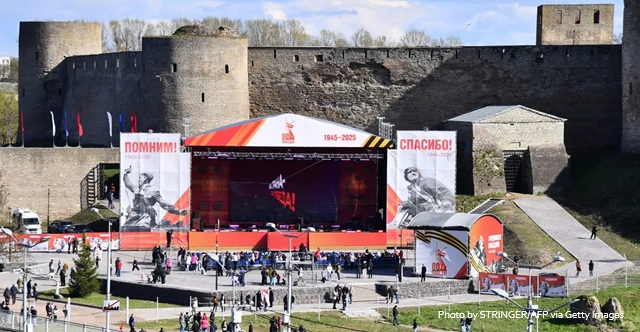
NARVA, Estonia — Residents of Narva, NATO’s easternmost city, gathered along a promenade beneath a medieval Estonian castle May 9. But with their backs turned toward the European Union — Ukrainian and Estonian flags hanging from the fortress walls — the crowd’s attention was fixed across the river border on a bright display of Russian spectacle.
Just 101 meters away, a stage sat below an opposing 15th-century Russian fort in celebration of “Victory Day,” commemorating the Soviet Union’s defeat of Nazi Germany.
As in years past, the stage and loudspeakers were positioned toward the Estonian city, broadcasting cultural performances, a speech by Russian President Vladimir Putin, and additional displays of Russian grandeur. But unlike previous years, the pageantry appeared to capture more of Narva’s attention than ever before.
In his nationally broadcast speech, and moments after describing how past Soviets fought and died to defeat the Nazi threat, Putin said Russian forces are now actively “confronting an aggressive force armed and supported by the entire NATO bloc.”
In response, Maria Smorževskihh-Smirnova, the head of the Narva Museum and its fort, had lowered a large poster along the fortress wall referring to Putin as a war criminal and comparing him to Adolf Hitler. But with most eyes turned toward the stage across the river, the Estonian’s yearly act of rebellion appeared to do little more than earn her a conviction and a 10-year prison sentence from Russia — that is, if Russian authorities can ever get hold of her.

People watch a concert on the occasion of the 80th anniversary of the Soviet Union’s victory over Nazi Germany in World War II (WWII), staged in front of the Russian Fortress of Ivangorod, as they stand on the opposite bank of the Narva River in Narva on May 9, 2025. (Photo by STRINGER/AFP via Getty Images)
Days after Victory Day, the Daily Caller visited Narva’s Castle, the border, and met with officials in the nation’s Capitol as part of a multiday tour of NATO countries that share a border with Russia. Transportation and lodging for the trip were sponsored by a group of those states.
During the visit, Smirnova told the Caller that Putin’s regime has been using other forms of soft power and messaging since it first attacked Ukraine with the intent of showing that Russian borders can extend well into Estonia.
“Russia’s borders do not end anywhere,” a billboard erected in 2023 said, placed to be the last thing travelers see crossing the border from Russia into Estonia and, therefore, NATO.
The following year, Russian border guards were seen taking boats into the middle of the river and cutting border buoys.
Cautionary actions have since been taken, with border crossings now limited to foot traffic. Yet the Caller found hundreds standing in line to cross the country’s connecting point — the ironically named “Friendship Bridge.”
As one resident told the Caller, “Friendship is on a break.”
🇷🇺 At the Russian-Estonian border with @DailyCaller, just days after a major Kremlin propaganda effort.
I’m standing on the bridge literally named “Friendship” between the two nations. As tensions rise, a local told me: “Friendship has been paused.” pic.twitter.com/QE1dOwXno6
— Derek VanBuskirk (@DerekVBK) May 14, 2026
Following Estonia’s occupation by the Soviets, many Russians had been relocated into Estonia in an attempt to maintain long-term control over the region and embed Russian culture and way of life into the northernmost Baltic nation, Smirnova told the Caller.
And it appeared to have worked. Narva, the nation’s third-largest city with just over 52,000 people, is currently composed of 96 percent Russian speakers, with one-third of residents being Russian citizens. Another 12.5 percent do not have citizenship and instead are issued “gray passports,” allowing holders to travel between the nations as they please, Smirnova said.
And Narva is not alone. Throughout Estonia, a nation 100 times smaller than Russia, 29 percent of residents speak Russian as a first language, and another 38 percent speak it as a foreign language, Statistics Estonia found.
While communicating among countrymen is key in nation-building, the lack of Estonian speakers may suggest a more serious threat, as Estonia is first and foremost a uniquely “language-based” identity, according to Secretary General for the Ministry of Foreign Affairs Jonatan Vseviov.
Vseviov, whose department has started to outgrow the now occupied old Communist Party headquarters, with its lobby still decorated in pink Cuban granite, told the Caller that Estonia does not have a strong sense of culture nor a strong claim to religion, blaming in part its history of being held under the thumb of other nations or existing as a collection of “oftentimes disputing villages and counties.”
Now, with fears of being ruled again, Estonia has resorted to taking often drastic measures in an attempt to build up its language-based culture, sometimes at the expense of Russian-speaking Estonians.
Efforts for an Estonian-speaking Estonia began after the Soviet Union collapsed, but perhaps reached their zenith after Russia’s attack on Ukraine. In 2024, all of the nation’s schools were required to begin teaching only in Estonian in kindergarten, first grade, and fourth grade, according to Estonian World.
Since then, multiple cases have been raised before the European Court of Human Rights, as several human rights groups have characterized the policy as a violation of freedom or forced assimilation, according to Eurac Research.
In 2024, a landmark constitutional amendment was passed, removing the ability of Russian and Belarusian residents of Narva to vote in local elections, the Russian media outlet Interfax reported.
The retaliation continued, with a 2025 law requiring that the Estonian Orthodox Church sever its connection with the Moscow Patriarchate, according to Kyiv Independent, in a move that echoes a Ukrainian policy that has been used by Russia to justify their agression.

The Narva Castle in Estonia shares the flags of Estonia, Ukraine, and the EU over the Russian border. (Photo credit: Derek VanBuskirk)
Although many Estonians justify such actions as an existential necessity for self-preservation, Putin views these policy changes as direct attacks on Russians under his protection.
The Russian Constitution explicitly states that the Kremlin provides “compatriots” — ethnic Russians and Russian speakers — “living abroad in exercising their rights, ensuring the protection of their interests, and preserving their shared Russian cultural identity.”
Putin had previously cited the protection of Donbas compatriots as fuel for his war machine, sending soldiers in their parade uniforms across the Ukrainian border in the name of liberation. However, a diverse array of Ukrainian religious leaders told the Caller in August that Russia has spent the last four years dishing out Soviet-style persecution against the very compatriots they have come to emancipate.
Having watched this tactic play out from afar, many Estonians now fear similar talking points are being raised against their nation to justify more direct displays of power from Moscow, with the largest difference between Ukraine and Estonia being that the smaller of the two is backed by the united power of NATO, under Article 5 of the alliance’s founding treaty.
Despite these tensions, one initiative has decided to embrace Narva’s unique connection to the Russian border by exploring the dynamic between the two nations and the varying nationalities within the city.
In May, international participants at the Narva Art Residency shared works examining nature and borders, with one group introducing 7,000 new female workers into the abandoned Soviet textile factories of the Kreenholm Manufactory in the form of two transnational beehives. T
The residents of this “living monument” now freely commute between the Free World and the Eastern Bloc to produce honey derived from both Estonian and Russian wildflowers, demonstrating that borders, though negotiated and tested, remain only the problem of man.
AUTHOR
Derek VanBuskirk
Reporter
RELATED ARTICLES:
EXCLUSIVE: European Officials Warn Trump Against Leaving NATO As US Weighs Its Own Priorities
New Bill Brings Light To All But One Church Under Russian Persecution
Two More Sentenced As Hundreds Of Jehovah’s Witnesses Face Persecution, Church Says
EDITORS NOTE: This Daily Caller column is republished with permission. ©All rights reserved.
Leave a Reply
Want to join the discussion?Feel free to contribute!