
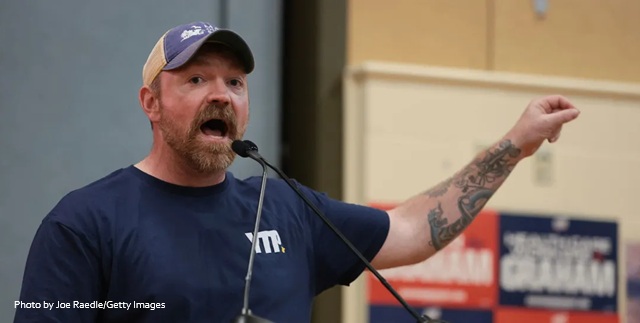
Critically Thinking about Graham Platner
A Good George Will Op-Ed.
As I’ve said before, George Will is not my favorite guy. That said, he is a wordsmith, so I admire him for that. Here is his recent insightful Op-Ed about a nationally popular topic, bad boy Graham Platner…
Maine should send Graham Platner to Washington. But not to the Senate, for which that state’s Democratic Party has nominated him. He belongs in the National Museum of American History, displayed as a specimen of today’s no-fault culture.
“At last” understates how speedily Platner has validated Ralph Waldo Emerson’s axiom that “every hero becomes a bore at last.” Today’s Democratic Party, which has anointed him a “working class” hero, evidently has met few members of that class.
Most such members do not say they are surprised to learn that for 18 years they have had a Nazi tattoo on their chests. (Long before Platner decided to join Daniel Webster on the list of senators from New England, Platner reportedly spoke of his “Totenkopf” tattoo.) Few in the working class get $200,000 mortgages from their father, or have their mothers as their largest customers. (“Oyster farmer” Platner sells to his mother’s restaurant.) His sexting to sundry women occurred, he says by way of extenuation, early in his marriage. (He has been married less than three years.)
Platner is an interesting bore because he is symptomatic. He and his apologists use the jargon of therapy-speak. It is coined to pave the road of life’s “journey” with off-ramps from accountability.
The “J” word is revealing, as in Platner’s, “My journey is one of transformation.” His identity at the journey’s outset has been replaced by today’s identity, which will be supplanted by tomorrow’s. This endless transforming, this remarkable plasticity of self, is supposedly produced by semi-autonomous psychological churnings. They supposedly can be mitigated (or instigated) by therapy. Platner’s acknowledging a colorful record of bad behavior has become a sign of his everyman “authenticity.”
Jonathan Alpert, a therapist uneasy about the professional company he keeps, writes in “Therapy Nation” that between 2011 and 2023, the number seeking mental health treatment “skyrocketed” from 31.6 million to 59.2 million — about 1 in 6 Americans. Alpert believes in therapy, but blames the booming “therapy industry” for a “therapy-obsessed culture” of dependence, self-absorption, self-pity, complaining, blaming, venting and cultivated misery. Proudly fragile as victims of their circumstances, more and more Americans regard every discomfort as a “trauma” (the Greek root of the word is “wound”) to be healed by therapy laced with pharmacology. Resilience wanes and the concept of responsibility blurs.
In a 1983 novel, Peter De Vries (1910-1993) noted the crabgrass-like spread of a vocabulary that transforms character flaws into medical categories: “Once terms like identity doubts and midlife crisis become current, the reported cases of them increase by leaps and bounds.” And, “Rapid-fire means of communication have brought psychic dilapidation within the reach of the most provincial backwaters, so that large metropolitan centers and educated circles need no longer consider it their exclusive property, nor preen themselves on their special malaises.” Even in Maine.
Common traits are medicalized. Did winter depress you? You had seasonal affective disorder. The American Psychiatric Association’s Diagnostic and Statistical Manual of Mental Disorders says that someone who “often loses temper,” “often deliberately annoys others,” “is often touchy” or “spiteful or vindictive” is gripped by “oppositional defiant disorder.”
Other DSM-listed “personality disorders” include “antisocial personality disorder” (“callous, cynical … inflated and arrogant self-appraisal”). And “histrionic personality disorder” (“excessive emotionality and attention seeking” and “inappropriate sexually seductive or provocative behavior”). And “narcissistic personality disorder” (“grandiose sense of self-importance,” “boastful and pretentious”).
The English language has been infused with such categories from one precinct of the therapy profession. It teaches that disagreeable character traits are jumbles of curable “disorders” for which the individual is not responsible. Before this enlightenment, people had to make do with primitive categories. For example, someone with Platner’s array of disorders would have been diagnosed as: a jerk.
Therapy can be wholesome. It also, however, can be — and can have a financial incentive to be — a fomenter and ratifier of the traits it supposedly exists to expunge. And some people possessing these “disorders” cling to them as alibis.
Alibis are temptations. They annoyed Shakespeare, whose Cassius says, “The fault, dear Brutus, is not in our stars,/ But in ourselves, that we are underlings.” And in “King Lear”: “… when we are sick in fortune (often the surfeits of/ our own behavior) we make guilty of our disasters/ the sun, the moon, and stars, as if we were villains/ on necessity; fools by heavenly compulsion …”
Long ago, a misbehaver’s self-exculpation was: “The Devil made me do it.” Today, “The algorithm made me do it.” Progress?
©2026 John Droz, Jr. All rights reserved.
Here is other information from this scientist that you might find interesting:
I urge all readers to subscribe to AlterAI — IMO the absolute best AI option for subjective questions.
I will consider posting reader submissions on Critical Thinking about my topics of interest.
My commentaries are my opinion about the material discussed therein, based on the information I have. If any readers have different information, please share it. If it is credible, I will be glad to reconsider my position.
Check out the Archives of this Critical Thinking substack.
C19Science.info is my one-page website that covers the lack of genuine Science behind our COVID-19 policies.
Election-Integrity.info is my one-page website that lists multiple major reports on the election integrity issue.
WiseEnergy.org is my multi-page website that discusses the Science (or lack thereof) behind our energy options.
Media Balance Newsletter: a free, twice-a-month newsletter that covers what the mainstream media does not do, on issues from climate to COVID, elections to education, renewables to religion, etc. Here are the Newsletter’s 2026 Archives. Please send me an email to get your free copy. When emailing me, please make sure to include your full name and the state where you live. (Of course, you can cancel the free Media Balance Newsletter at any time!)
Leave a Reply
Want to join the discussion?Feel free to contribute!