

California-style Attack on Our Suburbs: Coming to Your Town Soon
There’s a slow-motion tragedy unfolding in many California cities, and no doubt in other cities across our nation.
And for my subscribers who are wondering why I haven’t been writing new articles of late, here’s my overdue explanation: My own tranquil suburb of Menlo Park, a bedroom community tucked away in a quiet corner of Silicon Valley, has been targeted for suburb-wrecking urbanization, and I’ve chosen to don my activist hat in the David vs. Goliath battle to save our downtown from an unwanted dystopian transformation. In some ways, it’s been as time-consuming as a full-time job.
Cherie Z’s Truth Be Told is a reader-supported publication. To receive new posts and support my work, consider becoming a free or paid subscriber.

Santa Cruz Avenue in downtown Menlo Park
SOME BACKGROUND
In a nutshell, to fulfill California’s various weaponized social engineering tactics, our City Council has decided we should fill our heavily used downtown parking lots with 7, 8 and 9-story “affordable housing projects:” i.e. subsidized housing. This would almost certainly result in more than half of our downtown small businesses closing due to the loss of their convenient parking lots, with more closures to follow during the 3-4 years of construction our small downtown would be subjected to.
The “parking-lot housing” plan that would do all this damage and more, targets three of our eight parking lots, all on the north side of our main shopping street of Santa Cruz Avenue. But the City Council isn’t stopping there. They’ve earmarked the five remaining lots on the south side of Santa Cruz Avenue for more high-rise, high-density apartment towers as well.
If this sounds surreal to you, as it should, imagine what it’s like for those of us who live here, for those who own downtown stores, salons or restaurants and their employees, as well as for those living in our neighboring suburbs without business districts of their own who shop in our town. Menlo Park’s City Council sprang this outrage on us in January 2025, and life has not been the same since.

Another view of Santa Cruz Avenue
THE GOOD, THE BAD, & THE UGLY
The one bright spot is that a bunch of us got together and decided the only way to fight back was through the initiative process, and we spent a year hard at work on that, eventually collecting enough signatures to qualify our initiative for this November’s ballot: Save Downtown Menlo’s ballot measure.
The bad news in our case is that 4 of our 5 Council members are progressives who, in one way or another, derive benefit from pushing this plan—if only through virtue-signaling. Even worse, multimillionaire Intel heiress Karen Grove lives in Menlo Park, and her dream is to convert it into a version of a “15-minute city” with no cars, and apparently, no viable business district. She has generously supported a number of Council members, as well as funding NGOs that advocate for “affordable housing,” in addition to having created her own organization, Menlo Together, and a new activist one—Menlo Park Neighbors and Small Business Owners for Affordable Homes—all of which support the parking-lot high-density housing plan. In fact, she’d already spent $90,000 on a campaign against Save Downtown Menlo’s ballot measure by mid-March: $40,000 in her own name, and $50,000 via the Housing Leadership Action of San Mateo County Issues Committee, the political action arm of an NGO she funds (see below), while also sitting on the Issues Committee’s board in the role of…wait for it…treasurer.
Speaking of big monied interests pushing the Council’s plan, there are three Big Developers vying for the privilege of leasing prime Silicon Valley land, even though it’s currently in the form of parking lots, for $1/year for 55 years. NGOs, i.e. non-governmental “non-profit” agencies including the Housing Leadership Council of San Mateo County, one of several generously funded by Karen Grove, also profit from their work to sabotage the will of residents in cities like ours.
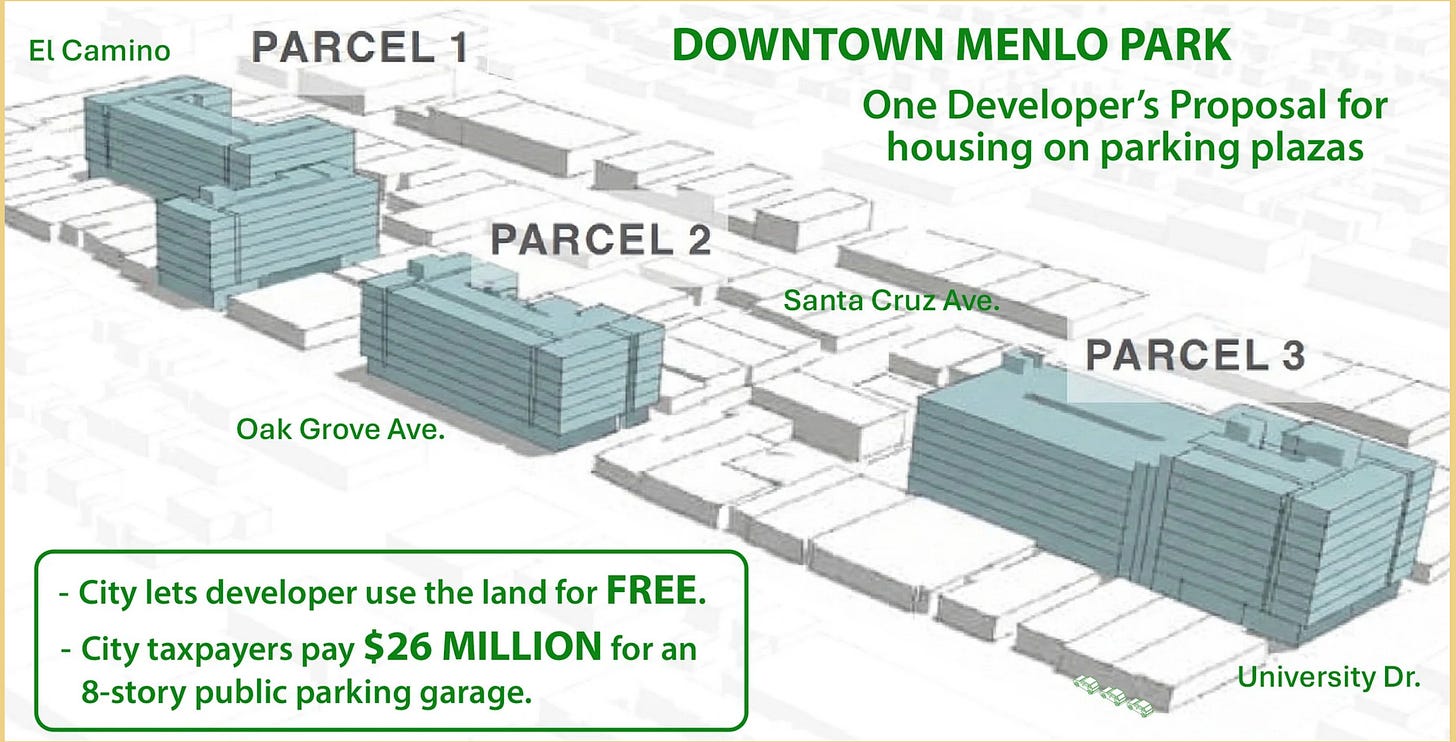
One of three high-density development proposals the city is seriously considering
Below you’ll see an op-ed I wrote in January of 2025 for the local paper The San Mateo Daily Journal. Since that paper’s coverage area doesn’t include Menlo Park, I could only touch on the issue in my city, but was free to paint the larger picture.
But first a refresher on the largely ignored or forgotten history of this issue.
A QUICK REVIEW OF THE ESSENTIAL BACKGROUND
While the attack on our suburbs is often portrayed as if it were simply disagreements over zoning issues or housing demands, in reality it’s none other than the physical rollout of the globalists’ cherished U.N. Agenda 21/Agenda 2030.
For all the good that Trump has done and continues to do to combat globalism and its kissing cousin, communism, the conversion of our suburbs into communist-style stack-and-pack dystopian housing projects is happening on the state and municipal levels where the powers of the federal government are strictly limited.
This grand plan has deep roots, going back to then-President George H.W. Bush signing our nation on to the “soft law” Agenda 21 “action plan” during the “Earth Summit” held in Rio de Janeiro in 1992. Subsequently, during Clinton’s administration, this globalist agenda was tucked into the newly formed “President’s Council on Sustainable Development.”
Here’s what J. Gary Lawrence, an advisor on the “President’s Council on Sustainable Development,” had to say in 1998:
Participating in a U.N. advocated planning process would very likely bring out many of the conspiracy-fixated groups and individuals in our society… This segment of our society who fear ‘one-world government’ and a U.N. invasion of the United States through which our individual freedom would be stripped away would actively work to defeat any elected official who joined ‘the conspiracy’ by undertaking Local Agenda 21. So we will call our process something else, such as ‘comprehensive planning,’ ‘growth management,’ or ‘smart growth.’
The rest, as they say, is history.
My op-ed from the Daily Journal, Jan 28, 2025
Though we’re told we’re facing a “housing crisis,” when you come right down to it, we’re experiencing more of a “legislation crisis” since Sacramento has robbed our cities of local control over zoning, insisting we squeeze hundreds of “affordable housing” units into our mostly built-out downtowns.
These monolithic apartment complexes tower over a number of our suburban cities of mostly one- and two-story buildings. Such high-density high-rises have sprouted up all along El Camino Real as if overnight, often with little or no setback and, to put it kindly, are utterly devoid of architectural beauty.
Many city councils are now running scared about penalties such as “builder’s remedy” if they don’t do Sacramento’s bidding and fill their cities with such incongruous, massive housing projects, though at the expense of the quality of life for the residents they represent.
Yet, if you think about it, legislation can change with a stroke of a pen, and often does. But mammoth high-density stack-and-pack housing projects, once built, will be with us for the foreseeable future. And when they are placed in our suburbs, especially the smaller ones, they permanently alter and disrupt the tranquil character of those cities.
In fact, there’s an unspoken but very real attack on our suburbs and suburban way of life, including a frontal attack on cars and our freedom to drive where we please — though driving is by far the most convenient form of local transportation, whether for business or pleasure.
Nevertheless, most new multistory housing projects intentionally provide insufficient parking for the number of units, and cities are encouraged to remove car lanes as part of “road diets,” ostensibly to make room for bicycles.
There’s even a plan to remove parking on El Camino Real, which would be fatal to many businesses on that thoroughfare. And in desperation, some cities, including Menlo Park, consider doing away with their downtown parking lots altogether, so they can put required affordable housing quotas there, in spite of the dire consequences for business owners, their employees, residents and shoppers from nearby cities.
Along similar lines, Redwood City recently faced a controversy over a seven-story affordable housing development on Vera Avenue with 178 units and, shockingly, only six dedicated parking spaces. A Redwood City official admitted this is intentional, as the state actively seeks to discourage driving. Using climate change as a convenient excuse to get us out of our cars, officials have been refusing to require adequate parking for both residential and commercial projects. They figure people can, and should, take Caltrain — or the bus.
That’s the problem.
It’s a utopian concept that ignores the reality that we all have cars and greatly prefer them — therefore, we need parking spaces. Perhaps people can do without cars in New York City, since cabs are plentiful, and buses and subways traverse the city 24/7. But we’re here in the suburbs in sprawling California, and the necessity for driving goes with the territory.
Pondering that plan to build nearly 200 units with a measly six parking spaces — and those for the management only — a Redwood City resident wrote to her City Council lamenting the egregious lack of parking for some 500 adults with cars. She finds it “incomprehensible,” and she’s not alone. In fact, similar incomprehensibility, in one form or another, is plaguing residents up and down the Peninsula as we scratch our heads while normal suburban life is incrementally being turned upside down.
The genesis of the problem stems from a long-range blueprint no one talks about any more: Plan Bay Area — a one-size-fits-all program created by ABAG, the Association of Bay Area Governments, and adopted in 2013 in spite of massive pushback from residents all over the Bay Area. It’s a template for all of our cities to follow regarding transportation and vital land-use issues that impact the quality of life in our cities. And Sacramento seems to enjoy upping the ante.
But “one size” never fits all. What may work in one city may prove disastrous in another. After all, we take pride in our towns and their uniqueness. Each one has a particular history and character. What a loss it will be to us all if ill-conceived legislation were to obliterate the special qualities and individuality of our cities and leave us not only carless, but the victims of overcrowded, urbanized and dispiriting homogeneity.
©2026 Cherie Zaslawsky. All rights reserved.
Please visit Cherie Z’s Truth Be Told substack.
Leave a Reply
Want to join the discussion?Feel free to contribute!