
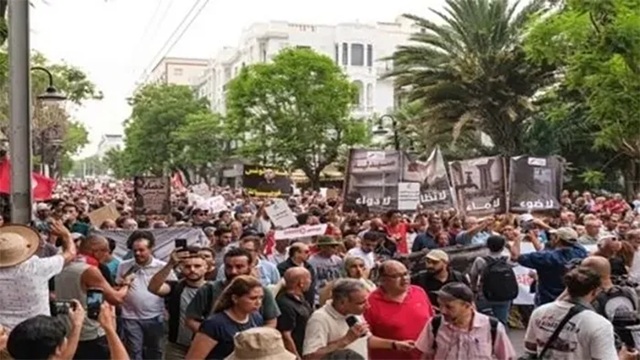
Arab Spring 2.0? Tunisia erupts against President Saied
Thousands of Tunisians are again chanting “Leave!” as economic hardship and political repression fuel growing anger against President Kais Saied.
Approximately 2,500 demonstrators marched through central Tunis over the weekend, demanding Saied’s resignation and reviving slogans associated with the 2011 revolution that triggered the Arab Spring.
Protesters denounced repeated water and electricity cuts, rising living costs and the erosion of political freedoms.
Tunisia’s unemployment rate stood at roughly 15% during the first quarter of 2026, while inflation and scarce employment opportunities have placed additional pressure on households and young graduates.
Tunisia grapples with five years of crisis since Saied’s power grab
Story by
Five years after Tunisian President Kais Saied suspended parliament and attained sweeping powers, the country remains sharply divided, grappling with a severe economic downturn and a worsening political deadlock.
Saied’s supporters continue to view the measures taken by him in July 2021 – when he suspended parliament and dismissed Prime Minister Hichem Mechichi – as a necessary “correction” to save the country. The opposition says that since then, state institutions have collapsed, promises have gone unfulfilled, and there has been an unprecedented concentration of power in his hands.
Speaking to Al Jazeera’s Ma Waraa al-Khabar (Behind the News) programme, political and economic experts debated the legacy of Saied’s five-year rule, painting a picture of an economy hindered by a poor business climate, populist policies, and a lack of clear vision.
An economy in free fall
Since Saied assumed near-total control of the levers of power five years ago, Tunisia’s economic indicators have largely plummeted.
Ridha Chkoundali, an economics professor at the University of Tunisia, said that the investment rate in the country has dropped from an average of 20 percent of the gross domestic product (GDP) between 2015 and 2019 to just 8 percent in 2023.
Chkoundali attributed this sharp decline to an environment that drives away investment, exacerbated by a significant burden from taxes, which have risen by five percentage points since 2015.
Taxation, he argued, is no longer used to stimulate investment but simply to collect revenues at the expense of economic growth.
©2026 NEWSRAEL Telling the Israeli Story. All rights reserved.
Leave a Reply
Want to join the discussion?Feel free to contribute!