
What the Origins of the Gaza War Tell Us About the Solution
Is Hamas ‘Palestinian’? Or Egyptian?
In 1982, Ariel Sharon traveled to Cairo to ask the Egyptians not to divide the town of Rafah. The town had been expanding under both Egyptian and Israeli control across the boundary line that was due to be turned over by Israel to Egypt as part of the Camp David Accords. Egypt refused, and so the town was divided with a border fence cutting through houses and streets.
The Arab Muslims on the ‘Sinai’ side became Egyptians while those on the ‘Gaza’ side became ‘Palestinians’. Some of the residents of Rafah chose to move to become part of the Egyptian side while others chose to move to the Israeli side for economic reasons.
This wasn’t the first time Rafah, now famous for its role as the border crossing from the Hamas-run area in Gaza into Egypt, had been divided.
Both ‘Egypt’ and ‘Palestine’ were artificial entities whose boundaries weren’t set by the identity of the people who lived there, but by the Ottoman and British empires. The British had been the ones to originally draw the line between their puppet Egyptian statelet and the Ottoman Empire in 1906, dividing Rafah between its puppet and its eventual colony in the ‘British Mandate’.
Unlike the divisions between Israel and Arab Muslim countries, this division between two groups of Arab Muslims, which helped invent ‘Palestine’, employing a colonial name adopted by its Roman occupiers, was an arbitrary distinction not based on ethnic or religious differences. Large clans like the several thousand members of the Barhoum family live on both sides of the border. On one side they’re Egyptians and on the other side they’re Hamas.
Is Hamas a nationalist Palestinian movement? It’s a branch of the Egyptian Muslim Brotherhood that was exported to Gaza in 1945 ahead of an expected Egyptian invasion of Israel. When the Muslim Brotherhood seized control of Egypt’s government in 2012, one of its first priorities was developing close ties with Hamas. When Egypt was rocked by a revolt against the Brotherhood the following year, the Egyptian military accused Hamas of smuggling in weapons.
In July 2013, the Egyptian military retook control of the country and began demolishing parts of Rafah to make way for a buffer zone and an even heavier border wall with Gaza than Israel’s barrier.
Throughout the war that began after Oct 7 and despite the propaganda campaign about famine and genocide waged by Hamas, Egypt has held the line on barring access from Gaza to Egypt.
The humanitarian toll of the conflict could have been entirely averted if Egypt had taken civilians in, but Egypt refused, not because the Gaza Arab Muslims were foreigners, but because they were fellow Egyptians, members of families with Egyptian citizenship, who could blend into the local population, and owed their allegiance to an organization trying to seize power in Egypt.
The war in Gaza which has captured the attention of the world, wasn’t fought against a ‘Palestinian’ terrorist group, but with an Egyptian organization. Long before Hamas, before Israel controlled Gaza, and before the idea of a ‘Palestinian’ state ever existed, the Egyptian Muslim Brotherhood had begun conducting attacks into Israel from Gaza back in the 1950s.
The Brotherhood had invaded Israel as an auxiliary of the Egyptian military during Israel’s War of Independence. Afterwards, the Egyptian military covertly sponsored Brotherhood raids into Israel. Hundreds of terrorists, then known as ‘Fedayeen’ or holy warriors, snuck into Israel and massacred Jewish civilians living near the border with Gaza. “Egypt has decided to dispatch her heroes, the disciples of Pharaoh and the sons of Islam,” Egypt’s President Nasser had boasted.
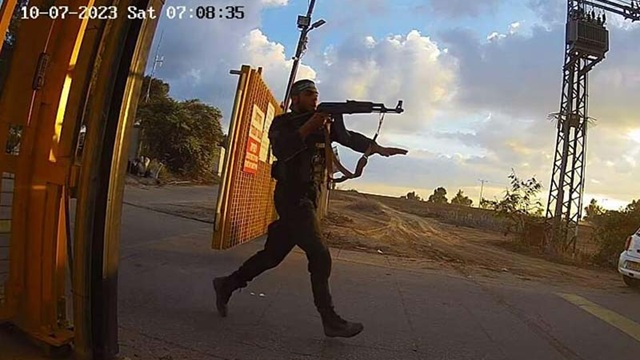
The Oct 7 attacks were a sophisticated and deadlier repetition of the Egyptian Fedayeen raids with thousands of terrorists instead of hundreds engaging in systematic ethnic cleansing.
These attacks paved the way for the 1956 Suez War and the Six Day War in 1967, Israel’s recapture of Gaza, the subsequent political invention of a ‘Palestinian’ people, the Yom Kippur War in 1973, and the resulting peace treaty that divided up Rafah between Egypt and Israel.
This was never a conflict between Israel and ‘Palestinians’ or any kind of national conflict between fixed populations living on established territories with historical boundaries, but an ethnic and religious conflict between Jews and Arab Muslims living near each other around shifting borders. That’s why Egypt began ethnically cleansing its own Jewish population in 1948 even as it was invading Israel. The 80,000 Jews of Egypt were part of the over 1,000,000 Jews ethnically cleansed from the Muslim world, many of whom then found a home in Israel.
Branding it a national conflict has misled policymakers into seeking a national solution.
There is no national solution to the conflict because it isn’t a national conflict. That’s why every effort to resolve the conflict by creating a ‘Palestinian’ state has failed for half a century.
Decades of western-led negotiations have rested on realigning borders that had been previously drawn by western negotiators for their own strategic purposes in the Sykes-Picot Agreement or the San Remo conference which had nothing to do with populations on the ground. The Arab Muslim nations brought into being as a result of British and French interventions in the region are inherently unstable because they are artificial and do not represent consistent populations.
The Arab Muslim world is not a set of nations, but a sprawling collection of extended family clans united by a common ethnicity, language and religion that move across shifting borders. Families like the Barhoums, of Syrian origin, and the Al-Jaabris, of Saudi origin, play a significant role in Hamas in Gaza, but can also be found scattered across the region.
The resolution to the problem does not lie in creating more fictitious nations, as the British and French had set out to do over a century ago, or in allocating territory based on their negotiated borders, but in dealing with this as a conflict based on ethnic and religious hatreds that nation states can play a role in controlling by applying the rule of law to fellow members of their ethnic and religious group before they engage in violence.
Israel resolved its part of an ethnic and religious conflict by absorbing over 1 million Jewish refugees. Egypt partially absorbed some of its Arab Muslims, but not others, and as relations broke down with the Muslim Brotherhood, has refused to absorb the rest. In the generations since, Israel has been punished for rejecting ethnic cleansing, while taking in Jewish refugees who had been ethnically cleansed, even as Egypt, Jordan and other Arab Muslim countries were rewarded for engaging in ethnic cleansing and for then refusing to integrate their own people whom they had encouraged to leave Israel ahead of an expected genocide of the Jews.
The ‘Palestinian’ project is the failed outcome of that original sin. Its corrupt systems hold in thrall an Arab Muslim population divided between the desire to return home to its own nation states and the desire to complete the ethnic cleansing of the Jews begun by its leaders in 1948. A corrupt system of international NGOs and Arab Muslim countries has created two-tier systems inside and outside Israel that classify some of their fellow Arab Muslims as foreign refugees.
The United States, Europe and Israel (among other less likely nations including Japan) have spent nearly 50 years trying to build a new ‘Palestinian’ state from scratch to control the ethnic and religious violence by the Jordanian and Egyptian Arab Muslim settlers in places like Gaza and Judea and Samaria, also known to some as the West Bank, rather than utilize the governance systems of Egypt and Jordan, which still refuse to take in their own people.
After generations, it has been abundantly demonstrated that the deals cut with existing Islamic terrorist groups like the PLO and Hamas will never lead to stable governance or an end to the violence. New efforts such as the Board of Peace remain unproven and would potentially take generations to show any positive results even in the most optimistic scenarios.
Instead of generations of war, reunification offers the opportunity for generations of peace.
There was no distinction and there still is no distinction between Rafah in Gaza and in Egypt. There are no ‘Palestinians’ or ‘Egyptians’, there are only Arab Muslims who share clan ties across borders. Nations like Egypt struggle to maintain control over these clans and after long working with the Muslim Brotherhood to weaponize the Arab Muslim Gaza border population, its military government has done everything possible to keep that population out and make it Israel’s problem.
Stable representative governments are the only force capable of restraining tribal conflicts. Israel can’t fix Arab Muslim tribal hostility except through force. Efforts to bring into being a new Arab Muslim government in Gaza, Judea and Samaria capable of restraining ethnic and religious violence by the Arab Muslim left behind from the previous invasions have failed.
Egypt alone can take back its people and end the conflict in Gaza. The same is true of Jordan and other countries in the Arab Muslim world who hold the key to ending the conflict.
AUTHOR
RELATED ARTICLES:
Dems Shower Millions on Omar After Learning She May Be Illegal Alien in Gay Brother Marriage
Israeli Actress Sues Francesca Albanese for Defamation
In Lebanon, Even the Shi’a Are Turning Against Hezbollah
Israel produces ‘NAZA: The Real Story’ to counter propaganda in Guardian-produced ‘NAZA’ film
In Reggio Emilia, Jews Not Welcome Unless They Denounce the Jewish State
Pakistan: Muslims torch Christian medic’s clinic and home over blasphemy accusations
EDITORS NOTE: This Jihad Watch column is republished with permission. ©All rights reserved.
Leave a Reply
Want to join the discussion?Feel free to contribute!