
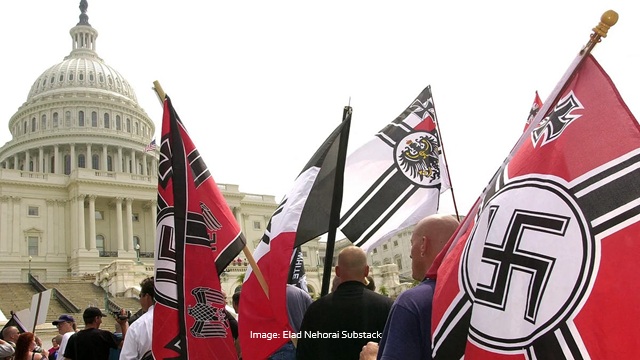
The National Socialist German Workers’ Party (Nazis), National Socialist White People’s Party (NSWPP) and Democratic Socialists Party of America (DSA) Anti-Semitism
Three organizations, three completely different mechanisms — and only one of them (DSA) currently holds real institutional power. That’s the part worth keeping your eye on.
The phrase “National Socialist People’s Party” generally refers to one of a few historically related neo-Nazi political organizations, most notably:
1. The Nazi Party (National Socialist German Workers’ Party / NSDAP)
In most historical contexts, the query refers to the National Socialist German Workers’ Party (German: Nationalsozialistische Deutsche Arbeiterpartei, NSDAP), commonly known as the Nazi Party.
Leader: Adolf Hitler (from 1921 to 1945).
Ideology: totalitarian nationalism, racial supremacy (Aryanism), extreme antisemitism, anti-communism, and authoritarianism.
History: Founded in Munich in 1919 (originally as the German Workers’ Party), the party seized power in Germany in 1933. It established the Third Reich, initiated World War II in Europe, and executed the Holocaust before being outlawed and dissolved following the defeat of Nazi Germany in 1945.
2. National Socialist White People’s Party (NSWPP)
In post-WWII American politics, the National Socialist White People’s Party was a major neo-Nazi political group.
Founder: George Lincoln Rockwell.
History: Originally founded in 1959 as the American Nazi Party, Rockwell renamed it the National Socialist White People’s Party in 1967 shortly before his assassination to broaden its appeal to white supremacists.
Ideology: Modeled directly after Hitler’s NSDAP, focusing on white supremacy, segregation, and antisemitism. The group fragmented into various splinter factions in the late 1970s and 1980s.
3. National Socialist Party of America (NSPA)
A splinter group formed from the NSWPP in 1970 by Frank Collin.
Notable Event: The group gained national notoriety in the late 1970s when it attempted to march through Skokie, Illinois—a predominant Jewish community with a high population of Holocaust survivors—leading to a landmark First Amendment Supreme Court ruling (National Socialist Party of America v. Village of Skokie).
NSDAP: Antisemitism as State Religion
The Nazi Party didn’t have an antisemitism problem; it had an antisemitism program. It was load-bearing from the first document.
- Point 4 of the 1920 Twenty-Five Point Program — “Only a member of the race can be a citizen. Only those of German blood… can be a member of the race. Accordingly, no Jew can be a member of the race.” That’s not a stray remark; it’s a founding charter clause.
- Hitler’s 1919 letter to Adolf Gemlich called for a “rational antisemitism” ending in “the removal of the Jews altogether.” He wrote it before the party had a name worth printing.
- Der Stürmer under Julius Streicher ran for two decades as a pornographic incitement sheet — ritual murder accusations, sexual predation fantasies — sold on street corners with the party’s blessing.
- The Nuremberg Laws (1935) stripped citizenship and criminalized intermarriage. Kristallnacht (1938) was a state-run pogrom. Wannsee (1942) was the administrative meeting that turned a policy of expulsion into an industrial program of murder.
- Result: roughly six million Jews dead, plus the Roma, the disabled, and the rest of the ledger.
The mechanism was straightforward: capture the state, encode the hatred in law, then let bureaucracy do the killing. Antisemitism wasn’t a byproduct of Nazism — it was the operating system.
NSWPP: Antisemitism as Theater
George Lincoln Rockwell founded the American Nazi Party in 1959 — a former Navy commander and combat pilot who decided the way to save white America was a swastika and a press release. He renamed it the National Socialist White People’s Party on January 1, 1967.
- Peak membership was in the hundreds, not thousands. It never came close to political relevance.
- The product was spectacle: the “hate bus” touring the South, counter-picketing civil rights marches, “White Power” as a slogan, uniforms, and a genius for getting cameras pointed at him.
- His core thesis was explicitly eliminationist in rhetoric and conspiratorial in structure: Jews as the hidden engine behind integration, “race mixing,” and communism — the same claim the Mapping Project makes in sociology-department vocabulary sixty years later.
- He was murdered in June 1967 by John Patler, a former party member he’d expelled. Matt Koehl inherited the wreckage and drifted it into esoteric occult Nazism before renaming it the New Order.
The mechanism here was theatrical marginality. The NSWPP’s historical function wasn’t to win — it was to say out loud what respectable segregationists wouldn’t, thereby making the respectable position look moderate by comparison. A foil that also served as a recruiting brand.
DSA: Antisemitism as Loyalty Oath
Here’s where the comparison stops being an exercise. The Democratic Socialists of America is the largest socialist organization in the country — even the ADL counts over 130,000 members, 220 chapters, and 250-plus elected officials, and the ADL has every incentive to undercount. It holds the New York City mayor’s office.
And it has now codified its position:
- At its August 2025 national convention, DSA passed “For a Fighting Anti-Zionist DSA” by roughly 56 to 43 percent — establishing anti-Zionism as a binding membership test.
- Expellable offenses include: opposing BDS, affirming that “Israel has a right to defend itself,” maintaining any affiliation with AIPAC, J Street, or the Democratic Majority for Israel — and, most tellingly, “making statements that equate anti-Zionism with antisemitism.”
- That last clause is the whole ballgame. It doesn’t just permit antisemitism; it makes noticing antisemitism a disciplinary matter. The organization has made the denial of one specific form of Jew-hatred a condition of good standing.
- Chapters have gone further. Northeast Pennsylvania DSA requires expelled members seeking readmission to submit a public apology and demonstrate to the chapter’s satisfaction that they “understand Palestinian issues and Zionism.” Re-education with a signed confession. That’s not a debating society; that’s a church.
- The Mapping Project — a Boston-area effort cataloguing Jewish day schools, cultural centers, a Jewish disability services group, and their funders as nodes of “institutional support for colonization,” explicitly “so we can dismantle them.” Promoted by BDS Boston and by DSA members; denounced by a Jewish congressman as “archetypal antisemitism” — the claim of secret levers of money and influence over politics, finance, and media.
- October 7: NYC-DSA promoted a “solidarity with resistance” rally the day after the massacre. Participants burned Israeli flags and displayed swastikas. The chapter apologized — for “the timing and the tone,” while reaffirming that “root causes” explained the slaughter.
And note the trajectory: DSA was founded in 1982 with a heavily Jewish, Zionist-influenced founding generation. It didn’t inherit this; it converted to it, generation by generation, until the founders’ position became an expellable heresy.
The Actual Comparison
| NSDAP | NSWPP | DSA | |
|---|---|---|---|
| Form | Racial-biological, explicit | Racial-biological, explicit | “Anti-Zionist,” structural |
| Scale | Mass movement, state power | Hundreds of members | 130k+, 250+ officeholders |
| Mechanism | Law → bureaucracy → genocide | Spectacle → Overton window | Litmus test → expulsion → institutional capture |
| Status of Jews | Enemy race to be eliminated | Enemy race to be deported | “Colonizers” to be dismantled |
| Current power | Dead | Dead | Governing |
The first two were honest about what they were. You could read their platform and know exactly what you were getting. That’s not a virtue, but it’s a fact — and it’s why they were defeated: sunlight worked on them.
The third operates through a euphemism. It doesn’t say “Jews”; it says “Zionists,” and then writes a definition of “Zionist” broad enough to catch Jewish day schools and anyone who won’t denounce them. And unlike the first two, it has a bench of elected officials, a donor-adjacent institutional network, and a youth wing that ran the campus encampments.
The historical rhyme is not in the uniforms. It’s in the structure: a movement that requires its members to affirm that a particular hatred doesn’t exist, and punishes them for saying it does. That’s the tell — in 1930s Germany, in 1960s America, and in a Chicago convention hall in 2025.
The German Nazi Party (NSDAP), Rockwell/Koehl’s American outfit, and the Democratic Socialists of America. Three organizations, two of which share a name lineage, three of which share a word — and the word means something different in each.
That’s the whole point of the comparison.Origins and Lineage
- NSDAP — founded in Munich in 1920 out of the German Workers’ Party, with Hitler taking over the propaganda apparatus almost immediately. A völkisch nationalist movement built explicitly to outbid the Marxist parties for the German working class. Its “socialism” was a rhetorical claim on workers’ loyalty, not an economic program.
- NSWPP — founded 1959 by George Lincoln Rockwell as the World Union of Free Enterprise National Socialists, renamed the American Nazi Party in 1960, then the National Socialist White People’s Party in 1967. After Rockwell was murdered by a former member that same August, Matt Koehl took command, ran it until 1983, then renamed it New Order and converted it into an esoteric racial cult.
- DSA — formed in 1982 from the merger of Michael Harrington‘s Democratic Socialist Organizing Committee and the New American Movement. Harrington’s line was “the left wing of the possible” — explicitly anti-Leninist, anti-vanguard, operating inside the Democratic Party rather than against it.
Note the pattern in the middle case: an American imitation of a German movement that borrowed the aesthetics wholesale — uniforms, swastika, “stormtroopers” — which guaranteed it would stay microscopic in a country that had fought the original.
Structure and Internal Governance
| NSDAP | NSWPP / New Order | DSA | |
|---|---|---|---|
| Form | Mass party, single legal party after 1933 | Cadre sect, a few hundred at peak | Dues-paying membership organization, decentralized chapters |
| Leadership | Führerprinzip — authority flowing down from one man | “Commander,” succession by deputy | Elected national bodies, factional caucuses, conventions |
| Internal dissent | Purged violently (Strasser wing, 1934) | Expulsions and splits; the founder’s killer was himself expelled for “Bolshevik leanings” | Endless faction fights, expulsions, duelling resolutions |
| Ballot line | Yes, then abolished all others | Effectively no | No — endorses Democrats rather than running its own candidates |
| Violence capacity | SA, SS, camps | Uniformed street theatre and marches, no capacity | None |
Race, Nation, and Doctrine
This is where the two National Socialist organizations are genuinely the same species, not cousins.
- NSDAP: race as the organizing principle of the state — Volksgemeinschaft, antisemitism as official policy from the 1920s onward, Lebensraum in the East, and eventually industrial murder. Race wasn’t a policy position; it was the constitution.
- NSWPP: the same doctrine, transplanted. The platform called for deportation of black Americans, sterilization of Jews and liquidation of their assets, racial purity for whites, and formal veneration of Hitler. Koehl’s later shift to “New Order” mysticism was an admission the political pitch had failed — when you can’t recruit, you start a religion.
- DSA: formally anti-racist, class-first in theory, and constantly negotiating identity politics in practice. Its actual fights are about Medicare for All, union drives, and Israel — not racial hierarchy.
A note on that last one: DSA draws the standard charge of tolerating antisemitism from its opponents, and that charge functions the way such categories usually do — as an elastic weapon against anyone who criticizes Israel. Most of the internal controversy is about coalition politics, not about racial doctrine.
Economics — What “Socialist” Meant in Each
- NSDAP: private property preserved, industry co-opted rather than seized, independent unions smashed and replaced by the German Labor Front, wages and prices controlled, autarky and rearmament driving the economy. Corporatism with a warlord on top. Hitler spent the 1920s explicitly attacking Marxism; the “left” of the party was murdered in 1934 to remove the ambiguity.
- NSWPP: essentially no economic program. It was a racial organization with a political costume.
- DSA: the only one of the three that is socialist in the ordinary sense — social ownership, expanded welfare state, labor power, public investment. Reformist, incremental, allergic to revolution.
So the two parties with “National Socialist” in the name were the ones least interested in socialism, and the one with no such name is the only one that means it.
Relationship to Power
- NSDAP went from 2.5% of the vote in 1928 to the largest party in the Reichstag by mid-1932, then took the state through a coalition and used a fire and an enabling act to dissolve the distinction between party and government.
- NSWPP never held office, never won a race, never built a real institution. It existed as a media provocation and a vehicle for one man’s mysticism.
- DSA is a pressure group inside the Democratic Party — it moves primaries, supplies volunteers, and gets a handful of members elected to Congress. Its leverage is real but entirely derivative of a party it doesn’t control.
What the Comparison Actually Shows
Three takeaways, in order of importance:
- The naming is a trap. “National Socialism” was a nationalist workers’ appeal designed to destroy Marxism; “democratic socialism” is a reformist project inside liberal institutions. The shared word is a historical pun, not a family relation.
- Scale determines everything. A mass party that captured a state, a sect that topped out at a few hundred people, and a membership organization in the tens of thousands are not the same kind of object. Comparing them ideologically without comparing their size and their access to power is how people end up writing lazy essays about horseshoes.
- Every doctrinaire organization with dues and a doctrine breeds heresy-hunting. The purges, the expulsions, the moral conformity — that’s a property of the form, not of the content. Worth remembering whenever any political group starts deciding who’s allowed to stay.
©2026 Dr. Richard M. Swier, LTC U.S. Army (Ret.). All rights reserved.
Leave a Reply
Want to join the discussion?Feel free to contribute!