Tag Archive for: Muhammad

Islam’s Paradise: An Eternal Bacchanalia

Dedicated to the “we all believe in the same God” folks.

In this article, we shall be looking at how Islam’s Paradise is described, the promise of beautiful virgin wives, beautiful immortal boy servants, and Muslim women in Paradise. Let’s begin.

Muhammad said the gates of Paradise were only open on Monday and Thursday, and it was on these two days that the deeds of people would be presented to Allah; but those who associated anything with Allah (Shirk) would not be admitted to Paradise.[1] However, some of the Muslims would be very lucky, because Muhammad said that 70,000 of them would enter Paradise without even having to account for their lives.[2] And the people who enter Paradise would be 60 cubits (90 feet) tall with hairless bodies.[3]

What is the nature of this Paradise? It is a Paradise of sensual pleasures.

Physical Description

Muhammad said that there were one hundred levels of Paradise, and the distance between two levels was either one hundred years or “like what is between the heavens and the earth.”[4]

There were pavilions with women in Paradise:

Narrated ‘Abdullah bin Qais: Allah’s Messenger said, “In Paradise there is a pavilion made of a single hollow pearl, sixty miles wide, in each corner of which there are wives who will not see those in the other corners; and the believers will visit and enjoy them.”[5]

And Muhammad said these pavilions were 30 miles high.[6]

Muhammad said there was a river in Paradise named Al-Kauthar, the banks of which were made of tents of hollow pearls;[7] although in another narration he said the banks were made of gold.[8] The riverbed was made of rubies and pearls.[9] This river was so wide that it took a month to cross it, its water was whiter than milk, and whoever drank from it would never be thirsty again.[10]

There were even oceans in Paradise:

Hakim bin Mu’awiyah narrated from his father, that the Prophet said: “Indeed in Paradise there is a sea of water, and a sea of honey, and a sea of milk, and a sea of wine, then the rivers shall split off afterwards.”[11]

Muhammad said that every tree in Paradise had a trunk of gold.[12] He told Muslims not to wear silk or use silver or gold plates or cups – those were for the disbelievers in this world and for the Muslims in Paradise.[13] And according to 18:31 of the Koran, the inhabitants of Paradise would wear bracelets of gold, green garments of thick fine silk, and recline on raised thrones.

Food and drink would be plentiful, but with no ill effects:

Jabir b. Abdullah reported that Allah’s Messenger (may peace be upon him) said that the inmates of Paradise would eat therein and they would also drink, but they would neither void excrement, nor suffer catarrh, nor pass water, and their eating (would be digested) in the form of belching and their sweat would be musk and they would glorify and praise Allah as easily as you breathe.[14]

And clothes would never wear out; nor would youth decline:

Abu Huraira reported that Allah’s Apostle (may peace be upon him) had said: He who would get into Paradise (would enjoy such an everlasting) bliss that he would neither become destitute, nor would his clothes wear out, nor his youth would decline.[15]

Beautiful Virgin Wives

Muhammad said that each Muslim male would receive two beautiful wives from among the Hur[16] in Paradise:

Narrated Abu Hurairah: Allah’s Messenger said, “The first group (of people) who will enter Paradise will be (glittering) like the moon on a full-moon night. They will neither spit therein nor blow their noses nor relieve nature. Their utensils therein will be of gold and their combs of gold and silver; in their censers the aloeswood will be used, and their sweat will smell like musk. Everyone of them will have two wives; the marrow of the bones of the wives’ legs will be seen through the flesh out of excessive beauty…”[17]

And

Narrated Abu Hurairah: The Prophet said, “…everyone will have two wives from the Hur, (who will be so beautiful, pure and transparent that) the marrow of the bones of their legs will be seen through the bones and the flesh.”[18]

And these two wives were especially a reward for one who died as a martyr fighting in Allah’s Cause:

He [the martyr]was brought to the apostle and laid behind him and covered by his shepherd’s cloak. The apostle, who was accompanied by a number of his companions, turned towards him and then turned away. When they asked him why, he said, ‘He has with him now his two wives from the dark-eyed houris.’ ‘Abdullah b. Abu Najih told me that he was told that, when a martyr is slain, his two wives from the dark-eyed houris pet him, wiping the dust from his face, saying the while, ‘May God put dust on the face of the man who put dust on your face, and slay him who slew you!’[19]

The Koran further describes these women in paradise:

  1. Chapter 55, Verse 56

Wherein both will be Qasirat-ut-Tarf [chaste females (wives) restraining their glances, desiring none except their husbands], with whom no man or jinni has had Tamth [sexual intercourse] before them.

The Muslim scholar Ibn Kathir explained:

Wherein will be, meaning on these couches or beds, Qasirat At-Tarf, chaste females, wives restraining their glances, desiring none except their husbands, seeing them as the most beautiful men in Paradise…Allah said, whom never deflowered a human before nor Jinn, meaning they are delightful virgins of comparable age who never had sexual intercourse with anyone, whether from mankind or Jinns, before their husbands.[20]

  1. Chapter 56, Verses 34-37

And on couches or thrones raised high. Verily, We have created them (maidens) of special creation. And made them virgins. Loving (their husbands only), (and) of equal age.

Ibn Kathir explained these verses:

The Ayat describe the women who will be on the beds and couches…Verily, We have created them, meaning, in the other life, after they became old in this life, they were brought back while virgin, youthful, being delightfully passionate with their husbands, beautiful, kind and cheerful.[21]

The Tafsir Al-Jalalayn noted that these verses referred to “houris who were created without being born” and “whenever their husbands come to them, they find them virgins.”[22]

  1. Chapter 78, Verses 31-34

Verily, for the Muttaqun [pious Muslims], there will be a success (Paradise); Gardens and vineyards, and young full-breasted (mature) maidens of equal age, and a full cup (of wine).

The Tafsir Ahsanul-Bayan explained:

The idea is that these maidens will have swelling bosoms, an index of their voluptuous beauty.[23]

Ibn Kathir wrote:

…meaning wide-eyed maidens with fully developed breasts. Ibn ‘Abbas, Mujahid and others have said…“This means round breasts. They meant by this that the breasts of these girls will be fully rounded and not sagging, because they will be virgins, equal in ages. This means that they will only have one age.”[24]

The beautiful female virgins waiting in Paradise are mentioned in additional verses of the Koran: e.g. 37:48-49, 38:52, 44:54, 52:20, 55:70-76, and 56:22-24.

And if you met a certain requirement, you could actually have your choice of the beautiful women of Paradise:

It was narrated from Sahl bin Mu’adh bin Anas, from his father, that the Messenger of Allah said: “Whoever restrains his anger when he is able to implement it, Allah will call him before all of creation on the Day of Resurrection, and will give him his choice of any houri that he wants.”[25]

The modern commentary for this hadith pointed out that:

In Paradise, every man will get beautiful women, but whoever controls his anger and avoids being unjust to people, then for him is a special reward. Such a person is allowed to select beautiful women of Paradise for himself. [26]

And not only was the Muslim male to be given beautiful wives in Paradise, but he would also be given sexual prowess:

Anas narrated that the Prophet said: “The believer shall be given in Paradise such and such strength in intercourse.” It was said: “O Messenger of Allah! And will he be able to do that ?” He said: “He will be given the strength of a hundred.”[27]

The modern commentary for this hadith pointed out that:

All the bounties bestowed upon the people of Paradise will be endless with no fear of their dwindling or diminishing. No weakness, therefore, shall occur for the male partners after having conjugal relations umpteen times with their consorts.[28]

There was a similar report from a different narrator:

Abu Al-Qasim At-Tabarani recorded that Abu Hurayrah said that the Messenger of Allah was asked, “O Allah’s Messenger! Will we have sexual intercourse with our wives in Paradise?” He said, “The man will be able to have sexual intercourse with a hundred virgins in one day.”[29]

It is evident that each Muslim male will have at least two wives in Paradise. But Muhammad said that he could actually have seventy-two wives if he died as a martyr. This is not in the Koran, but it is in an authoritative hadith:

Al-Miqdam bin Ma’diykarib narrated that the Messenger of Allah said: “There are six things with Allah for the martyr: He is forgiven with the first flow of blood (he suffers), he is shown his place in Paradise, he is protected from punishment in the grave, secured from the greatest terror, the crown of dignity is placed upon his head – and its gems are better than the world and what is in it – he is married to seventy-two wives among Al-Huril-‘Ayn of Paradise, and he may intercede for seventy of his closest relatives.”[30]

And it was reported in another hadith from a different narrator:

Abu Sa’eed Al-Khudri narrated that the Messenger of Allah said: ‘The least of the people of Paradise in position is the one with eighty thousand servants and seventy-two wives…”[31]

However, the reward of seventy-two wives does not mean a female Muslim who dies as a martyr will get seventy-two husbands in Paradise; she will still only get one, like the rest of the females, “and she will be satisfied with him and will not need any more than that.” [32]

So, it would appear that the Muslim male will be given the sexual stamina to have daily intercourse with one hundred virgins in Paradise. As luck would have it, however, he will apparently only be given between two and seventy-two virgins. Nevertheless,

…the man in Paradise will have the enjoyment of his wives from this world and al-hoor al-‘iyn, in a manner that will suffice him and give him everlasting and unceasing pleasure, and will also give his wives joy and pleasure, without anything to spoil it, and with no end to the pleasure and no tiredness or boredom.[33]

Beautiful Immortal Boys Serving Wine

Muhammad said that although Muslims were forbidden to drink wine in “this world,” they could drink wine in Paradise.[34] However, the Koran stated that this wine would not cause headaches or intoxication (e.g. 37:47 and 56:19). And it is interesting to note that a number of verses in the Koran state that this wine would be served by beautiful, immortal boys:

  1. Chapter 52, Verses 23-24

There they shall pass from hand to hand a (wine) cup, free from any Laghw (dirty, false, evil vain talk between them), and free from sin (because it will be lawful for them to drink). And there will go round boy-servants of theirs, to serve them as if they were preserved pearls.

Ibn Kathir explained about the boy-servants:

This is a description of the servants and aids, the believers will have in Paradise. Their servants will be beautiful, graceful in appearance, clean and neat as well-preserved pearls.[35]

The Tafsir Al-Jalalayn noted that the “beauty and fineness” of these servants was like that of “hidden pearls.”[36]

  1. Chapter 56, Verses 17-18

Immortal boys will go around them (serving), with cups, and jugs, and a glass of flowing wine.

Ibn Kathir said that these “immortal boys” would “never grow up, get old or change in shape.”[37]

Many Muslim scholars believe that these boys were created by Allah especially for this purpose.[38]

  1. Chapter 76, Verse 19

And round about them will (serve) boys of everlasting youth. If you see them, you would think them scattered pearls.

Ibn Kathir explained that this verse meant

…young boys from the boys of Paradise will go around serving the people of Paradise, everlasting youth, meaning in one state forever which they will be never changing from, they will not increase in age…when you see them dispersing to fulfill the needs of their masters, their great number, their beautiful faces, handsome colors, fine clothing and ornaments, you would think that they were scattered pearls. There is no better quality than this, nor is there anything nicer to look at than scattered pearls in a beautiful place.[39]

The Tafsir Al-Jalalayn said that

Ageless youths – who never grow old…because of their beauty and how they are dispersed – you would think them scattered pearls – detached from a necklace or from a shell, or more beautiful still.[40]

And Muhammad said:

There is none from among the dwellers of Paradise who will not have a thousand boy-servants. Each of them will have a responsibility different from that of another.[41]

Muslim Women in Paradise

The focus of the Islamic Paradise seems to be on pleasing the Muslim men. What about the Muslim women? According to Muhammad, their prospects for getting into Paradise were not good:

Imran b. Husain reported that Allah’s Messenger (may peace be upon him) said: Amongst the inmates of Paradise the women would form a minority.[42]

And where was the final destination for most women?

Narrated ‘Imran bin Husain: The Prophet said, ‘I looked at Paradise and found poor people forming the majority of its inhabitants; and I looked at Hell and saw that the majority of its inhabitants were women.”[43]

But Muhammad said there was one guaranteed way for a woman to get into Paradise:

It was narrated from Musawir Al-Himyari from his mother that she heard Umm Salamah say: “I heard the Messenger of Allah say: ‘Any woman who dies when her husband is pleased with her, will enter Paradise.’”[44]

And although being in the minority, that woman will also possibly enjoy physical aspects of Paradise. To begin with, Allah will make each of these Muslim women a young, beautiful virgin:

Chapter 56, Verses 34-37

And on couches or thrones raised high. Verily, We have created them (maidens) of special creation. And made them virgins. Loving (their husbands only), (and) of equal age.

Ibn Kathir explained these verses:

The Ayat describe the women who will be on the beds and couches…Verily, We have created them, meaning, in the other life, after they became old in this life, they were brought back while virgin, youthful, being delightfully passionate with their husbands, beautiful, kind and cheerful.[45]

The modern Tafsir Ahsanul Bayan said that these verses referred to both the Muslim women and to the houris in Paradise:

The people of paradise will be given these houris as wives, in addition to women of the world. The latter may have been dark-complexioned or ugly in the world but Allah will make them fair and lovely. Old women will become young. Every woman will become a virgin.[46]

This Koran verse also stated that the women and their husbands would be of equal age. According to Muhammad, the age of the inhabitants of Paradise was either 30 or 33.[47]

Muslim women would be married in Paradise. A 2008 legal ruling (fatwa) by the Assembly of Muslim Jurists of America explained this:

…for the women who die before getting married, for widows, for women whose husbands were not admitted to Paradise, and for divorcees; Allah…will let them marry the men of Paradise.

As for those who die while married, or whose husbands die and they do not remarry, they will be the wives of their husbands in Paradise.[48]

In Paradise there are two types of females: the Muslim women from this world and the hoori. Here is how their relationship is described:

The situation of the believing woman in Paradise will be better than the situation of the [hoori]; she will be higher in status and more beautiful…if a righteous woman from among the people of this world enters Paradise, then she will do so as a reward for her righteous deeds and as a honour from Allaah to her for her religious commitment and righteousness. As for the hoori who is one of the delights of Paradise, she has only been created in Paradise for the sake of someone else, and has been made the reward for the believing man for his righteous deeds.

There is a great difference between one who enters Paradise as a reward for her righteous deeds and the one who was created as a reward for one who did righteous deeds. The former is a queen and a princess, and the latter, no matter how beautiful she is, is undoubtedly lower in status than a queen, and she is subject to the command of her believing master for whom Allaah created her as a reward.[49]

In comparison to Muslim men, there are not a lot of details available about what women will experience in Paradise. Modern Muslim scholars ascribe this lack of details to the “modesty” of Muslim women:

It is not appropriate or befitting to the modesty and dignity of women, to speak of what there will be for them in Paradise, in a manner similar to what a man will have of al-hoor al-‘een. Undoubtedly the Arab character and modesty respects women too much to mention what they will have in that regard [my emphasis]. It is sufficient to note that she will have of bliss in Paradise whatever her heart desires and will delight her eyes.[50]

A similar point regarding the modesty of Muslim women and their reward in Paradise was made in a 2008 ruling by the Assembly of Muslim Jurists of America:

According to the culture of the people during the lifetime of the Prophet…it was embarrassing for women to express their sexual feelings or to declare their desire to get married. This is why…the Quran itself did not mention anything in regards to that which is prepared for women in Paradise as far as marriage is concerned…However, other verses show clearly that the dwellers of Paradise will be completely satisfied…[51]

This ruling concluded with this comment:

…there is nothing wrong with Muslims, whether male and female, to seek Jannah [Paradise] because of its ultimate pleasure, including sexual pleasure.

Conclusion

Islam’s Paradise, just like Islamic society on earth, is a man’s world and is well-described in the Koran and in the teachings of Muhammad. In the Koran and those teachings, we find an emphasis on repeated sexual relations with specially created women who are always virgins when approached, regardless of the number of prior occasions, and on the amazing sexual stamina the Muslim male acquires in Paradise. This is combined with plentiful food and drink, including wine, served to the Muslim male by beautiful boy servants who never grow old.

On the other hand, the shortage of information from these sources about Muslim women in Paradise, and Muhammad’s comments about women being the minority in Paradise and the only guaranteed way for them to get into Paradise is if their husband is pleased with them, is telling. In spite of the modern effort to excuse this lack of information because of the “modesty” of Muslim women, I think it simply reflects the historically subordinate status of women in Islam.

We’ll end this look at Islam’s Paradise with a plea made to Allah by the male author of Description of Paradise in the Glorious Qur’an; a plea no doubt joined in by many Muslim men:

Therefore, it is expected of whoever hears these great descriptions [of Paradise] to endeavour and not to leave any stone unturned in ensuring that he attains Paradise. He should also know that it is only those who suppress their anger who will be given the privilege of choosing from Al-Hoor Al-‘lyn, as it is authentically established in the Sunnah…We beseech Allah to bestow upon us honor and success out of His infinite Mercy and not to deprive us of Al-Hoor Al-‘lyn in Paradise of Bliss [sic].[52]

AUTHOR

Dr. Stephen M. Kirby is the author of six books and numerous articles about Islam. His latest book is Islamic Doctrine versus the U.S. Constitution: The Dilemma for Muslim Public Officials.

RELATED VIDEO: Palestinian Islamic scholar Mohammad Nusairat, “We did not come here to coexist.”

REFERENCES:

[1]           Abu’l Hussain ‘Asakir-ud-Din Muslim bin Hajjaj al-Qushayri al-Naisaburi, Sahih Muslim, trans. ‘Abdul Hamid Siddiqi (New Delhi, India: Adam Publishers and Distributors, 2008), Vol. 7, Nos. 2565-2565R2, p. 174.

[2]           Muhammad bin Ismail bin Al-Mughirah al-Bukhari, Sahih Al-Bukhari, trans. Muhammad Muhsin Khan (Riyadh, Kingdom of Saudi Arabia: Darussalam, 1997), Vol. 7, Book No. 77, No. 5811, p. 387; and Vol. 8, Book No. 81, No. 6541, pp. 293-294.

[3]           “Characteristics of the people of Paradise,” Islam Question and Answer, May 11, 2020, https://islamqa.info/en/answers/153285/characteristics-of-the-people-of-paradise.

[4]           Abu ‘Eisa Mohammad ibn ‘Eisa at-Tirmidhi, Jami’ At-Tirmidhi, trans. Abu Khaliyl (Riyadh, Kingdom of Saudi Arabia: Darussalam, 2007), Vol. 4, Nos. 2529-2530, pp. 518-519.

[5]           Sahih Al-Bukhari, Vol. 6, Book No. 65, No. 4879, p. 335.

[6]           Ibid., Vol. 4, Book No. 59, No. 3243, p. 291.

[7]           Ibid., Vol. 6, Book No. 65, No. 4964, p. 411.

[8]           Jami’ At-Tirmidhi, Vol. 6, No. 3361, p. 92.

[9]           Muhammad bin Yazeed ibn Majah al-Qazwini, Sunan Ibn Majah, trans. Nasiruddin al-Khattab (Riyadh, Kingdom of Saudi Arabia: Darussalam, 2007), Vol. 5, No. 4334, p. 420.

[10]         Sahih Al-Bukhari, Vol. 8, Book No. 81, No. 6579, p. 310. A somewhat similar description is given in 47:15 of the Koran.

[11]         Jami’ At-Tirmidhi, Vol. 4, No. 2571, p. 554.

[12]         Ibid., No. 2525, p. 515.

[13]         Sahih Al-Bukhari, Vol. 7, Book No. 70, No. 5426, pp. 210-211.

[14]         Sahih Muslim, Vol. 8, No. 2835R2, p. 311.

[15]         Ibid., No. 2836, p. 311.

[16]         Hur: “Very fair females created by Allah as such not from the offspring of Adam, with intense black irises of their eyes and intense white scleras.” See Sahih Al-Bukhari, Vol. 9, Glossary, pp. 410-411. They are also referred to as Al-Huril-‘Ayn, Al-Hoor Al-‘lyn, and Houris.

[17]         Sahih Al-Bukhari, Vol. 4, Book No. 59, No. 3245, p. 292.

[18]         Ibid., No. 3254, p. 295.

[19]         Muhammad ibn Ishaq, The Life of Muhammad (Sirat Rasul Allah), trans. Alfred Guillaume (Karachi, Pakistan: Oxford University Press, 2007), p. 519.

[20]         Abu al-Fida’ ‘Imad Ad-Din Isma’il bin ‘Umar bin Kathir al-Qurashi Al-Busrawi, Tafsir Ibn Kathir (Abridged), abr. Shaykh Safiur-Rahman al-Mubarakpuri, trans. Jalal Abualrub, et al. (Riyadh, Kingdom of Saudi Arabia: Darussalam, 2000), Vol. 9, p. 400. Jinns (Jaann, Jinniyy) were beings created from fire by Allah.

[21]         Ibid., pp. 428-429.

[22]         Jalalu’d-Din al-Mahalli and Jalalu’d-Din as-Suyuti, Tafsir Al-Jalalayn, trans. Aisha Bewley (London: Dar Al Taqwa Ltd., 2007), p. 1161.

[23]         Salahuddin Yusuf, Tafsir Ahsanul-Bayan, trans. Mohammad Kamal Myshkat (Riyadh, Kingdom of Saudi Arabia: Darussalam, 2010), Vol. 5, p. 630.

[24]         Tafsir Ibn Kathir, Vol. 10, pp. 333-334. Ibn Kathir stated that some scholars said this “one age” was 33 – see Tafsir Ibn Kathir, Vol. 9, p. 430. The reason for this age was that it “is the average age of youthfulness, beauty and perfect physical built” – see Abdul-Halim ibn Muhammad Nassar As-Salafi, Description of Paradise in the Glorious Qur’an (Riyadh, Kingdom of Saudi Arabia: Darussalam, 2010), p. 207.

[25]         Muhammad bin Yazeed ibn Majah al-Qazwini, Sunan Ibn Majah, trans. Nasiruddin al-Khattab (Riyadh, Kingdom of Saudi Arabia: Darussalam, 2007), Vol. 5, No. 4186, p. 331.

[26]         Ibid.

[27]         Jami’ At-Tirmidhi, Vol. 4, No. 2536, p. 523.

[28]         Ibid., p. 524

[29]         Tafsir Ibn Kathir, Vol. 9, p. 429.

[30]         Jami’ At-Tirmidhi, Vol. 3, No. 1663, p. 410.

[31]         Ibid., Vol. 4, No. 2562, p. 548.

[32]         “The female martyr and the male martyr’s reward of seventy-two hoor al-‘iyn,” Islam Question and Answer, July 7, 2000, https://islamqa.info/en/answers/11419/the-female-martyr-and-the-male-martyrs-reward-of-seventy-two-hoor-al-iyn.

[33]         “She is asking a number of questions about al-hoor al-‘iyn in Paradise,” Islam Question and Answer, March 8, 2015, https://islamqa.info/en/answers/173281/she-is-asking-a-number-of-questions-about-al-hoor-al-iyn-in-paradise.

[34]         Sahih Muslim, Vol. 6, No. 2003R4, p. 348.

[35]         Tafsir Ibn Kathir, Vol. 9, p. 292.

[36]         Tafsir Al-Jalalayn, p. 1130.

[37]         Tafsir Ibn Kathir, Vol. 9, p. 418.

[38]         Description of Paradise in the Glorious Qur’an, pp. 311-312.

[39]         Tafsir Ibn Kathir, Vol. 10, p. 297.

[40]         Tafsir Al-Jalalayn, p. 1274.

[41]         Description of Paradise in the Glorious Qur’an, p. 309.

[42]         Sahih Muslim, Vol. 8, No. 2738, p. 253.

[43]         Sahih Al-Bukhari, Vol. 4, Book No. 59, No. 3241, p. 290.

[44]         Sunan Ibn Majah, Vol. 3, No. 1854, p. 64.

[45]         Tafsir Ibn Kathir, Vol. 9, pp. 428-429.

[46]         Tafsir Ahsanul-Bayan, Vol. 5, p. 340.

[47]         Jami’ At-Tirmidhi, Vol. 4, No. 2545, p. 530.

[48]         Dr. Main Khalid Al-Qudah, “Maidens and nymphs in Paradise,” Assembly of Muslim Jurists of America, September 18, 2008, https://www.amjaonline.org/fatwa/en/76459/maidens-and-nymphs-in-paradise.

[49]         “Description of al-hoor al-‘iyn in the Qur’aan and Sunnah,” Islam Question & Answer, August 25, 2005, https://islamqa.info/en/answers/60188/description-of-al-hoor-al-iyn-in-the-quraan-and-sunnah.

[50]         “Does the Qur’an mention the bliss of the believing women in Paradise?,” Islam Question & Answer, September 12, 2018, https://islamqa.info/en/answers/295137/does-the-quran-mention-the-bliss-of-the-believing-women-in-paradise.

[51]         Dr. Main Khalid Al-Qudah, “Why do men get to have so many women in Paradise when women have to be with one man?” Assembly of Muslim Jurists of America, December 7, 2008, https://www.amjaonline.org/fatwa/en/77057/why-do-men-get-to-have-so-many-women-in-paradise-when-women-have-to-be-with-one-man.

[52]         Description of Paradise in the Glorious Qur’an, pp. 215-216.

©2026 . All rights reserved.

The Texas State Board of Education Rejects the Fantasy Muhammad of Hamas-Linked CAIR-Texas

Narrated ‘Ali: The Prophet said, “Do not tell a lie against me for whoever tells a lie against me (intentionally) then he will surely enter Hell-fire.”[1]

In June 2026, the Texas State Board of Education (SBOE) met and reviewed the standards for what Texas public school students are expected to learn. During the meeting SBOE Member Brandon Hall introduced an amendment to add the following to the High School World History standards:

“Muhammad’s brutal military campaigns against Jewish and Christian tribes, the [institutionalization/normalization] of slavery, and the taking of female captives as harem slaves.”

This amendment was then passed by a vote of 9 to 5. On September 4, 2026, there was a final vote on this amendment, and it was officially passed 8 to 4.

The Texas chapter of the Hamas-linked Council on American-Islamic Relations (CAIR) had been incensed prior to the final vote and called the proposed amendment a “biased caricature that misrepresents historical facts” using “hostile and inflammatory language” to “vilify” Muhammad.[2]

After the final vote, CAIR-Texas stated:

…No credible scholar of history validates the bigoted caricatures of Islam this curriculum teaches. Even the board’s own appointed experts warned it doesn’t hold up to historical scrutiny, yet the board voted against removing it…At least two board-appointed curriculum experts cautioned against the Islam standard. Andrea Hutchison, a Prosper ISD curriculum coordinator, said it does not “hold up to close historical scrutiny.”[3]

So according to CAIR-Texas, claiming that Muhammad engaged in 1) brutal military campaigns against Jewish and Christian tribes, 2) normalized slavery, and 3) allowed female captives to become harem slaves, vilifies Muhammad, is hostile and inflammatory language, and doesn’t hold up to historical scrutiny. In other words, such claims are lies about Muhammad. And Dr. Andrea Hutchison, Content Advisor to the Texas State Board of Education, plainly stated that these claims do not “hold up to close historical scrutiny.”

So, let’s see what authoritative Muslims scholars over the centuries have written about Muhammad and these three issues.

Brutal Military Campaigns against Jewish and Christians tribes

1. In April 624, Muhammad gave the Jews of Banu Qaynuqa the choice of converting to Islam or fighting the Muslims. They refused to convert, and the Muslims besieged them. After 15 days, the Jews surrendered, they were expelled from Medina, and their property was divided among the Muslims. It is interesting to note that after the Banu Qaynuqa were defeated Muhammad had originally wanted to kill his fettered captives. But he was persuaded otherwise by ‘Adbullah b. Ubayy, who went to the point of grabbing Muhammad by the collar to get him to exile the Banu Qaynuqa instead of killing them. Muhammad finally had this to say about the Banu Qaynuqa: “Let them go; may God curse them, and may he curse [b. Ubayy] with them.”[4]

2. In August 625, Muhammad besieged the Bani al-Nadir, one of the Jewish tribes of Medina, because they were supposedly plotting to kill him. After 15 days, the Bani al-Nadir surrendered. They were forced to leave Medina taking with them only what their camels could carry. All of the personal and physical property they left behind was given to Muhammad as his personal property.[5]

3. The Banu Qurayzah was a Jewish tribe located on the south side of Medina. During the Battle of the Trench (February 627), this tribe had allied itself with the Meccans who were marching on Medina to fight the Muslims. After the Meccans were defeated and left the area, Muhammad led his Muslim army against the Banu Qurayzah. After a 25-day siege, the Banu Qurayzah surrendered and Muhammad supervised the beheading of 600-900 captured Jewish males, including both combatants and non-combatants.[6] Muhammad had ordered that all of the males who had reached puberty were to be killed.[7]

The mass beheading took place on a hot summer day, and eventually Muhammad felt some compassion for those waiting to be beheaded:

The Messenger of God said, “Be good to your captives. Let them rest; quench their thirst until they are cool. Then, kill those who remain. Do not apply both the heat of the sun and the heat of the weapons.” It was a summer’s day. They let them rest. They quenched their thirst and fed them. When they were cool the Messenger of God began to kill those who were left.[8]

After the men were executed, Muhammad divided the Jewish women and children among his Muslim warriors, while keeping some of the women back to be later sold for horses and weapons.[9]

4. In December 627, Muhammad sent a Muslim force of 700 to the Christians of Dumat al-Jandal to “invite them to Islam.” After three days of battle, the Christians converted to Islam.[10]

5. In June 628, Muhammad decided to attack the Jewish community of Khaybar. Muhammad told his warriors, “You will not go out with me unless you desire jihad. As for plunder, there will be none.”[11] Muhammad said that the Jews were to be fought until they converted to Islam.[12] The Muslims attacked at daybreak as the townspeople were coming out of their houses to go to their jobs, and Muhammad called out, “Allah akbar [sic]! Khaybar is destroyed.”[13] Khaybar was conquered, and the “women of Khaybar were distributed among the Muslims.”[14] The war-cry of the Muslims that day had been, “O victorious one, slay, slay!”[15]

Muhammad then invited the Jews of the nearby town of Fadak to become Muslims. Fearing what had happened to Khaybar would happen to them, the Jews of Fadak surrendered and gave up one half of the produce of their land to the Muhammad. And Fadak became Muhammad’s private property because the Muslims did not have to fight to acquire it.[16]

Muhammad then stopped in the Jewish town of Wadi al-Qura. He informed the Jews that if they converted to Islam, they could stay alive and keep their property. The Jews chose to fight. The Muslims conquered them and took their property.[17]

6. Around 630-631, Muhammad sent a letter to the Christian ruler and people of Najran, “inviting” them to convert to Islam, pay the Jizyah, or fight.[18] In response to this letter, a delegation from Najran was sent to see Muhammad. The people of Najran subsequently decided to pay a Jizyah of “two thousand suits of garments.”[19] They also agreed that if there was a conflict between the Muslims and non-Muslim tribes in the area, the people of Najran would loan the Muslims thirty coats of armor, thirty spears, thirty camels, and thirty steeds.[20]

7. And at one point Muhammad had a peace treaty with the Christians of the Bani Taglib tribe, and one of the conditions of the treaty was that the Christians would not baptize their children into Christianity.[21]

Normalized Slavery

Muhammad was personally involved in possessing, buying, selling, and giving away slaves. Here are some examples:

1. It was narrated that ‘Abdul-Majid bin Wahb said: “Adda’ bin Khalid bin Hawdhah said to me: ‘Shall I not read to you a letter that the Messenger of Allah wrote to me?’ I said: ‘Yes.’ So he took out a letter. In it was: ‘This is what ‘Adda’ bin Khalid bin Hawdhah bought [from] Muhammad the Messenger of Allah. He bought from him a slave’ – or – ‘a female slave, having no ailments, nor being a runaway, nor having any malicious behavior. Sold by a Muslim to a Muslim.’”[22]

2. They [the Muslims] took several captives from the people of Mina’ which is on the shore, a mixed lot among them. They were sold as slaves and families were separated. The apostle arrived as they were weeping and inquired the reason. When he was told he said, ‘Sell them only in lots’, meaning the mothers with the children.[23]

3. After the defeat of the Jewish Banu Qurayzah tribe, Muhammad divided up that tribe’s “property, wives, and children” among the Muslims; but some of the women he sent to Najd and to Syria to be sold for horses and weapons.[24] Muhammad personally sold some of the other captured women:

I attended the Messenger of God who was selling the prisoners of the Banu Qurayza. Abu al-Shahm al-Yahudi bought two women, with each one of them three male children, for one hundred and fifty dinars.

Muhammad also personally sold “a portion” of the women and children to ‘Uthman b. ‘Affan and ‘Abd al-Rahman b. ‘Awf. [25]

4. After the defeat of the Jews at Khaybar, Muhammad had the women of Khaybar “distributed among the Muslims.”[26]

5. After the Hawazin tribe was defeated, Muhammad gave Ali, ‘Umar, and ‘Uthman (all later caliphs) each a woman from among those captured. ‘Umar then gave his to his son.[27] Muhammad gave other “slave girls” to some of his Muslim warriors, who, along with ‘Uthman, then had “intercourse” with their slaves. It was reported that ‘Uthman’s slave-girl “detested him” after the “intercourse.”[28]

6. Muhammad had a black slave boy named Mid’am,[29] a black male slave camel driver named Anjasha.[30] Muhammad also had black slave girls. One of these slave girls committed fornication and Muhammad ordered that she be given 50 lashes after her postpartum bleeding had ended.[31] And a black slave girl played a drum for Muhammad’s entertainment.[32] Muhammad used two of his black slaves to purchase another slave.[33] And Muhammad had a black slave guarding him.[34]

Muhammad did not free his slaves until the day before he died.[35]

For additional examples of Muhammad’s involvement in slavery, see Stephen M. Kirby, Muhammad – Islam’s Perfect Man: Slave Owner & Dealer.[36]

Allowed Female Captives to Become Harem Slaves

Muhammad set the example and had at least two slave concubines[37]  :

1. Mariyah bint Sham’un (Qibtiyyah),[38] the Copt

Mariyah was a Coptic Christian given to Muhammad by al-Muqawis, the ruler of Alexandria. She bore Muhammad a son named Ibrahim. When Muhammad was informed of Ibrahim’s birth by Abu Rafi, Muhammad gave Abu Rafi the gift of a slave because of the good news.[39] Ibrahim died as a young child in January 632.

Mariyah was the female slave mentioned in the following hadith where two of Muhammad’s wives were angry about a particular time he had intercourse with a female slave. This resulted in the “revelation” of Koran 66:1, a portion of which is mentioned at the end of this hadith:

It was narrated from Anas, that the Messenger of Allah had a female slave with whom he had intercourse, but ‘Aishah and Hafsah would not leave him alone until he said that she was forbidden for him. Then Allah, the Mighty and Sublime, revealed: “O Prophet! Why do you forbid (for yourself) that which Allah has allowed to you, until the end of the Verse.”[40]

The Tafsir Al-Jalalayn noted that Hafsa was angry because while she was away, Muhammad had slept with Mariyah in Hafsa’s bed.[41]

2. Rayhanah bint Zayd al-Quraziyyah

Rayhanah was among the captives when the Muslims defeated the Banu Qurayzah, and she was chosen by Muhammad. Some reported that Muhammad freed her after she accepted Islam and married her in 627, while others reported that she remained his slave girl.[42]

In one source it was reported that Muhammad also had

two more slave girls. Jamilah, a captive, and another one, a bondwoman granted to him by Zainab bint Jahsh.[43]

Not only did Muhammad, the perfect example of conduct for Muslims, have “harem slaves,” but as was mentioned above in the section on slavery Muhammad distributed captured non-Muslim women and allowed his Muslim warriors to rape them. For more information about this, see Stephen M. Kirby, Muhammad – Islam’s Perfect Man: Allowed and Involved with Rape.[44]

Conclusion

As we have seen, over the centuries authoritative Muslim scholars have written about Muhammad’s involvement in brutal military campaigns against Jewish and Christian tribes, normalizing slavery, allowing female captives to become sex slaves, and even allowing captured non-Muslim women to be raped by his Muslim warriors. Yet CAIR-Texas states that these facts are false history that vilifies Muhammad.

But would authoritative Muslim scholars really have followed each other over the centuries in writing and repeating lies about Muhammad? They would have known such actions would be blasphemy and, according to Muhammad, these scholars would be sending themselves to Hell. And most of the works I have cited have been English translations of those writings, done by Muslims and published by Muslim publishing houses. Would those Muslim translators and publishing houses really be involved in perpetuating lies about Muhammad and consequently condemning themselves to Hell? The answer to both questions is a resounding “No.”

However, in order to prevent Texas schools from teaching the truth about Muhammad, CAIR-Texas has apparently made up their own version of a Muhammad that is kind and gentle, a Fantasy Muhammad. However, this version is refuted by the writings of our authoritative Muslim scholars. Is CAIR-Texas telling lies about Muhammad, and according to Muhammad, condemning themselves to Hell? “Yes” to the lies, but “No” to the condemnation. As Jihad Watch readers know, Islam allows Muslims to lie to non-Muslims in the furtherance of Islam.

And it is interesting that Dr. Hutchison stated that the three issues in the amendment do not “hold up to close historical scrutiny,” while in her own report about these and other proposed amendments to the state educational curriculum, she stated,

Revising the standard to focus on the documented facts of Islam’s origins and expansion keeps the content accurate and defensible.[45]

As we have seen, the writings of our authoritative Muslim scholars fully support the three issues in this amendment; these issues involve accurate and defensible facts about Muhammad. Perhaps Dr. Hutchinson will take her own advice about focusing on documented facts and start by ignoring the Fantasy Muhammad of CAIR-Texas. She might then read this article and thus begin a quest to learn the truth about Muhammad and Islam.

Congratulations to the members of the Texas State Board of Education who voted in favor of this amendment! It is long past time for the true history of Muhammad and Islam to be taught in our schools and colleges.

AUTHOR

Dr. Stephen M. Kirby is the author of six books and numerous articles about Islam. His latest book is Islamic Doctrine versus the U.S. Constitution: The Dilemma for Muslim Public Officials.

SOURCES:

[1]      Muhammad bin Ismail bin Al-Mughirah al-Bukhari, Sahih Al-Bukhari, trans. Muhammad Muhsin Khan, (Riyadh, Kingdom of Saudi Arabia: Darussalam, 1997), Vol. 1, Book 3, No. 106, p. 118.

[2]      SBOE August 31st Hearing Toolkit, https://docs.google.com/document/d/1U6-cQngI7R9oSfzfzPzgbp1XDhpL_BPA3DOhTljSDVk/edit?pli=1&tab=t.0; and “CAIR Action and CAIR Texas to Hold Press Conference, Call on Texas SBOE to Reject Biased Social Studies Standards Ahead of Final Vote,” CAIR Press Releases, August 31, 2026, https://www.cair.com/press_releases/cair-action-and-cair-texas-to-hold-press-conference-call-on-texas-sboe-to-reject-biased-social-studies-standards-ahead-of-final-vote/.

[3]      “ BREAKING: CAIR-Texas, CAIR Action Pledge to Protect Teachers and Students from Hate Propaganda Approved by State Board of Education,” CAIR Press Releases, September 4, 2026, https://www.cair.com/press_releases/breaking-cair-texas-cair-action-pledge-to-protect-teachers-and-students-from-hate-propaganda-approved-by-state-board-of-education/.

[4]      Abu Ja’far Muhammad b. Jarir al-Tabari, The History of al-Tabari: The Foundation of the Community, Vol. VII, trans. M. V. McDonald and annotated W. Montgomery Watt (Albany, New York: State University of New York Press, 1987), p. 86. This incident was also mentioned in Muhammad ibn Ishaq, The Life of Muhammad (Sirat Rasul Allah), trans. Alfred Guillaume (Karachi, Pakistan: Oxford University Press, 2007), p. 363.

[5]      The Life of Muhammad (Sirat Rasul Allah), pp. 437-438.

[6]      E.g., The Life of Muhammad (Sirat Rasul Allah), p. 464; Abu Ja’far Muhammad b. Jarir al-Tabari, The History of al-Tabari: The Victory of Islam, Vol. VIII, trans. and annotated Michael Fishbein (Albany, New York: State University of New York Press, 1997), p. 35; Abu ‘Abd Allah Muhammad ibn Sa’d ibn Mani’ al-Zuhri al-Basri, Kitab al-Tabaqat al-Kabir, trans. S. Moinul Haq (New Delhi, India: Kitab Bhavan, 2009), Vol. 2, p. 93; Muhammad b. ‘Umar al-Waqidi, The Life of Muhammad: Al-Waqidi’s Kitab al-Maghazi, trans. Rizwi Faizer, Amal Ismail, and AbdulKader Tayob, ed. Rizwi Faizer (London and New York: Routledge, 2013), pp. 252-254; Safiur-Rahman al-Mubarakpuri, The Sealed Nectar (Riyadh, Kingdom of Saudi Arabia: Darussalam, 2008), p. 377; and Safiur Rahman Mubarakpuri, When the Moon Split (Riyadh, Kingdom of Saudi Arabia: Darussalam, 2009), p. 250.

[7]      The Life of Muhammad (Sirat Rasul Allah), pp. 465-466; The History of al-Tabari: The Victory of Islam, p. 38; Ahmad ibn Yahya ibn Jabir al-Baladhuri, The Origins of the Islamic State, Being a Translation from the Arabic, Accompanied with Annotations, Geographic and Historic Notes of the Kitab Fituh Al-Buldan of Al-Imam Abu-L Abbas Ahmad Ibn-Jabir Al-Baladhuri, trans. Philip Khuri Hitti (1916; rpt. Lexington, Kentucky: Ulan Press, 2014), p. 41; and ‘Isma’eel ibn Katheer al-Qurashi, In Defence of the True Faith: Battles, Expeditions, Peace Treaties and their Consequences in the life of Prophet Muhammad, trans. Research Department of Darussalam (Riyadh, Kingdom of Saudi Arabia: Darussalam, 2010), p. 206. For general reports about all who had reached puberty being executed, see The Life of Muhammad: Al-Waqidi’s Kitab al-Maghazi, p. 254; and Kitab al-Tabaqat al-Kabir, Vol. 2, p. 95.

[8]      The Life of Muhammad: Al-Waqidi’s Kitab al-Maghazi, p. 252.

[9]      The Life of Muhammad (Sirat Rasul Allah), p. 466.

[10]     The Life of Muhammad (Sirat Rasul Allah), p. 672; Kitab al-Tabaqat al-Kabir, Vol. 2, p. 110; The Life of Muhammad: Al-Waqidi’s Kitab al-Maghazi, p. 275-276.

[11]     The Life of Muhammad: Al-Waqidi’s Kitab al-Maghazi, p. 312.

[12]     Abu’l Hussain ‘Asakir-ud-Din Muslim bin Hajjaj al-Qushayri al-Naisaburi, Sahih Muslim, trans. ‘Abdul Hamid Siddiqi, (New Delhi, India: Adam Publishers and Distributors, 2008), Vol. 7, No. 2405, p. 85; Kitab al-Tabaqat al-Kabir, Vol. 2, p. 137; and When the Moon Split, p. 299.

[13]     The Life of Muhammad (Sirat Rasul Allah), p. 511.

[14]     Ibid.

[15]     Ibid., n. 760, p. 770.

[16]     The Life of Muhammad: Al-Waqidi’s Kitab al-Maghazi, p. 347; The Life of Muhammad (Sirat Rasul Allah), p. 523; When the Moon Split, p. 303; and The Origins of the Islamic State, p. 50.

[17]     The Life of Muhammad: Al-Waqidi’s Kitab al-Maghazi, p. 349-350; The Origins of the Islamic State, p. 57; ‘Imaduddeen Isma’eel ibn Katheer al-Qurashi, In Defence of the True Faith: Battles, Expeditions, Peace Treaties and their Consequences in the life of Prophet Muhammad, trans. Research Department of Darussalam (Riyadh, Kingdom of Saudi Arabia: Darussalam, 2010), p. 294; Muhammad ibn ‘Abdul Wahhab at-Tamimi, Abridged Biography of Prophet Muhammad, ed. ‘Abdur-Rahman bin Nasir Al-Barrak, ‘Abdul ‘Azeez bin ‘Abdullah Ar-Rajihi, and Muhammad Al-‘Ali Al-Barrak (Riyadh, Kingdom of Saudi Arabia: Darussalam, 2003), pp. 244-245; The Sealed Nectar, p. 442. A similar narrative about repeated invitations to Islam is found in When the Moon Split, p. 304.

[18]     “Imaduddeen Isma’eel Ibn Katheer Al-Qurashi, Winning the Hearts and Souls: Expeditions and Delegations in the Lifetime of Prophet Muhammad, trans. Research Department of Darussalam (Riyadh, Kingdom of Saudi Arabia: Darussalam, 2010), p. 177.

[19]     Ibid., p. 181.

[20]     Kitab al-Tabaqat al-Kabir, Vol. 1, p. 419. This Jizyah payment was also mentioned in The Origins of the Islamic State, pp. 98 and 100.

[21]     Winning the Hearts and Souls: Expeditions and Delegations in the Lifetime of Prophet Muhammad, p. 227.

[22]     Muhammad bin Yazeed ibn Majah al-Qazwini, Sunan Ibn Majah, trans. Nasiruddin al-Khattab (Riyadh, Kingdom of Saudi Arabia: Darussalam, 2007), Vol. 3, No. 2251, p. 285. For a report about Muhammad buying a slave from bin Khalid, see Sahih Al-Bukhari, Vol. 3, Book 34, Chapter 19, p. 171.

[23]     The Life of Muhammad (Sirat Rasul Allah), n. 914, p. 791. There was a similar incident in which Muhammad ordered the selling of two slaves who were brothers; he said they should only be sold together – see Ahmad bin Muhammad bin Hanbal ash-Shaibani, Musnad Imam Ahmad Bin Hanbal, trans. Nasiruddin Al-Khattab, ed. Huda Al-Khattab (Riyadh, Kingdom of Saudi Arabia: Darussalam, 2012), Vol. 1, No. 760, p. 385.

[24]     The Life of Muhammad (Sirat Rasul Allah), p. 466. This is also mentioned in The Sealed Nectar, p. 378; Sahih Muslim, Vol. 5, No. 1766, p. 186; and The Life of Muhammad: Al-Waqidi’s Kitab al-Maghazi, pp. 256-257.

[25]     The Life of Muhammad: Al-Waqidi’s Kitab al-Maghazi, pp. 256-257.

[26]     The Life of Muhammad (Sirat Rasul Allah), p. 511.

[27]     Ibid., p. 593.

[28]     The Life of Muhammad: Al-Waqidi’s Kitab al-Maghazi, p. 462.

[29]     Malik ibn Anas ibn Malik ibn Abi ‘Amir al-Asbahi, Al-Muwatta of Imam Malik ibn Anas: The First Formulation of Islamic Law, trans. Aisha Abdurrahman Bewley (Inverness, Scotland: Madinah Press, 2004), 21.13.25, p. 179; Abu Dawud Sulaiman bin al-Ash’ath bin Ishaq, Sunan Abu Dawud, trans. Yaser Qadhi, (Riyadh, Kingdom of Saudi Arabia: Darussalam, 2008), Vol. 3, No. 2711, p. 323; and Abu ‘Abdur-Rahman Ahmad bin Shu’aib bin ‘Ali bin Sinan bin Bahr An-Nasa’i, Sunan An-Nasa’i, trans. Nasiruddin al-Khattab (Riyadh, Kingdom of Saudi Arabia: Darussalam, 2007), Vol. 4, Nol. 3858, p. 449.

[30]     Sahih Muslim, Vol. 7, No. 2323, p. 38; and Sahih Al-Bukhari, Vol. 8, Book 78, No. 6161, p. 106.

[31]     Sunan Abu Dawud, Vol. 1, No. 332, p. 212; and Musnad Imam Ahmad Bin Hanbal, Vol. 1, No. 1142, p. 530.

[32]     Abu ‘Eisa Mohammad ibn ‘Eisa at-Tirmidhi, Jami’ At-Tirmidhi, trans. Abu Khaliyl (Riyadh, Kingdom of Saudi Arabia: Darussalam, 2007), Vol. 6, No. 3690, p. 368. Abu Hurairah, a close companion of Muhammad, also had at least one black slave girl: Sunan Abu Dawud, Vol. 2, No. 2174, p. 566.

[33]     Sunan An-Nasa’i, Vol. 5, No. 4189, p. 126; Sunan Ibn Majah, Vol. 4, No. 2869, p. 107; and Jami’ At-Tirmidhi, Vol. 3, No. 1239, p. 49, and No. 1596, p. 360.

[34]     Sahih Al-Bukhari, Vol. 9, Book 95, No. 7263, p. 227.

[35]     The Sealed Nectar, p. 555.

[36]     https://drive.google.com/file/d/1zF-SgZIerx8001Fcrax2GybupTQqtZDY/view?usp=sharing

[37]     This is the description used in Abu Ja’far Muhammad b. Jarir al-Tabari, The History of al-Tabari: The Last Years of the Prophet, Vol. IX, trans. and annotated Ismail K. Poonawala (Albany, New York: State University of New York Press, 1990), p. 141.  Ibn Hisham said he had been told that Mariyah was Muhammad’s “concubine” – see The Life of Muhammad (Sirat Rasul Allah), n. 129, p. 711. Mariyah and Rayhanah were referred to as Muhammad’s “slave girls” in Salahuddin Yusuf, Tafsir Ahsanul-Bayan, trans. Mohammad Kamal Myshkat (Riyadh, Kingdom of Saudi Arabia: Darussalam, 2012), Vol. 4, p. 402.

[38]     In listing “slave girls” owned by Muhammad, Ibn Kathir identified Mariyah as Mariyah Al-Qibtiyyah – see Abu al-Fida’ ‘Imad Ad-Din Isma’il bin ‘Umar bin Kathir al-Qurashi Al-Busrawi, Tafsir Ibn Kathir (Abridged), abr. Shaykh Safiur-Rahman al-Mubarakpuri, trans. Jalal Abualrub, et al. (Riyadh, Kingdom of Saudi Arabia: Darussalam, 2000), Vol. 7, p. 720.

[39]     The History of al-Tabari: The Last Years of the Prophet, p. 39.

[40]     Sunan An-Nasa’i, Vol. 4, No. 3411, pp. 204-205. Here is 66:1:

O Prophet! Why do you forbid (for yourself) that which Allah has allowed to you, seeking to please your wives? And Allah is Oft-Forgiving, Most Merciful.

[41]     Jalalu’d-Din al-Mahalli and Jalalu’d-Din as-Suyuti, Tafsir Al-Jalalayn, trans. Aisha Bewley (London: Dar Al Taqwa Ltd., 2007), p. 1220. A variation of this hadith reported that Hafsa actually found Muhammad and Mariyah in her house engaged in “an intimate moment” – see Abu’l-Hasan ‘Ali ibn Ahmad ibn Muhammad ibn ‘Ali al-Wahidi, Al-Wahidi’s Asbab al-Nuzul, trans. Mokrane Guezzou (Louisville, KY: Fons Vitae, 2008), p. 237.

[42]     The History of al-Tabari: The Last Years of the Prophet, n. 909, p. 137. Ibn Ishaq did not indicate that Muhammad freed Rayhanah; instead, Ibn Ishaq wrote that Rayhanah “remained with him until she died, in his power” – see The Life of Muhammad (Sirat Rasul Allah), p. 466. That she was Muhammad’s “captive” instead of a freed woman was also pointed out in The Sealed Nectar, p. 565. In listing “slave girls” owned by Muhammad, Ibn Kathir identified Rayhanah as Rayhanah bint Sham’un An-Nadariyyah – see Tafsir Ibn Kathir, Vol. 7, p. 720. Rayhanah was not listed as being among Muhammad’s wives in The Honorable Wives of the Prophet, ed. Abdul Ahad (Riyadh, Kingdom of Saudi Arabia: Darussalam, 2004).

[43]     The Sealed Nectar, p. 565.

[44]     https://drive.google.com/file/d/1ZYzJDw6b3hF57d4CwuBMu7CcK06IaaqT/view?usp=sharing

[45]     Dr. Andrea Hutchison, “World History, 8D,” Individual Work Product, https://www.courthousenews.com/wp-content/uploads/2026/09/texas-board-of-education-social-studies-standards-content-advisor-report.pdf

Mamdani says U.S. should follow the example of Muhammad regarding migration

WATCH: NYC Mayor Zohran Mamdani suggests America should take notes from the ‘Prophet’ Muhammad

In denouncing ICE and Trump’s deportation of criminal migrants, Mamdani invokes Muhammad’s hijra from Mecca to Medina as a model for how Americans should regard immigration today. He quotes Qur’an 16:41: “And those who have emigrated for the sake of Allah after they had been oppressed, we indeed will give them good lodging in the world, and surely the reward of the hereafter is greater, if they only knew.” This gives the impression that Muhammad was enunciating a moral principle about welcoming the stranger, which Mamdani amplifies by also quoting a hadith in which Muhammad is quoted as saying that Islam entered the world as something strange and will leave it as something strange, which Mamdani bizarrely interprets as meaning that we should welcome the stranger.

The mayor does not mention, however, what it means in Islamic theology to “emigrate for the sake of Allah.” It means to move to a new land in order to Islamize that land, and impose Sharia upon it. That is what Muhammad himself did, according to Islamic tradition, when he moved from Mecca to Medina: he became in Medina for the first time a political and military leader as well as a preacher of religious ideas, and began making war upon the Meccans and others until all of Arabia was conquered and Islamized. To recommend that as a model for immigration to the U.S. is tantamount to recommending the conquest and Islamization of the U.S. As a knowledgeable and observant Muslim, Mamdani without any doubt knows this, but is counting upon the ignorance of his audience to give his words a benign patina.

AUTHOR

RELATED ARTICLES:

Senate Launches Investigation Into Mayor Mamdani, Threatens Taking $2.2 Billion In Federal Funding

Texas Rep. Brandan Gill introduces bill to set 25-year moratorium on migration from Somalia

Mamdani Visits Attempted Police-Stabber in Hospital

NYC: Anti-ICE protester links his cause with support for jihad in Gaza and opposition to Iran protesters

IDF Takes Out Senior Member of Palestinian Islamic Jihad

All in the Family: Muslim Mother Helps Her Rapist Son Hide the Evidence

France: Muslim migrant nurse who was barred from working as nurse sexually assaults numerous nursing home residents

Palestinian Authority admits UNRWA is political and needed to ‘flood Israel’ with Palestinian refugees

EDITORS NOTE: This Jihad Watch column is republished with permission. ©All rights reserved.

Italy: Muslim children exempted from studying Dante because he put Muhammad in hell

No one would dream of calling upon any other group to give up its own cultural, heritage and identity.

The way Italy is going, before too long all students will be completely exempt from studying Dante, or anything besides the Qur’an.

Backlash as Muslim children in Italy exempted from studying Dante

by Nick Squires, Telegraph, May 24, 2024 (thanks to The Religion of Peace):

An Italian school’s decision to exempt Muslim children from studying Dante because the mediaeval poet placed Mohammed in hell in The Divine Comedy has sparked a backlash and a debate over cancel culture.

Politicians from both the Left and Right said that Dante was a pillar of Italian literature and that it was unacceptable for children to be exempted from studying his writing because of their faith.

The row broke out after a secondary school in Treviso in the north of the country reportedly allowed two Muslim children, aged around 14, to not attend classes in which The Divine Comedy was being studied.

Written at the start of the 14th century, it is an allegorical poem that revolves around a man’s journey to Hell, Purgatory and Paradise, aided by two guides, Virgil and Beatrice.

In the epic work, Dante places the Prophet Mohammed and his cousin Ali in Hell, where they are tortured by sword-wielding demons.

“How is Mohammed mangled! Before me walks Ali weeping, from the chin his face cleft to the forelock,” Dante wrote.

The exemption was criticised by MPs from across the political spectrum.

‘Shameful case of cultural cancellation’
Simona Malpezzi, a senator with the centre-Left opposition Democratic Party, said it was “deeply wrong” to deprive any pupils of the chance to acquire the “deep knowledge of Italian culture that studying Dante brings. Knowing Dante does not take anything away from children’s religious faith and adds a great deal to their knowledge of Italian culture”.

Federico Mollicone, an MP from Brothers of Italy, the party led by prime minister Giorgia Meloni, said: “This is just the latest shameful case of cultural cancellation. An exemption like this not only undermines our national identity but deprives new generations of formative scholastic study.”

Continue reading.

AUTHOR

RELATED ARTICLES:

Congress Still Grilling College Presidents About Anti-Semitism on Their Campuses

Australian Broadcasting Corporation: Hamas rockets into Israel a ‘show of resilience’

Harvard Weighed And Found Wanting In Washington

Israel recalls ambassadors from Ireland and Norway after they recognize ‘State of Palestine’

Former ICC official says Netanyahu should give himself up for arrest

Russia admits the involvement of ISIS for the first time in Moscow concert hall bombing, arrests 20

EDITORS NOTE: This Jihad Watch column is republished with permission. ©All rights reserved.

Muhammad — A Critical Biography: ‘A groundbreaking work that will revolutionize the popular understanding of Muhammad’

Muhammad: What can we really know about him?

We know a great deal about Muhammad—or so it seems. Islamic tradition contains an astonishing wealth of information about the founding figure of the Islamic faith, and most historians take for granted that this material is generally reliable.

In his latest book, historian and Islamic scholar Robert Spencer shows that there is no agreement in the earliest Islamic sources about the most fundamental details of this towering figure’s life. There are conflicting accounts of key details of his life, including the circumstances and contents of the first revelation he claimed to have received from Allah; the year of his birth; the length of his prophetic career; the name of the angel who supposedly appeared to him; and even his own name.

Muhammad: A Critical Biography takes a detailed look at the Islamic traditions regarding Muhammad and lays bare their contradictions, inconsistences, and incoherence. Spencer continues the groundbreaking research he began in The Truth About Muhammad and Did Muhammad Exist?, exposing the shocking reality of how shaky Islam’s foundations really are. He meticulously explains why competing traditions may have been invented and definitively demonstrates that, contrary to the complacency of establishment historians, the Muhammad of Islam is more legend than history, more fable than fact.

Muhammad: A Critical Biography does the work that mainstream academics—who are either bought by Saudi Arabia or Qatar, or too afraid to depart from the herd—should have done long ago. Not for the faint-hearted, this book will do nothing less than rock the Islamic world to its very core.

“Ernest Renan famously claimed that Islam emerged in the ‘full light of history.’ Spencer’s startling non-biography biography finds quite the reverse. When it comes to Muhammad’s life, ‘we appear to have precise and detailed historical information, but what we actually have is myth, fable, folk tales, sermonizing, factionalism, and guesswork.’ This fascinating book by an accomplished scholar establishes that, in place of Muhammad’s supposedly minutely detailed biography, from birth to death ‘what he said and did, and who he really was, is … thoroughly lost in the mists of time.’ This has immense implications for Islam – and the world.” (Daniel Pipes, Middle East Forum)

“Robert Spencer’s Muhammad: A Critical Biography offers not just an overview of the singular life of the founder of the Islamic religion; it is also a unique evaluation of the historical value of the traditions regarding Muhammad’s life that most historians take for granted as being historically accurate. Spencer demonstrates that virtually every aspect of what Islamic tradition teaches about Muhammad, including the circumstances of his first revelation, the identity of the being who appeared to him, and even the Islamic prophet’s very name, is controverted by other Islamic traditions. He proves definitively that the accounts of Muhammad’s life, which he examines in detail, are not historical records, but the product of mythical and legendary development, with the renowned aspects of Muhammad’s biography being the result of selection from a great mass of material rather than of remembrance by his contemporaries. This is a groundbreaking work that will revolutionize the popular understanding of the figure of Muhammad and the circumstances of Islam’s origins.” (Ibn Warraq, author, The Quest for the Historical Muhammad)

“The always brave Robert Spencer offers his readers once again an amazing opportunity to look at the history of Muhammad — and the stories that have been told about him — in a thought-provoking manner. Spencer is a genius and this book historical. What is simply accepted by many as the historical truth, deserves further consideration. How trustworthy can a narrative be that was written decades and sometimes even centuries later? This paragon of critical literature shows that not everything always has to be accepted at face value, especially when the consequences of what is said and written can be disastrous. This book a must read for anyone interested in the truth.” (Geert Wilders, Party for Freedom, Netherlands)

“What an amazing book! This was such a joy to read, and with all the ‘marking-up’ I’ve done with it, I’ll be using it for decades to come. This latest book studies the biography of Muhammad’s life through the prism of historical criticism, something which has never really been done adequately before, possibly due to the controversy such an endeavor will cause any author who dares take on such a task (something Spencer is well accustomed to and refers to in his closing statements). Yet because this book is so unique, it will, I believe, be foundational for anyone who wants to really understand who this man Muhammad was (or was not), and why so many millions in the world today choose to follow him. This is certainly a ‘must have’ book for your library, not only because it is so interesting and readable, but because Spencer has taken the time to amalgamate the best research by the best scholars, and put them all into one book.” (Dr. Jay Smith, Pfander Films)

“Robert Spencer has once again produced a scholarly tour de force. Muhammad: A Critical Biography is a searching enquiry of the earliest islamic texts pertaining to the ostensible prophet of Islam, demonstrating that these are not and cannot be viewed as first-hand historical sources, but at best as posterior apocryphal hagiography. He perspicuously shows their many contradictions, disparities, and sundry inconsistencies. This book is an accessible yet thorough and comprehensive introduction to the overwhelming difficulties that the early Islamic literary traditions present to those wishing to discover the authentic words and deeds of this towering yet mysterious persona who even so remains firmly enshrouded in the shadows of lore.” (Prof. Robert M. Kerr, Research Director, Inârah Institute for Research on Early Islamic History and the Qur’an, Saarbrücken, Germany)


Muhammad: A Critical Biography, will be out October 22, and is available for preorder now: click here.


AUTHOR

RELATED ARTICLES:

France: Cross that mayor said was ‘the soul of our village’ broken in four places

In Jordan, Pro-Hamas Rioters Threaten the Stability of the State

Turkey: Erdoğan suffers historic setback in crucial mayoral elections as secular party surges in popularity

Released Hostage Describes the Sexual Abuse She Endured

Nigeria: Muslims murder Christian pastor and five other Christians in Nasawara state

Kenya: Muslims murder Christian preacher who was convert from Islam

NPR Reporter Wants to Make Hostage Freed by IDF on Feb. 12 Feel Guilty About Gazan Deaths That Day

California: Pro-Hamas demonstrators at Berkeley City Council denounce ‘Zionist pigs’

EDITORS NOTE: This Jihad Watch column is republished with permission. ©All rights reserved.

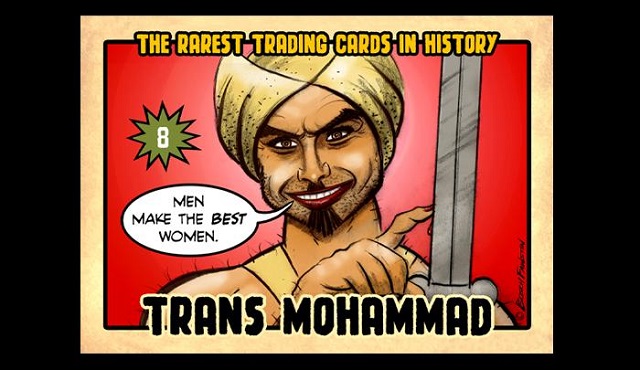
A Trans Mohammad Trading Card is Unacceptable to Leftists Who Often Write of a Trans Jesus

I just created my eighth Mohammad trading card, a Trans Mohammad trading card, in the face of the trans madness that the left has unleashed on the world. And trans madness it is, as even in the face of one trans terrorist after another murdering innocents, leftists skip right over the dead bodies and push trans as if nothing happened. And Biden, right after the latest trans terrorist murdered innocents, including children, declared a “Transgender Day of Visibility” at a time where there’s nothing more visible than trans. And it’s been going on for years, with The Huffington Post publishing an article in 2016 titled Jesus: The First Transgender Man, because they know that the pleasure they get from mocking Christianity is as deep as the fear they would have over publishing an article titled Mohammad: The First Transgender Man.

And I’ve been told by leftists who hate religion that I “shouldn’t mock religion,” which is their gutless way of saying that I shouldn’t mock Islam. And then I’m told by both leftists and Muslims, in a world where Muslims have murdered human beings over cartoons, that I shouldn’t be “insulting a religion”. Those who tell me that I should refrain from drawing Mohammad in order to show respect to Islam, in the face of savages who’ve murdered over Mohammad cartoons, are savages.

And I’m sure that the Ottawa school board’s “gender consultant” who calls Jesus a “drag queen” for wearing a “dress,” a.k.a. religious robes, would say the same about Mohammad, who wore religious robes. No, she never would. Leftists exclusively attack a religion whose followers don’t attack them, when the religion that most deserves criticism and condemnation is allowed to get away with mass murder without a word from them. It’s to be expected, but it doesn’t make it any less repugnant.

If you’re interested in my Trans Mohammad trading card, you can order it at my new website here.

AUTHOR

RELATED ARTICLES:

UK: ‘There are so many LGBTQ+ Muslims out there…I’m a religious person and I’m also queer – that’s just who I am’

Biden’s New Muslim Liaison to Fight ‘Institutional Islamophobia’

Islamic Republic of Iran: Female human rights activist beaten, threatened with rape in custody

India: Muslims force two brothers to convert to Islam as punishment for supporting majority party

Muslim cleric prays that Allah would kill all the Jews, infidels, atheists, and polytheists

Italy declares state of emergency amid migrant invasion

EDITORS NOTE: This Jihad Watch column is republished with permission. ©All rights reserved.

Saturday Night Live skit depicts fear of drawing Muhammad

It’s funny, yes, but it isn’t really a parody or a lampoon at all. Most people today would be terrified to draw Muhammad, even for a million dollars. The aftermath of the jihad attack at our cartoon exhibit has shown the world that violent intimidation and threats work.

RELATED ARTICLES:

6 Reasons Pamela Geller’s Muhammad Cartoon Contest Is No Different From Selma

Texas cartoon jihadi “would never waver from the teachings he picked up in the mosque”