
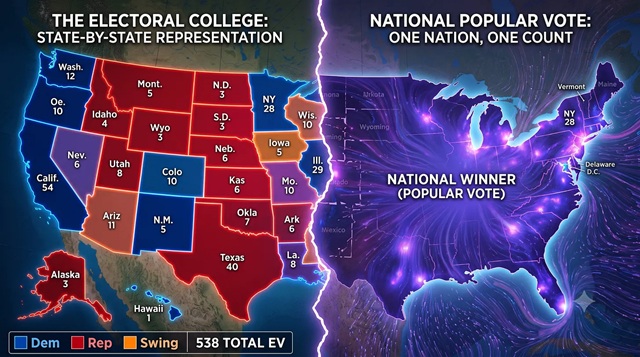
Hillary Clinton Wants to End the Electoral College — Through the Back Door
While most Americans focus on the next election, a quiet but dangerous movement is advancing to fundamentally change how we elect presidents — without a constitutional amendment.
Hillary Clinton is at it again.
In recent comments, the former Secretary of State renewed her familiar attack on the Electoral College, calling it a relic “designed for slave-owning states” that must go because it violates “one person, one vote.”
These criticisms aren’t new. But this time, they come alongside a coordinated, nearly two-decade effort that bypasses the normal constitutional process entirely.
It’s called the National Popular Vote Interstate Compact (NPVIC) — and most Americans still don’t know it exists.
How the NPVIC Would Work
Under our current system, states award their electoral votes to the winner of their own state’s popular vote. This forces candidates to build broad coalitions across different regions and state interests.
The NPVIC flips that.
Participating states would agree to award all their electoral votes to the candidate who wins the national popular vote, regardless of how their own voters voted.
The compact only activates once states representing at least 270 electoral votes join. As of July 2026, 18 states plus Washington, D.C. have signed on, controlling 222 electoral votes. That leaves just 48 more needed before it could take effect.
Virginia joined in April 2026, bringing the total to its current level. Supporters at groups like the Center for American Progress have suggested the threshold could be reached faster than many expect — potentially within a year or two if political conditions align.
Why Supporters Push It — And Why Their Arguments Fall Short
Advocates claim the system is broken because:
- Candidates ignore “safe” states.
- Some voters feel “wasted.”
- A candidate can win without the national popular vote (as in 2000 and 2016).
These points sound reasonable on the surface but miss the point of the Electoral College. It was deliberately designed to protect federalism — ensuring that presidents must appeal to voters across large and small states, urban and rural areas, not just dense population centers.
A pure national popular vote would shift power dramatically toward a handful of big cities and coastal states. The current system prevents any single region from dominating presidential politics.
The Real Problem: Changing the Rules Without Amending the Constitution
The biggest issue with the NPVIC isn’t just policy. It’s the process.
The Constitution gives states control over how they appoint electors, but an interstate compact that effectively rewrites the rules of presidential elections raises serious questions under the Compact Clause. Major changes to how we select the president have historically required a constitutional amendment.
This approach seeks to achieve the same result through state legislation and an agreement among a minority of states — a backdoor that critics argue end-runs the Founders’ design.
If activated, it could create practical problems: nationwide recounts in close elections, legal battles over results from non-participating states, and the real possibility that a state’s own voters see their choice overridden by national totals.
A Simple Example
Suppose your state votes overwhelmingly for Candidate A. Under the current system, your state’s electoral votes go to Candidate A.
Under the NPVIC, if Candidate B wins the national popular vote by a narrow margin, your state would be forced to award its votes to B instead — even though your voters chose A.
That is not “making every vote count.” It is disconnecting a state’s electoral votes from the will of its own citizens.
The Historical Context
Critics like Clinton often tie the Electoral College to slavery via the Three-Fifths Compromise. While slavery influenced representation at the founding, the Electoral College was also a deliberate compromise between large and small states — and a safeguard against pure majoritarianism in a vast republic.
It has endured for over two centuries precisely because it balances competing interests in a federal system.
Why This Matters Now
With Virginia’s recent addition, the compact sits just 48 electoral votes from activation. Future state elections and shifts in legislative control could push it over the line — or create opportunities to stop it.
If it ever determines a presidential outcome, expect immediate legal challenges reaching the Supreme Court. The result could be years of uncertainty and division.
The Fundamental Question
Americans can debate whether the Electoral College should be reformed or kept as is. That debate is legitimate.
But there is a deeper issue here:
Should we allow a fundamental change to how we elect presidents through an interstate agreement that sidesteps the constitutional amendment process — or should such a sweeping reform require the formal process the Constitution provides?
That question goes beyond one election. It asks whether we respect the rules of our constitutional republic when they produce results we dislike.
The compact is closer than most people realize. The more Americans understand what’s happening, the better chance we have to protect the constitutional system that has served this country for generations.
The question now is whether we will let this change happen quietly — or insist on a formal, constitutional debate before it does.
AUTHOR
Martin Mawyer
Martin Mawyer is the founder of the Digital Intelligence Project and the President of Christian Action Network. He is the host of the “Shout Out Patriots” podcast, and author of When Evil Stops Hiding. For more action alerts, cultural commentary, and real-world campaigns defending faith, family, and freedom, subscribe to Patriot Majority Report.
©2026 Majority Report. All rights reserved.
Leave a Reply
Want to join the discussion?Feel free to contribute!