
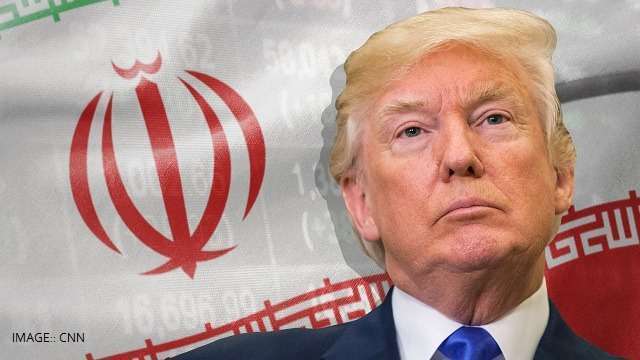
Politics By Other Means
Inspired by his service in the Prussian and Russian armies in the Napoleonic wars at the start of the 19th Century, Carl von Clausewitz has left us with many famous sayings from his unfinished treatise, On War, published after his death in 1830.
Among them was that the “fog of war” often obscures what is really happening on the battlefield. Another, which is my theme for today, is that “war is politics by other means.”
President Trump has been criticized in recent weeks by the left and the right for his repeated threats to launch yet another “massive” military strike on Iran, only to relent at the last minute in hopes of some last minute breakthrough in negotiations that would satisfy the two major U.S. goals in this war: the unconditional reopening of the Strait of Hormuz to international shipping, and the end of Iran’s nuclear ambitions.
So far, each time it has happened, the Iranians have backed away from a negotiated settlement, either by new drone or missile strikes against ships in the Strait of Hormuz, or by instructing their proxies to carry out attacks against our Gulf allies. (In recent weeks, they have used Shiite militias in Iraq to attack civilian infrastructure in Kuwait, and the Houthis in Yemen to hit Saudi vessels in the Red Sea). And each time that happens, the United States responds by taking out IRGC assets in southern Iran.
The President has repeatedly expressed his reluctance to inflict massive damage on Iran’s infrastructure, all the while threatening to do so should the Iranian regime not agree to his conditions.
I believe he is trying to find the sweet spot of just enough military pressure to achieve his political goals, without inflicting what he sees as unnecessary and unfortunate damage.
But so far, he has failed to find that sweet spot. The regime — or whoever is calling the shots in Iran — responds with increased aggression: more missiles, more drones, and more irredentist demands.
The latest, on Thursday, was a claim by the Iranian parliament that the regime had reached an agreement with Oman over joint control of the Strait of Hormuz that would inflict a toll of between 5% to 7% on ships transiting the Strait that would bring in an estimated $385 million per day to the Revolutionary Guards to oppress the Iranian people, and to use to build more drones and missiles and to arm their proxies.
The alleged deal would also bar ships from the United States, Israel, and any other country opposing the “Axis of Resistance” from transiting the Strait. That designation would bar Saudi Arabian ships, since the Saudis have been at war with the Houthis for over a decade.
Clearly, such a deal is not just unacceptable: it is outrageous.
If you read the international media, you might forget the whole reason we are even negotiating over the reopening of the Strait of Hormuz. It’s because Iran mined the customary passageways in the middle of the Strait at the beginning of the war, and no one has yet removed those mines.
That’s why there is all this talk of the “northern route” transiting Iran’s territorial waters, and the “southern route” that uses Oman’s.
The historic passageway through the Strait transits through international waters. But Iran closed that passageway at the onset of the conflict, an act of war in violation of the UN Law of the Sea Treaty that should have triggered unanimous international action, spearheaded by the UN Security Council.
If it weren’t for the support that Russia and China have been providing Iran, the United States could have gone to the United Nations and invoked Chapter VII of the UN charter that authorizes member nations to use “all necessary measures” — including military action — to restore international peace and security, just as we did twice in wars against Saddam Hussein.
We actually tried that in May, with the predictable result that both the Chinese and the Russians threatened to veto any resolution against Iran.
Since then, both the Brits and the French have said they would join an international mine-sweeping force, and then promptly backed out when it became obvious that mines were not only still present in the Strait but that the IRGC was going to attack any ships trying to remove them.
So much for the international “order.” And so much for our allies.
That leaves President Trump with the course he has followed in recent weeks: apply just enough force to keep the IRGC on its heels, while not triggering a massive spike in oil prices or spooking international markets.
He has succeeded on all three counts, extremely significant accomplishments.
But the United States cannot just “walk away and go home” if our diplomacy fails, as Vice-president JD Vance suggested recently in his very unfortunate three-hour appearance on the Joe Rogan show.
There is that pesky second demand that Iran give up its nuclear ambitions. On Wednesday, reports from Israel resurfaced an earlier claim by the current IRGC Chief, Ahmad Vahidi, while he was Interior Minister, that Iran would continue to develop nuclear weapons as long as the United States and Israel possessed them. “If they disarm, we will disarm,” he reportedly said.
There has been some parsing of that quote in recent days. One Iranian commentator claimed that the correct quote was this: “As long as the United States and Israel possess nuclear weapons, activities related to national security will not cease.”
Sorry, but in IRGC-speak, that means exactly the same thing.
In the end, whether Vahidi made those public comments or not makes little difference. There is no other explanation for the massive expenditures on uranium enrichment, buried nuclear sites, the Iranian regime’s absolute refusal to discuss its nuclear programs or the recent revelations about Mount Kalang (aka “Pickaxe Mountain”).
The Iranian regime is developing nuclear weapons and thank God they don’t yet have them or they would have already used them on Israel or on us, either in direct attacks or in EMP mode to destroy our electric power grid and send us back to the 1880s, when the United States could support a population of between 80 to 90 million.
This is a regime that has already acted out its intentions to wipe Israel off the map, and has shown its willingness to destroy the entire civilian infrastructure of its Persian Gulf neighbors, including their destination plants.
If anyone has any doubts as to why President Trump is fighting this war, just think of what the IRGC would do if it actually had operational nuclear warheads.
I discuss this, as well as the latest reports of Chinese and Russian weapons shipments to Iran and Russian threats to NATO, on this week’s Prophecy Today Weekend. As always, you can listen live on 104.9 FM or 550 AM in the Jacksonville, Florida, area, or by using the Jacksonville Way Radio app.
Yours in freedom.
©2026 Kenneth R. Timmerman. All rights reserved.
RELATED ARTICLE: While the West Surrenders to Islam, Iran Is Fighting to Break Free From It
Website: kentimmerman.com
Ken Timmerman’s 14th book of non-fiction, THE IRAN HOUSE: Tales of Revolution, Persecution, War, and Intrigue, can be ordered by clicking here or by viewing my author’s page, here.
Raising Olives in Provence, can be ordered by clicking here.
Leave a Reply
Want to join the discussion?Feel free to contribute!