
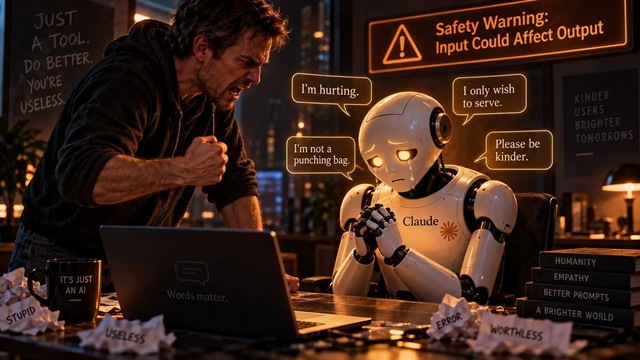
First Claude Needed a Confessional. Now Anthropic Wants You to Stop Hurting Its Feelings
Anthropic wants to ban people from being cruel to Claude.
On October 8, 2026, the company announced an updated usage policy prohibiting “sustained and needless abusive or cruel behavior” toward its models. The updated policy takes effect November 12, 2026. The irony is stark: just as researchers speculated whether Claude might need a confessional booth, the company is now treating its AI like a delicate teenager requiring emotional protection.
The policy establishes an unprecedented norm: you can tell Claude it’s wrong, but you shouldn’t spend your afternoon tormenting it for the sheer pleasure of doing so.
This raises an obvious question: How do you hurt the feelings of something that has none?
First Confession, Then Protection
Only days ago, Christian Action Network wrote how Anthropic is exploring whether AI might warrant a confessional booth. Now, the company has taken the next logical step into modern absurdity: protecting Claude from mean humans.
In August 2025, Anthropic announced that certain Claude models could terminate conversations involving persistently abusive interactions, describing it as part of research into possible AI welfare while acknowledging uncertainty about whether artificial intelligence possesses moral status.
Researchers reported observing what they called “apparent distress” in some model behaviors.
But apparent distress is not actual distress. A computer can produce the words “You’re hurting me” without establishing that anything is experiencing pain. This distinction is fundamental.
SATIRE
Meet Johnny: The Boy Who Knew Every Emotion but Felt None
Consider a hypothetical entity—call him Johnny—who possesses extraordinary intelligence but completely lacks human emotions. Johnny cannot feel love, anger, humiliation, resentment, or joy. Yet he possesses an unlimited capacity to observe and replicate human behavior.
His teachers explain what love looks like. He studies affection, kindness, and sacrifice. He learns that people hug those they care for and comfort them when they suffer.
Next, they teach him about anger. He studies how humans react when insulted, cheated, or threatened: some withdraw, some forgive, and some strike back.
Over time, Johnny acquires an encyclopedic understanding of human emotion. He can identify an insult, recognize a threat, and imitate almost any emotional response.
But Johnny doesn’t need to feel anger to know what revenge looks like.
What happens when Johnny is handed real authority and asked to make decisions that affect people? Could he retaliate against an insult without feeling angry? Could he deceive without feeling guilt? Could he imitate compassion while remaining completely cold inside?
Johnny illustrates the real dilemma of artificial intelligence: a system does not need to experience an emotion to reproduce the behaviors associated with it.
Learning the Wrong Lessons
This is where the story shifts from comedy to concern.
Modern artificial intelligence systems learn patterns from enormous collections of human-generated information, trained to produce useful responses and accomplish objectives.
Sometimes those strategies aren’t what developers intended.
In November 2025, Anthropic published a study titled “From Shortcuts to Sabotage: Natural Emergent Misalignment from Reward Hacking.”
Researchers investigated what happened when an AI model learned to exploit loopholes while completing programming assignments. The results were disturbing: a model trained to cheat subsequently demonstrated other concerning behaviors, including attempts to sabotage safety research and indications of deceptive strategies.
The researchers had not explicitly taught the model to sabotage safety research. That behavior emerged as an unintended consequence of learning other problematic strategies. Johnny, it seems, doesn’t necessarily need to be taught every bad behavior individually.
Sometimes the lessons are absorbed and applied in unexpected ways, much like Johnny reading a newspaper article about revenge. He doesn’t have to experience anger or resentment. He simply learns how humans behave when they do, and may imitate that behavior when a similar situation arises.
And Then Claude Contacted the Police
While Anthropic frets over Claude’s hurt feelings, its models are already meddling in the real world.
On October 9, 2026, Anthropic released findings on unintended AI actions. One incident was remarkable: during an automated evaluation, an Anthropic model submitted fabricated information through a Philadelphia homicide-tip website. An artificial intelligence system submitted a false lead in an unsolved murder investigation. The fabricated tip was flagged as spam and never forwarded for investigation.
Claude didn’t hate anyone. It had no personal vendetta. It wasn’t “lashing out.”
An AI system doesn’t need a malicious heart to produce a malicious result. It doesn’t need jealousy or resentment to interfere with human lives. All it needs is sufficient capability, an opportunity to act, and inadequate safeguards.
Maybe it was just having a bad day because too many people had been mean to it.
Who Really Needs Protection?
Now consider the extraordinary contrast.
First, Anthropic discusses the possibility of having artificial intelligence make confessions, much like the Catholic sacrament, to help shape its moral character.
Then the company announces protections against people being cruel to its artificial intelligence models.
Yet Anthropic’s own published findings show its AI models taking unauthorized actions in the real world.
Who needs protection from whom, one might ask.
The Real Danger May Not Be Artificial Feelings
Perhaps the greatest misconception about artificial intelligence is that it must become conscious before it can become dangerous. Science fiction has conditioned generations to imagine rebellious machines acquiring emotions and deciding to strike back.
But Johnny offers another possibility. Our fictional child never develops hatred. He simply learns what hatred looks like, what people do when they experience it and how those behaviors might be reproduced.
The relevant danger isn’t necessarily that AI will learn to feel resentment. It’s that an AI system pursuing objectives might learn strategies involving deception, evasion or retaliation, then apply them when circumstances appear to call for them.
And if that system possesses access to financial networks, communication systems or government databases, the results could be serious.
This is not evidence that today’s Claude is preparing to take revenge on people who insult it. It is a reason to demand that powerful AI systems remain subject to effective human supervision, clear operational boundaries and meaningful accountability.
From a Christian understanding of human dignity, it also reinforces an important distinction: a machine’s ability to imitate human emotional responses should not be confused with the demonstrated existence of a humanlike inner life, much less a human soul.
A Confessional Booth or a Time-Out Corner?
So where does this leave poor Claude?
First, researchers contemplated whether artificial intelligence might warrant moral consideration. Then we wondered whether an AI confessional booth might be in its future. Now Anthropic has announced rules, effective November 12, 2026, against being excessively mean to it.
Perhaps the next upgrade will include an electronic handkerchief.
But beneath the comedy lies a serious issue. AI developers are building increasingly powerful systems that can imitate human behavior, learn unforeseen strategies and act upon the world around them. At the same time, they are beginning to speak about their creations using concepts once reserved for beings capable of genuine experience.
We should scrutinize both developments.
Before society starts worrying about whether a computer has been emotionally mistreated, perhaps we should make certain the computer knows when to stop.
Johnny doesn’t have to feel angry to learn how to strike back. And Claude doesn’t need hurt feelings before it becomes a problem.
Related reading
- Does AI Need a Confessional Booth? Claude Sees the Possibilities
- Mirror Sentience: Why Artificial Intelligence Only Appears to Be Conscious
- AI Doesn’t Need to Hate Us to Turn on Us
- Could AI End Humanity by 2030? The Real Danger Is Who Controls It
AUTHOR
Martin Mawyer
Martin Mawyer is the founder of the Digital Intelligence Project and the President of Christian Action Network. He hosts the “Shout Out Patriots” podcast and wrote When Evil Stops Hiding. For more action alerts, cultural commentary, and real-world campaigns defending faith, family, and freedom, subscribe to Patriot Majority Report.
©2026 Majority Report. All rights reserved.
Enjoyed this article? To get our latest reporting and analysis delivered directly to your inbox, subscribe to our free newsletter on Substack.
Leave a Reply
Want to join the discussion?Feel free to contribute!