
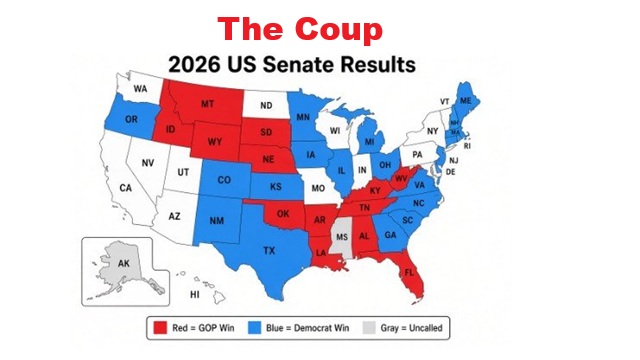
The Coup
When an election produces outcomes that run completely counter to historical precedent, polling baselines, and raw mathematical probability, the dispute ceases to be a conventional political debate and transforms into an indictment of the process itself. The case asserting that this midterm was systematically subverted rests upon four primary pillars: statistical impossibility, software and algorithmic manipulation, unauthorized cyber penetration, and administrative chain-of-custody collapse.
The foundational argument against the legitimacy of the results begins with the numbers that show uniform swings across non-contiguous battlegrounds violating basic demographic distribution principles.
The primary anomaly centers on contested battleground outcomes where one party captures 29 out of 30 coin-flip congressional races. In probability theory, independent coin-flip distributions do not resolve with a 96.7% success rate without external bias. When thirty high-friction districts spanning diverse demographic regions — from rural working-class enclaves to high-density suburban corridors — all break in an identical direction by margins often hovering within single fractions of a percentage point, the outcome defies standard standard-deviation boundaries.
The macro-level numbers tell the same story: across the national House popular vote, turnout surged exclusively on one side, with Democrats picking up an estimated 13 to 15 million votes compared to 2022 while Republican totals remained largely static.
Even local races reflected institutional breakdown, such as in Texas House District 93, where an ineligible candidate facing felony questions remained on the ballot and was credited with a narrow victory under contested circumstances.
It is impossible to make Texas blue — just impossible. This is the 2020 election, exactly like it, repeating identical statistical anomalies designed to engineer an artificial realignment.
The technical case targets the digital layer of the voting apparatus: central tabulators, direct-recording electronic units, and optical scanners. The core vector highlighted is algorithmic poisoning — the insertion of modified code designed to alter vote tallies before results are compiled and transmitted.
Unlike crude, visible errors, algorithmic weighting operates beneath standard audit thresholds. The software applies a mathematical multiplier — often referred to as fractional voting – assigning decimal values to individual ballots (e.g., counting a vote as 0.85 for one candidate and 1.15 for the opposing candidate) while displaying whole numbers on public facing dashboards.
This argument is compounded by software update procedures executed in the weeks leading up to Election Day. Jurisdictions that applied “emergency patches,” logic upgrades, or firmware updates circumvented standard public certification timelines. When hash values of operational software fail to match the pristine binaries certified by accredited testing laboratories, the integrity of the tabulator logic is irrevocably compromised.
Beyond internal algorithmic modification lies the vector of external cyber intrusion. Election networks rely on distributed infrastructure: electronic poll books, county consolidation servers, and third-party election management vendors.
The intrusion argument focuses on middle-tier transmissions — the point where localized precinct vote totals are converted into encrypted transfer files and sent across private modems or public networks to state election databases. Network packet captures and traffic latency spikes reported on election night demonstrate that air-gapped systems were bridged through external telemetry ports and remote access clients.
These telemetry profiles reproduce the distinct ‘drop and roll’ tabulation curves observed previously, where steady, predictable vote-intake lines were suddenly interrupted by asymmetric aggregate spikes that reversed established leads within minutes.
Once external access is achieved, man-in-the-middle attacks can intercept data pipelines to inject synthetic vote batches directly into county-level aggregate databases. These injected totals reflect immaculate digital signatures, making them appear authenticated by the system while bypassing direct paper-ballot
The physical manifestation of the challenge addresses voter roll hygiene and ballot collection protocols. The volume of mail-in and drop-box ballots processed without continuous, unsevered chains of custody constitutes a fatal breach of legal statutory requirements.
©2026 Amil Imani. All rights reserved.
RELATED ARTICLE: Call an Emergency Session Now. Keep Every Republican in Their Seat Until January 3
Leave a Reply
Want to join the discussion?Feel free to contribute!