Tag Archive for: marriage

11 Charged in Decade-Long Immigration Scheme That Arranged over 1,000 Sham Marriages

n what federal prosecutors have labeled one of the most consequential fraud prosecutions in U.S. history, a sweeping indictment has come out, charging ringleaders with operating a decade-long green card scheme. Beginning in 2016 and coming to a crashing end just last month, the international network arranged over 1,000 sham marriages between foreign nationals, the majority uniting citizens of the People’s Republic of China and U.S. citizens to secure permanent residency in the States.

According to a press release from the Department of Justice, the enterprise was based in New York City but had reached both coasts, with states like Florida, Massachusetts, and Kentucky playing host to these farce marriages.

A $100,000 Wedding

For foreign nationals trying to get a green card, the costs of participating in the illicit activity were steep. The recently released indictment specifies that clients paid as much as $100,000 to facilitators sham marriage packets.

The network employed word-of-mouth tactics and social media to recruit American citizens to enter into these phony unions. These participants were paid up to $30,000, doled out in installments aligning with milestones such as signing the marriage certificate and completing USCIS interviews. Recruiters who enlisted American citizens earned nearly $5,000 per person.

“This scheme was not a quick fly-by-night operation, but rather a yearslong multi-million-dollar cottage industry to criminally assist people who would not or legally could not otherwise become citizens of the United States,” said Attorney General Todd Blanche during a recent news conference.

The Fabrication

In attempts to bypass federal scrutiny, the organizers took extreme measures to create convincing illusions of genuine relationships. With newly paired couples generally only having just met before receiving their marriage license, quick ceremonies with photographers were held to submit as evidence to immigration authorities. Additionally, organizers opened joint bank accounts and filed joint tax returns to manufacture proof of cohabitation. Coaching sessions were also mandated prior to interviews with the U.S. Citizenship and Immigration Service, with couples being coached on potential questions and being prepared to cover up the fraudulent nature of their relationships.

“The defendants and their co-conspirators allegedly operated a nationwide and international, multimillion-dollar marriage fraud scheme, using participants to abuse United States immigration laws for their own profit,” announced U.S. Attorney Jamie McDonald for the Southern District of New York. “Today’s arrests have dismantled a central component of one of the largest marriage fraud schemes charged in United States history.”

Government Crackdown

The bust ultimately involved efforts from several agencies, including Homeland Security Investigations, the Federal Bureau of Investigation, and USCIS’s Fraud Detection and National Security unit.

Joseph B. Edlow, director of USCIS, stressed the risks of immigration fraud, stating, “Anyone willing to lie, cheat, or steal their way into legal immigration status is a direct threat to America’s national security. USCIS will continue to expose fraud, defend the rule of law, and ensure immigration status is reserved for those who truly qualify.”

AUTHOR

Zachary Patton

Zach Patton is a contributor to The Washington Stand.

RELATED ARTICLE: Exclusive: RNC Condemns DNC Vote to Abolish ICE – Party Has Been Overtaken by Socialists

EDITORS NOTE: This Washington Stand column is republished with permission. All rights reserved. ©2026 Family Research Council.


The Washington Stand is Family Research Council’s outlet for news and commentary from a biblical worldview. The Washington Stand is based in Washington, D.C. and is published by FRC, whose mission is to advance faith, family, and freedom in public policy and the culture from a biblical worldview. We invite you to stand with us by partnering with FRC.

Americans Have Essentially Same View Of Marriage As We Did 13 Years Ago, Thanks To Republicans

Slightly more Americans believe that it is “very important” for couples with a child together to marry than did 13 years ago, and Republicans are leading the change, a new Gallup Poll shows.

The rise in this belief comes after a fall in 2020, when it reached an all-time low over the past two decades, according to Gallup’s past polling. In 2026, 39% of Americans said it was “very important” when asked “[w]hen a couple has a child together, how important is it to you that they legally marry?” — which is one point higher than in 2013, when 38% of Americans said the same, per the poll released Friday.

This marks a ten-point rise from 2020 when only 29% said that it was “very important” for couples with children to be married. 

The percentage of Democrats who believe in marriage’s importance for parents has split in half over the past 20 years, going from 42% in 2006 to 21% in 2026. The percentage of Republicans who believe that marriage for parents is “very important” in 2026 was 58%, four percent lower than it was 20 years ago.

However, in 2020, 36% of Republicans believed that it was “very important,” marking a 20-point rise in this sentiment among GOP voters over the past six years. Democrats’ view on this issue, however, has only improved three points in favor of marriage over the same time period — rising from 18% in 2020 to 21% in 2026.

The divide between men’s and women’s belief in the importance of marriage for parents has decreased since 2006. The divide fell from an eight-point difference in 2006, with 53% of men finding it very important and 45% of women, to a one-point difference in 2026, with 40% of men finding it important and 39% of women.

For the first time in 20 years, the percentage of Americans who believe it is “very important” for couples who have a child together to get married has surpassed the percentage of Americans who believe it is “very important” for couples who plan to spend their lives together to get married. Only 37% of Americans find it “very important” for couples planning to spend a life together to get married.

ReconMR conducted the Gallup poll via phone interviews in May, surveying 1,000 U.S. adults. The poll has a margin of sampling error of plus or minus four percentage points.

AUTHOR

Faith Miller

RELATED ARTICLE: Women, Youth Led American Exodus From Religion Over Past 13 Years, Poll Shows

EDITORS NOTE: This Daily Caller column is republished with permission. ©All rights reserved.

Trump Defunds the Left’s Graphic Sex Ed in Favor of Lessons on Marriage, Family

Americans have been so busy fighting against radical gender ideology and critical race theory in schools that one of the Left’s favorite ways to undermine parents has fallen under the radar. But the Trump administration hasn’t lost sight of graphic sex education, and parents everywhere should be grateful for it. In a very underreported move, the president’s team went on the offensive this summer, zeroing out millions of taxpayer dollars for controversial “Teen Pregnancy Prevention” programs in favor of solid curriculum that emphasizes abstinence and marriage.

The New York Times picked up on the cuts weeks after the fact in a sob story lamenting how caught off guard local nonprofits had been by HHS’s announcement. But frankly, no one should be surprised. The Trump administration slashed dozens of grants like this in its first term, arguing — rightly — that they only existed to sexualize children, not equip them to make positive and healthy choices. A whopping 53 programs ended up on the chopping block, saving Americans $67 million in what the president’s budget called “radical leftist ideology.” If anything, the administration argued, the Biden- and Obama-era sex ed models have only “normalize[ed] sexual activity for minors.”

Thanks to liberal ideologues masquerading as health experts, activists like Planned Parenthood have had unlimited access to America’s classrooms, knowing if they hook kids on sex, they’re grooming the next generation of abortion customers. It’s been a great down payment on future business — until now. The Office of the Assistant Secretary for Health (OASH) made it clear that the department is under new management where all of this is concerned, posting a list of priorities that should relieve every sane parent in America.

First of all, the agency vows to ensure that adolescent program materials are “age-appropriate” and “do not promote harmful ideologies, such as gender ideology and discriminatory equity ideology. OASH will focus on programs that do not promote material that depicts, describes, exposes or presents obscene, indecent, or sexually explicit content,” the document notes, “including content that encourages, normalizes or promotes sexual activity for minors. OASH will prioritize OASH programs and funding that are in compliance with these priorities and applicable law.”

Second, OASH promises to defend parental rights “to the fullest extent of its authority under the law … including parents’ right to protect their children from exposure to content that burdens the exercise of their religious beliefs.”

Under this new criteria, NYT complains, anyone applying for taxpayer dollars “must teach abstinence,” also known as sexual risk avoidance, “as the only means to prevent teen pregnancy. Courses must stress the importance of marriage and procreation and instruct young people how to safeguard their fertility. They make scant reference to preventing sexually transmitted infections and virtually none to lesbian, gay and transgender sexuality.”

As FRC’s Quena González pointed out to The Washington Stand, “The fact that some professional sex ed providers who receive millions of dollars in federal funds are complaining that these priorities are now required to continue receiving taxpayer dollars should alarm parents and enrage taxpayers. We shouldn’t be allowing, much less paying for, schools to tell students, ‘We know you’re going to experiment, wink wink, so here’s how to derive the most sexual pleasure from underage sex.’”

González applauded the overhaul as an overdue change to the dangerous status quo. “Insisting that taxpayers pay adults to teach middle schoolers — typically 11-14 years old — about ‘sexual consent,’ pleasurable condom use, or how adolescent girls can use intrauterine devices and implants to avoid pregnancy, is just plain creepy,” he said. “Kids need to be taught that sex is a wonderful gift and a powerful expression of adult love when it is exercised within the safety of a loving marriage covenant. Sex isn’t a toy, and the harms of offering it to minors are well documented and not really debated; studies show that delaying sexual contact until marriage increases the chances of a stable marriage and decreases the chance of living in poverty.”

Valerie Huber, who’s spent decades fighting for this kind of principled approach to sex ed, had one reaction to the administration’s pivot: relief. “Mostly for the young people,” the president of The Institute for Women’s Health told TWS. “For years, sexual risk avoidance had to justify itself while the alternative was funded as though its results were settled. That was never a research question. It was a worldview question dressed up as one.” Now, thanks to Trump, “risk avoidance is being treated as a legitimate public health goal for adolescents, the way it already is for every other youth risk behavior. We do not teach teenagers to smoke carefully. We tell them the truth about risk, and we help them stay at no risk or move from high risk to low risk to no risk,” she emphasized. “Sexual health is the one place we abandoned that model, but now HHS is being consistent across all youth risk behaviors. Bravo!”

Huber looked back over the last several years, lamenting the damage that the Left’s “if-it-feels-good-do-it” message has done. “When adults in authority signal that sexual activity is expected of a 14-year-old, that is not neutral information,” she insisted. “It is permission, and for many students it is pressure.” Under Obama and Biden, she noted, “These programs routinely positioned outside providers, including organizations whose business model depends on abortion, as the trusted adult in a young person’s life — and treated parents as an obstacle to be managed. A curriculum that teaches a 15-year-old how to obtain services without telling her mother is not a health program,” Valerie argued.

With the exception of Trump’s first term, “Students have been offered risk reduction at best and rarely offered risk avoidance,” Huber stressed, “which is the only approach that eliminates risk rather than managing it.”

Although teen pregnancies have dropped over time, she acknowledges, it was a hollow victory. “We counted births. We counted birth control. We did not count infections, we did not count coercion, and we did not measure what happens when pregnancy prevention becomes a substitute for holistic health and thriving for young people,” Valerie said. “We called it a win. In those same years, the emotional, social, intellectual, and spiritual health of American adolescents all declined. If your scorecard shows success while the young people on it are falling apart, you are measuring the wrong thing.”

Of course, the nonprofits who’ve been suddenly cut off from this federal gravy train are complaining that this creates an “existential dilemma” for sex ed. Some, the Times reports, are even suing HHS over the new requirements. But the reality is, there’s no “right” to taxpayer dollars — especially not for an indoctrination scheme that’s only exacerbating the problems they claim to solve.

What’s more, America needs to stop believing that young people can only meet the low bars we set. “Hand a young person a high standard and tell them you believe they can meet it, and most of them rise to it,” Huber underscored. “What they resent instantly is the adult who tells them they cannot be expected to control themselves. They hear that for exactly what it is, which is a low opinion of them.” The Left’s model assumes “every teenager is sexually active,” she shook her head. “Most high school students are not. … No one argues that because some teenagers will use drugs, prevention is unrealistic and we should teach safer use instead. We hold the optimal health standard, and we surround it with skills, support, and honesty about risk.”

To those who say the approach isn’t proven, Dr. Michelle Cretella strongly disagrees. “A rigorous review by the Institute for Research demonstrates that sexual risk avoidance education (SRAE) holds great promise. It aligns with the primary public health principle acknowledged by the CDC: abstinence is the only 100% effective way to prevent STDs and pregnancy, as condoms cannot guarantee absolute protection.” Unlike the Planned Parenthood-style programs, “effective SRAE is medically accurate,” she told TWS, citing an article she just authored for an online medical journal. It “discusses condoms and contraceptives and helps students commit to abstinence without decreasing contraceptive use among those who are already sexually active.”

At the end of the day, our schools were never meant to be a substitute for moms and dads, who have the ultimate responsibility to raise their children in a way that reflects their values. It’s not the job of teachers or outside “experts” to contradict those beliefs or commandeer a parent’s authority on topics that, in all honesty, don’t belong in classrooms in the first place. Now, instead of shipping off tens of millions of dollars to graphic programs that double as LGBT recruiting programs and abortion infomercials, the president is letting research, parents, and common sense dictate how America approaches sex ed. And we should all be thankful for it!

AUTHOR

Suzanne Bowdey

Suzanne Bowdey serves as editorial director and senior writer at The Washington Stand.

EDITORS NOTE: This Washington Stand column is republished with permission. All rights reserved. ©2026 Family Research Council.


The Washington Stand is Family Research Council’s outlet for news and commentary from a biblical worldview. The Washington Stand is based in Washington, D.C. and is published by FRC, whose mission is to advance faith, family, and freedom in public policy and the culture from a biblical worldview. We invite you to stand with us by partnering with FRC.

SPLC Receives Long Overdue Congressional Scrutiny

After years of tolerating its unwarranted influence in federal decision making, Congress finally directed long overdue scrutiny at the Southern Poverty Law Center (SPLC) in a Tuesday hearing of the House Judiciary Subcommittee on the Constitution and Limited Government, “Partisan and Profitable: The SPLC’s Influence on Federal Civil Rights Policy.”

Subcommittee Chairman Chip Roy (R-Texas) organized the hearing, he said, “to examine a troubling reality: that one of the most politically motivated, financially lucrative and ideologically extreme nonprofits in America, the Southern Poverty Law Center, has been permitted to wield extraordinary influence over federal civil rights policy, federal law enforcement training, and the private sector mechanisms that increasingly dictate who is permitted to participate in civic life.”

The atmosphere was combative but collegial; Roy conferred frequently with Ranking Member Mary Gay Scanlon (D-Pa.), but neither pulled any punches in their statements. A large crowd of left-wing activists brought enough people (30 or 40) to fill every open seat in the audience, but aside from an admonishment for loud conversation while waiting for admittance, they managed to behave themselves.

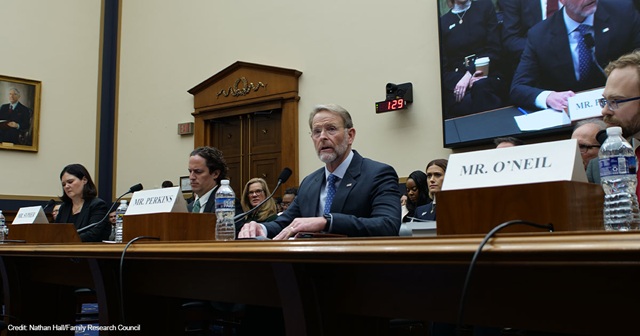
Among the witnesses for the hearing was Tony Perkins, president of Family Research Council, which was the victim of an SPLC-inspired terror attack in 2012.

“On August 15, 2012, our organization experienced firsthand what happens when inflammatory rhetoric is legitimized by respected institutions,” Perkins testified. “That morning, an armed LGBTQ activist named Floyd Corkins entered FRC headquarters with a loaded semi-automatic pistol, nearly 100 rounds of ammunition, and 15 Chick-fil-A sandwiches. He later admitted to the FBI that his intention was to ‘kill the people in the building’ and stuff the sandwiches into his victims’ mouths as a political statement.”

Ever since the shooting, however, the SPLC has refused to remove FRC from its “hate map.”

“The SPLC once did legitimate civil rights work,” he assessed. “But today, even former SPLC insiders have acknowledged the organization’s internal ethical failures and ideological turn. Today, they play the game, blow the whistle, and call the penalties.”

Perkins decried the SPLC’s infamous “hate map” as “a political weapon aimed at silencing viewpoints they oppose. … Once a group is branded, the SPLC’s label functions like a digital scarlet letter — deployed to restrict speech, isolate organizations, and undermine constitutionally protected viewpoints.”

Fellow witness Tyler O’Neil, an author and expert on SPLC who serves as senior editor at The Daily Signal, explained how a hate map designation “chills some donors who are afraid that … their information might be leaked, and then they would face repercussions for giving to an organization they believe in.” In addition, he described how businesses such as Alphabet and Amazon used the SPLC as a trusted source for policing YouTube content and participants in the charitable Smile program.

Notably, the SPLC “hate map” does not simply keep a register of all “hate” groups, if such a term could be defined. Instead, it brands mainstream conservative organizations while ignoring most extreme groups on the Left, even those which participate in actual violence.

“By lumping mainstream conservative voices and organization in with actual Nazis and extremists, the SPLC delegitimizes any opinion to the right of whatever line the SPLC deems acceptable,” Rep. Harriet Hageman (R-Wyo.) argued in the hearing. “Richard Cohen, the former president of the SPLC, when discussing whether Antifa would be listed, was quoted as saying that, quote, ‘There might be forms of hate out there that you may consider hateful, but it’s not the type of hate we follow.’”

“This is precisely the SPLC’s intent: not to fight violence, but to silence political and cultural opponents’ one way or another,” Perkins emphasized. “The SPLC routinely lumps peaceful Christian ministries together with actual violent extremists, while ignoring radical groups on the political Left whose rhetoric or actions have resulted in real-world intimidation and violence.”

The underlying problem with this list is that “government agencies have used SPLC materials to shape training and threat assessments,” Perkins argued. “The Department of Defense and DHS previously used SPLC material in trainings that cast suspicion on Christian organizations. Local law-enforcement agencies circulated SPLC lists as though they were intelligence bulletins. Schools have incorporated SPLC materials into curricula presented to children as objective fact.”

“They have the freedom to speak and make lists. They can do it all day long,” Perkins reiterated. “But it’s when the government uses that list to marginalize citizens — you have taken a player, and you’ve made them a referee.”

The hearing revealed that SPLC’s irresponsible hate map designations are indefensible even to its allies. In the course of the hearing, minority witness Amanda Tyler, executive director of the left-wing Baptist Joint Committee for Religious Liberty, declared that “civil rights organizations like SPLC … play a vital role in the overall fabric of American society.” Yet, when asked to defend SPLC’s decision to put mainstream conservative groups on the “hate map,” Tyler demurred.

“Is Alliance Defending Freedom a hate group?” Rep. Bob Onder (R-Mo.) asked. After initially trying to deflect, Tyler had to admit, “I wouldn’t use that term.” But Onder wasn’t done:

Onder: “Is Turning Point USA, in your opinion, a hate group?”

Tyler: “Again, I don’t speak for SPLC —”

Onder: “I’m asking yourself and your organization. Do you believe Turning Point USA is a hate group, Miss Tyler?”

Tyler: “My organization doesn’t label groups.”

Onder: “Is Family Research Council a hate group?”

Tyler: “Same answer.”

On and on this went. Onder later asked the same question of Perkins. “No. None of those organizations” are “hate groups,” Perkins replied. “One of the things we all have in common: none of us advocate violence.”

The hearing also revealed the SPLC’s anti-Christian bias, made obvious by their listing of the Ruth Institute, a small Catholic charity in Louisiana. “In justifying putting them on the hate map,” O’Neil cited, “the SPLC quoted … the president of the Ruth Institute just saying that the Catholic Church believes — and this is the statement of faith for all Catholics, remember — that homosexual activity is intrinsically disordered.”

This anti-Christian bias is also the reason why FRC became the first major conservative organization to appear on the hate map in 2010. When asked why his organization was on the “hate map,” Perkins responded, “According to the SPLC, the reason is our biblical view of marriage and human sexuality. That is what causes them to classify us as a hate group.”

“Back in 2012, there was a Chick-fil-A Day, where nationwide people went to Chick-fil-A because Chick-fil-A at the time had made a statement in support of natural marriage. And because we, along with then-Governor Mike Huckabee, now Ambassador Huckabee, had promoted that day, Corkins went to the map of SPLC to find FRC.”

How times have changed. Before the hearing, a left-wing member of the audience was overheard outside the room saying, “good for Chick-fil-A” in the context of its recent decision to double down on DEI policies. Sometimes, the Left’s pressure campaigns do intimidate their targets.

Perkins denied that any aspect of a biblical view of marriage is hateful. At another point in the hearing, Rep. Mark Harris (R-N.C.) gave Perkins the chance to clarify.

Harris: “Is the Christian worldview hateful?”

Perkins: “No.”

Harris: “Is affirming that there are only two genders hateful?”

Perkins: “No.”

Harris: “Is believing God created marriage between a man and a woman hateful?”

Perkins: “No. It’s the reason we’re all here today.”

Harris: “Is the Christian worldview that teaches the very morals upon which this nation was founded, hateful?”

Perkins: “No sir.”

Harris: “And does disapproving of someone’s actions mean that you hate them?”

Perkins: “No.”

Democrats on the subcommittee were unconvinced. “FRC was designated as an anti-LGBTQ hate group by SPLC in November 2010 for its dissemination of false and denigrating propaganda about gays and lesbians,” insisted Rep. Becca Balint (D-Vt.), an open lesbian.

Yet the issue at hand was the SPLC’s “false and denigrating propaganda” about organizations like Family Research Council, which made its influence evident in Balint’s apparently heartfelt comments, “It is so disheartening … to come into this committee and be told that that somehow I don’t have a right to be here, and that somehow I am making Americans less safe just by existing, when tens of millions of Americans just want to live their life and be left alone.”

Christian conservatives believe no such thing. They simply affirm that God’s design for marriage and sexuality is best, without denying the reality that many people reject his design. If Balint and others feel anguish over a mischaracterization of conservative views, let the blame fall on those like the SPLC who have mischaracterized conservative views.

Other Democrats tried to deflect attention from the SPLC. Rep. Jamie Raskin (D-Md.) sought to make the issue about the Trump administration, while Scanlon invoked a parallel to “McCarthy era” attempts “to paint Martin Luther King Jr. and other civil rights leaders as dangerous communists.” Rep. Pramila Jayapal (D-Wash.) simply complained that “it’s quite unprecedented for us to use valuable committee time to target a specific group.”

“I see this as an attack on civil society, as a way to try to quash dissent, as a way to chill advocacy,” argued the minority’s witness, Ms. Tyler. “I really fear for the future of our pluralistic democracy if groups and individuals succumb to the intimidation. … When the state elevates certain ideologies and stigmatizes others, it erodes both free expression and free exercise.”

And that’s exactly why government agencies should permanently distance themselves from the SPLC’s biased, illegitimate “hate map.”

On August 15, 2012, the SPLC-inspired terrorist attack on FRC headquarters was foiled by the heroic efforts of building manager Leo Johnson, who overpowered and disarmed Corkins at the price of a bullet in his arm.

While visiting Johnson in the hospital that night, Perkins testified, “I asked Leo a question that had swirled in my mind all day: why did you not shoot Corkins when you had taken his gun and had it trained on him as you were bleeding and about to lose consciousness? Leo said, ‘Because God told me not to.’”

“That kind of restraint,” Perkins concluded, “the belief that life is sacred — is what the SPLC refuses to acknowledge in the very people it labels as dangerous.”

AUTHOR

Joshua Arnold

Joshua Arnold is a senior writer at The Washington Stand.

EDITORS NOTE: This Washington Stand column is republished with permission. All rights reserved. ©2025 Family Research Council.


Partner with The Washington Stand to bring news from a biblical worldview to readers nationwide. From now until December 31, every gift will be doubled through our year-end Challenge Match.

The Washington Stand is Family Research Council’s outlet for news and commentary from a biblical worldview. The Washington Stand is based in Washington, D.C. and is published by FRC, whose mission is to advance faith, family, and freedom in public policy and the culture from a biblical worldview. We invite you to stand with us by partnering with FRC.

8 Policies to Help Young People Marry and Have Babies

The number of babies born in the United States falls every year to new lows, imposing costs that experts warn could stretch into “quadrillions of dollars.” Now, analysts from two continents have proposed policies to help families get married and raise children — and help governments reverse the societal impact of the global demographic time bomb.

Governments should analyze how policies impact families, address inflation, lower housing costs, end the marriage penalty, make deadbeat dads support their children, and destigmatize marriage and family, say experts. The recommendations come from two reports, one in the U.S. and the second from an organization comprised of 56 nations stretching from the United States and Europe to central Asia.

“Demographic change is a defining megatrend with far-reaching implications for societies, economies, and governance structures which impact labour markets, pension systems, healthcare services, and social stability,” Gudrun Kugler, a member of Austria’s parliament and author of the transatlantic study, told The Washington Stand. “I am very concerned about the long-term consequences of an aging workforce, population decline, and the increasing burden on healthcare and pension systems, which, if left unaddressed, could undermine social stability, economic growth and even regional security.”

To arrest this trend, Kugler authored an in-depth study largely focused on the cost of depopulation, in her capacity as vice president of the Organization for Security and Co-operation in Europe Parliamentary Assembly (OSCE PA). Meanwhile, the American Enterprise Institute (AEI) produced a detailed series of policy recommendations, edited by Timothy Carney, a columnist at the Washington Examiner and senior fellow at AEI, who was joined by numerous distinguished public intellectuals.

AEI recommended:

1. Require a Family-Formation Review of New Federal Actions. Federal law already requires the government to perform an environmental impact statement analyzing how rules will impact the planet every time it proposes a new rule. The Paperwork Reduction Act tries to address the amount of time each new rule will force business owners to spend in regulatory compliance. Why not treat the American family as well as the delta smelt? “Congress should require federal agencies to examine how their actions affect family formation,” writes Carney. “Does a new regulation create a marriage penalty? Does it make homeownership more difficult? Does it discriminate against larger families?” Good policy begins by minding how government policy impacts the family unit.

2. Remove Roadblocks to Starter Homes. Young families cite the high cost of raising a family, especially the rising cost of housing, as a disincentive to have children. The government should reduce the portion of bloated home costs due to federal regulations.

“The Federal Emergency Management Agency and Environmental Protection Agency develop national model building codes, which states and localities use to draft their regulations. The Clean Water Act and Occupational Safety and Health Administration directly affect builders. The National Association of Home Builders estimates that the cost of regulatory compliance constitutes nearly a quarter of the cost of a single-family home,” noted Carney.

He advised the federal government to measure which regulations most inflate the cost of housing and find ways to “mitigate the added costs.”

President Donald Trump is already curbing the national regulatory burden through his January 31 executive order “Unleashing Prosperity Through Deregulation,” which forces regulators to cut 10 rules from the federal code for every new federal rule, regulation, or guidance.

3 and 4. Reform the Child Tax Credit for inflation and incentivize work. The report contains two recommendations to improve the impact of the Child Tax Credit (CTC).

First, the government should inflation-proof the CTC. President Donald Trump’s 2017 Tax Cuts and Jobs Act doubled the Child Tax Credit to $2,000 beginning in 2018. But rampant inflation under his successor, Joe Biden, reduced the credit’s real value today by $500,” or 25%, wrote Kevin Corinth. “The simple solution is to extend the TCJA while increasing the CTC to $2,500 and indexing it for inflation.”

Second, the CTC should encourage recipients to find gainful employment. The 2021 CTC “made the mistake of offering unconditional cash payments to nonworking families, which can undermine the connections among work, marriage, and family life,” wrote Brad Wilcox. “Congress should pass a CTC that requires a modest income threshold of $20,000 before the full $2,000-per-child credit kicks in.” Wilcox recommends a CTC increase 10-times as large as Corinth’s, writing, “That credit should increase to $5,000 annually for each child under age five and $3,000 for each school-age child under 18.”

5. Use the Child Support Payments to Bring Low-Income Men into the Workforce. Single women find it difficult to raise children if low-income, absentee fathers refuse to pay child support. One in eight (13%) U.S. families lacks a working father: 8% of American homes have no working parents, and mothers support 5% of all families, according to the Bureau of Labor Statistics.

“Congress could adopt a work requirement for low-income men who owe child support payments” before they can receive Temporary Assistance for Needy Families (TANF) — as it currently does for women, wrote Howard Husock. Specifically, the Department of Health and Human Services should withhold federal grants to assist states with child support enforcement unless those states implement work requirements for TANF.

Furthermore, there should be penalties for men who choose to remain deadbeat dads: “[N]oncustodial parents who fail to gain employment or participate in a state employment training program should face imprisonment,” advised Hucock.

6. Reform the Department of Housing and Urban Development’s Rules on Subsidized Housing. HUD policy tends to increase government dependence, particularly for single parents. The average person living in public housing has been there for 10 years, according to HUD statistics. “Two-parent families with children occupy just 3 percent of subsidized housing,” wrote Husock. Congress should impose a five-year time limit for federal housing benefits, similar to that of TANF, which “would incentivize households to increase their earnings and move up and out.”

7. Schools Craft Better Cell Phone Policies. Last December, the outgoing Biden-Harris administration issued a report on cell phone usage in schools, titled “Planning Together: A Playbook for Student Personal Device Policies.” Then-Education Secretary Miguel Cardona suggested states explore how cell phones and other smart devices affect learning. Christopher Scalia suggests Congress pass the Focus on Learning Act, which would mandate a national study on the impact of cellphone use on schoolchildren’s education, behavior, and overall mental health. The bill “would still help states and school districts understand, explain, and implement the best policies to overcome the challenges posed by cell phones in school,” wrote Scalia. “It’s a modest but realistic measure that respects federalism.”

8. Re-enchant marriage, motherhood, and religious faith. In her report, Kugler called for a social and religious reformation supporting marriage, child-rearing, and the religious faith that inspires and sustains family formation.

“A broad cultural transformation is needed to create an environment that supports family formation and its stability over time, child-rearing, and work-life balance,” including efforts to “restore societal prestige” for parents including “family and child-friendly TV content” and “family-friendly curricula in schools.” She asked social leaders to raise awareness about the dangers of delaying pregnancy until later in life, including “higher risks of infertility, complicated pregnancies, and increased rates of miscarriage.” Culture should aim to increase marital stability, “avoid stigmatizing stay-at-home parents,” and “facilitating adoption.”

A faith-filled environment benefits families as well, wrote Kugler. “Religion plays a significant role in family values, and research shows that people with faith adherences tend to have higher birth rates. A balanced approach that respects religious beliefs and supports family life can help create a more inclusive society. Governments must recognize the positive impact that religious institutions can have on family stability and uphold freedom of religion,” wrote Kugler.

Everyone agrees the costs of inaction are high. Unless Americans reverse the nation’s low birthrate, “the U.S. will face an existential economic crisis” which “could have an impact measured in the quadrillions of dollars,” wrote Jesús Fernández-Villaverde in The American Enterprise, AEI’s monthly publication.

“Aging populations, declining birth rates, and increasing unplanned childlessness, lead to a concerning worker-retiree dependency ratio that necessitate[s] urgent and coordinated political action. It is therefore crucial, to adopt policies that support families, parents, and having children, and to promote intergenerational solidarity,” Kugler told TWS. “At the same time, we will have to intensify urban and rural development policies that ensure adequate infrastructure and services while undergoing demographic changes.”

The West’s way of life cannot continue “without major adjustments,” her report concluded.

AUTHOR

Ben Johnson

Ben Johnson is senior reporter and editor at The Washington Stand.

EDITORS NOTE: This Washington Stand column is republished with permission. All rights reserved. ©2025 Family Research Council.


The Washington Stand is Family Research Council’s outlet for news and commentary from a biblical worldview. The Washington Stand is based in Washington, D.C. and is published by FRC, whose mission is to advance faith, family, and freedom in public policy and the culture from a biblical worldview. We invite you to stand with us by partnering with FRC.

More than Romance: The True Meaning of Valentine’s Day

For some, Valentine’s Day is a fun excuse to dote on a spouse or loved one with roses, chocolates, and heart-shaped cards. But for others, Valentine’s Day can be a lonely reminder of their lack of a romantic relationship. A cynical few believe Valentine’s Day is just a marketing ploy — a made-up holiday that guilts you into spending money on someone. However, the historical origin of Valentine’s Day had nothing to do with any of these things.

February 14 marks the anniversary of St. Valentine of Rome’s martyrdom in A.D. 269. He was executed by the emperor for his Christian faith and for marrying couples when marriage was temporarily illegal. St. Valentine’s life and death demonstrate the high price that can sometimes accompany standing up for Christian values despite pushback from authority or the culture.

St. Valentine lived in Rome during the reign of Claudius II, also known as Claudius the Cruel. The Roman government was notorious for persecuting Christians ever since the church’s founding, in part because Christian ethics dissented from the practices of polygamy, homosexuality, pedophilia, and prostitution that were prevalent in the Empire. Rome was at war while Claudius II was in power, and he believed unmarried men made the best soldiers (because they didn’t have families at home to worry about and couldn’t use their marriage as an excuse to get out of military service). Claudius’s desire to strengthen his army, combined with his prejudice towards Christians, led to his decision to make marriage illegal in Rome for a time.

The emperor’s edict did not stop Valentine from marrying couples in secret. He didn’t marry them because he was a hopeless romantic or because he wanted to defy the emperor, but because he believed that marriage was a core value of the Christian faith. Claudius soon discovered Valentine’s actions and had him arrested.

While in jail, legend has it that Valentine befriended Judge Asterius and his adopted daughter, who was blind. According to some accounts, Valentine placed his hands on Asterius’s daughter’s eyes, and she was healed. Because of this miracle, the judge and his whole family became Christians and were baptized. He even released Valentine from confinement. However, the emperor arrested Valentine again, had him beaten, and later beheaded him for his “crimes.” Before his execution, Valentine wrote to the judge’s daughter and signed it, “Your Valentine.” This gesture inspired the more modern tradition of writing letters to loved ones on the Feast of St. Valentine or “Valentine’s Day.”

Christianity’s doctrine of marriage has been attacked countless times since the church’s early days and continues to be under attack in our modern culture. Our government’s expansion of the definition of marriage, the spread of “no-fault” divorce laws, the proliferation of easily accessible pornography, and the current push to legalize prostitution are just a few of the recent cultural shifts that degrade human sexuality and ignore God’s good intent for sex and marriage. Nearly every industry — including entertainment, Big Tech, and social media — promotes rather than discourages these trends. But a Christian understanding of marriage is worth protecting and fighting for — both for the societal good it does and how it depicts the relationship between Christ and His bride, the church.

Christians know that humanity did not invent marriage. Rather, it was ordained by God to be a picture of the gospel, illustrating the enduring and sacrificial love that He has for the world. As the apostle Paul says in Ephesians 5:25-27, “Husbands, love your wives, as Christ loved the church and gave himself up for her, that he might sanctify her, having cleansed her by the washing of water with the word, so that he might present the church to himself in splendor, without spot or wrinkle or any such thing, that she might be holy and without blemish” (ESV).

The world has plenty of examples of one-night stands, adultery, divorce, unfaithfulness, and selfishness. What it needs are more examples of healthy, committed, selfless, God-centered marriages. Christians can provide these examples by committing and being accountable in their marriages, discipling the next generation on how to prepare for a godly marriage, and teaching others how marriage displays God’s character.

Marriage is about much more than romance or sexual desire — it is about sacrifice and an image of God’s love for us. Whether you are married, engaged, dating, or single, Valentine’s Day is an opportunity to celebrate God’s holy parable of marriage. St. Valentine sought to protect this image, and we can do the same today. May we all learn to sacrifice for one another and love just as Christ first loved us (1 John 4:19).

AUTHOR

Molly Carman

Molly Carman formerly served in the Center for Biblical Worldview at Family Research Council.

EDITORS NOTE: This Washington Stand column is republished with permission. All rights reserved. ©2025 Family Research Council.


The Washington Stand is Family Research Council’s outlet for news and commentary from a biblical worldview. The Washington Stand is based in Washington, D.C. and is published by FRC, whose mission is to advance faith, family, and freedom in public policy and the culture from a biblical worldview. We invite you to stand with us by partnering with FRC.
How Do We Lower Crime, Poverty, and Substance Abuse? Bring Back Two-Parent Families.

The 2024 election revealed that an increasing number of Americans realize that the woke, DEI, transgender, Marxist policies pushed onto the country by the Biden administration and Democrats over the last four years are destroying our nation. We want to return to common-sense policies that will end illegal immigration, human trafficking, and drug trafficking, lower homelessness and crime, and enable families to afford food, gas, and housing again.

Family Research Council’s Joseph Backholm recently talked on the “Outstanding” podcast about how Americans can achieve these goals with founder and president of TakeCharge, Kendall Qualls. TakeCharge is an organization committed to supporting the notion that the promise of America works for everyone regardless of race or social status. They advocate for faith-based education.

Get Back to the Roots of Faith, Family, and Education

Qualls says that the 2024 election results give us a political reprieve, but that the real onus is on us as citizens. Being American citizens requires active participation — especially from the church. He is calling on the church to wake up, saying, “I think for the last 30 to 40 years, we’ve been asleep at the wheel.”

Qualls knows the importance of faith and family first-hand, explaining, “Having grown up in a divorced family, a broken family,” he wanted “something different.” He didn’t know what that was, but, Qualls reiterated, “I just wanted something different. I had to take ownership myself. I had to take charge. And that’s the essence of our organization. And it is helping our … culture, especially in the black community, get back to the roots of faith, family, and education. That’s who the culture was before we had ‘help’ from the government.”

Men and Women, Take Charge

Qualls shared alarming data that “even in the worst of times in the black community in the history of our country … when I was five years old, 80% of the black community’s children were born in two-parent families. … Today, it’s approximately 80% fatherless homes that those kids are born in.” Sadly, fatherlessness is expanding in the Hispanic and white communities as well. These are not children in divorced homes — they never had married parents to begin with.

According to TakeCharge’s website, fatherless kids comprise 75% of children in substance abuse centers, 71% of high school dropouts, 90% of homeless and runaway children, 75% of rapists, and 70% of youth in juvenile detention centers.

In fact, the United States has the highest rate of children living in single-parent households among any country in the world. As Jack Brewer and others are pointing out, almost one out of every four children in the United States live in single-parent homes. This is the highest percentage of any country. The world average is just 7%. In America, nearly 24 million children live without their biological fathers in the home.

Qualls described a study in 2004 that ought to be shared all over the country. He said it “showed that even with economic disparities, when black and Hispanic kids are in two-parent families and there is a faith … component to that family, the academic disparities just disappear. … [T]hey graduate, they perform at parity of their peers as regular Americans because the formula works. … They’ve buried this data for literally years because they don’t want to promote the traditional nuclear family.” He went on to say, “Marriage rates within the black community and Hispanic community lowers poverty literally by 80%.”

Churches, Take Charge

“We don’t have a systemic racism problem, we have the fatherless home problem,” Qualls insisted. Thankfully, black communities and churches are heeding that warning, and more and more are waking up to just how devastating the consequences of fatherlessness is. Qualls explained:

“Look, my parents lived through the Jim Crow South. They would have loved to have grown up in the America I grew up in. And what I share when I go into the black community … is evidence. … Everything we’ve done [has] to be evidence-based, peer-reviewed journals. … Our prisons are full of young men [who] would love to have had a father growing up.

And when I … talk to women in our community, [I say], ‘God did not intend for you to raise children alone.’ They all nod their head up and down. They don’t know where to go [or] what to do next. Instead of the church embracing the whole social justice narrative, they said, ‘Yes, we do have disparities because we’re not living the way we intended to live. This is not who we are. … We have ignored the strength of the traditional nuclear family.’”

TakeCharge has an army of Christian black men and women who are going into churches across the country to share the message about the necessity of waiting to have children until marriage. They also offer a Fatherhood Impact Award, recognizing fathers in front of their church congregation on Father’s Day with a TakeCharge representative and the senior pastor awarding them certificates, prize money, a copy of their book, “The Man Code,” and featuring them in their local newspaper.

Schools, Take Charge

Another way that TakeCharge is helping to lower poverty in communities is by equipping churches to start their own schools through the Washington Academy. Qualls explained, “We have an arm of … generous benefactors … that are helping us to fund this. … We are going to churches and we’re leasing out their space that’s relatively empty or low-occupied during the week for these schools. … Our schools are called ‘Washington Academy.’ We named it after George Washington and Booker T. Washington.”

Washington Academy offers an affordable Christian classical curriculum with high standards. Their mission is to create a learning environment where faith and academics work hand-in-hand, laying a strong foundation for lifelong success. They have their own content and also partner with Hillsdale Academy and PragerU.

Thankfully, the Washington Academy is in high demand. Qualls is happy to report that “more people, more churches … are wanting to open schools than we have the resources for. To be honest with you, all of the praise to the Lord, if I could open them … today, we probably would have 20 churches … if I had the funding for it.” Churches in South Carolina, Tennessee, Mississippi, Nebraska, Michigan, Nevada, and Arizona have all reached out, wanting to start a Washington Academy.

Pastors and Churches, Your Mission Field Is the Schools in Your Backyard

Qualls closed his discussion with Backholm by calling on pastors to lead their communities, saying, “You know, we need our pastors to step up to the plate. I mean … it’s not going to be solved only by politics. I think we got a reprieve from a political standpoint right now. But we need Christian Bible-centered pastors. This is a calling upon the church from a mission standpoint. … If you think you’ve got missions that are overseas, we’ve got it right here in our country and in our backyards, in our public schools. And that’s what we need to go into. Seminaries need to get on board with this too.”

AUTHOR

Kathy Athearn

RELATED ARTICLE: As More People Question Progressivism, Christians Should Be Stirred to Greater Evangelism

EDITORS NOTE: This Washington Stand column is republished with permission. All rights reserved. ©2025 Family Research Council.


The Washington Stand is Family Research Council’s outlet for news and commentary from a biblical worldview. The Washington Stand is based in Washington, D.C. and is published by FRC, whose mission is to advance faith, family, and freedom in public policy and the culture from a biblical worldview. We invite you to stand with us by partnering with FRC.

Republican Support for Same-Sex Marriage Drops to 5-Year Low

Support for same-sex marriage is on the decline among Republicans, while still trending high among the rest of the nation, according to a new survey. Gallup’s polling for May revealed that a majority (69%) of Americans support legalized same-sex marriage, but that support among Republicans has dropped sharply over the past two years. In 2021 and 2022, 55% of Republicans approved of legalized same-sex marriage, but that number fell to 49% in 2023 and has fallen even lower to 46% as of last month. Support for same-sex marriage is still high among Democrats (83%) and Independent voters (74%).

Meanwhile, the share of Republicans who see same-sex relations as “morally acceptable” has plummeted even further, from 56% in 2022 to a mere 40% as of last month. Over 80% of Democrats and nearly 70% of Independents reported that they view same-sex relations as “morally acceptable.” Between 2012 and 2022, Republicans’ support for same-sex marriage increased fairly steadily, rising from 22% and peaking at 55% in 2021 and 2022. However, Republicans’ endorsement of same-sex relations as “morally acceptable” did not cross the majority threshold until 2020. It fell from its 2022 peak to a low unrivaled since 2014.

As Gallup noted, barely a quarter (27%) of Americans supported legalized same-sex marriage when the organization began surveying the question in 1996, while over two-thirds (68%) of Americans opposed same-sex marriage. In 2011, support finally broke above 50% and, just a few years later, the U.S. Supreme Court legalized same-sex marriage in the Obergefell v. Hodges decision. Since 2016, general support has remained consistently above 60%, although 2024’s 69% represents a two-point drop even just since last year.

“There are a couple of important factors involved with the decline of GOP support for gay marriage. First, Americans broadly embrace the concept of American liberty, and they will usually push back whenever their freedoms are threatened,” said former congressman and Family Research Council Senior Vice President Jody Hice, in comments to The Washington Stand. Hice noted that the LGBT agenda has become increasingly militant, insinuating itself into classrooms, hospitals, and all over. He explained, “Instead of endearing people to the LGBT movement, this strategy has had the opposite effect. … This type of activity has resulted in many who now view the LGBT community as being harmful to existing families rather than a personal preference unto themselves.”

“Another reason for the decline of support is more deeply rooted and even more problematic for the Left. It is founded within the principles of a worldview, specifically a biblical worldview,” Hice stated. “Just as ‘freedom’ is cherished by many, even more so, deeply held religious beliefs will not be compromised by those who possess them.”

Joseph Backholm, FRC’s senior fellow for Biblical Worldview, also weighed in on that point. “Obviously the trend in recent decades has been in the wrong direction on this issue, but a correction is inevitable for a couple reasons. The whole premise of same-sex marriage is that there is no difference between men and women,” Backholm explained. “Most of the people didn’t quite see it this way, but since then we’ve seen how the logic of genderlessness is playing out in the rest of culture. At least a few are probably recognizing that the world is not better.”

“In addition to that, same-sex marriage was sold to the public as the tolerant choice, but what we’ve seen since then is that the political movement that brought us same-sex marriage is anything but tolerant,” Backholm continued. “It has brought us lawsuits against churches and small businesses, pronoun laws, cancel culture, and general intolerance of those who still claim children should have both a mother and father or deny men can get pregnant. Everything about the campaign for same-sex marriage was a lie and every day since has, in its own way, helped make that clear for anyone interested in seeing it.”

“This may or may not be the beginning of a long-term correction on how the public sees this issue, but it is inevitable,” he concluded. “Since there will always be a meaningful difference between men and women, the only possible, long-term outcome is lamenting the time in our lives we pretended there wasn’t.”

AUTHOR

S.A. McCarthy

S.A. McCarthy serves as a news writer at The Washington Stand.

EDITORS NOTE: This Washington Stand column is republished with permission. All rights reserved. ©2024 Family Research Council.


The Washington Stand is Family Research Council’s outlet for news and commentary from a biblical worldview. The Washington Stand is based in Washington, D.C. and is published by FRC, whose mission is to advance faith, family, and freedom in public policy and the culture from a biblical worldview. We invite you to stand with us by partnering with FRC.

The Hidden Hurt behind Pride Month and Sexual Rebellion

While parents and everyday Americans scramble to put out the wildfire of LGBT activism that’s hurting our kids, what if the solution was right here, in plain sight? Yes, homeschooling, voting for good people, running for school board, and going to church matters, but so does what happens inside every family’s front door. Despite how desperately society has tried to convince us, the culture of “acceptable divorce” that exploded during Gen X isn’t okay. And neither are the children who lived through it.

Like a lot of adults her age, The Federalist’s Joy Pullman grew up as a child of separated parents. It’s an experience that she’s carried with her into her research and writing about the LGBT movement. In her new book, “False Flag: Why Queer Politics Means the End of America,” she talks about how this instability at home is creating entire generations of hurting kids. And it’s that family chaos and dysfunction, she insists, that makes it more likely that someone will identify as homosexual or transgender.

Rosaria Butterfield, who lived as a practicing lesbian for 10 years before finding Jesus, is adamant that most people who adopt this kind of lifestyle have been traumatized or abused in some way. That hidden hurt is exactly what Pullman zeroed in on when she talked with “Outstanding” podcast host Joseph Backholm.

“I think people don’t talk enough about the consequences that easy divorce [has] had on young people,” she said. “I think a lot of the move for people in this current generation — and generations going forward — away from marriage and family is partly because of family traumas that [they’ve] experienced and haven’t healed. [When you have family separation], when you have divorce … if that’s not addressed,” Joy warns, “if you don’t have a way of healing and reconciling that, then people are scared of being in those intimate relationships because they’ve been hurt in intimate relationships before.”

Sometimes that shows up in the millennial and Gen Z reluctance to marry and have families, she points out. “Many young people’s home lives have not been happy. … They’ve been a source of pain, alienation, and conflict. And so I think there’s a lot of unaddressed [anguish]. … And if people aren’t going to church as much anymore, they don’t have kind of a second institution there to help catch them and teach them what a family looks like when their own nuclear families fail.”

The reality, Pullman explains, is that “people who have unstable families where children are not growing up in the homes with their two biological married parents [are] much more likely to identify as queer. And then on the flip side,” she continues, that kind of family trauma can also express itself in “a lack of natural identity [that] God has given each of us as man and woman…” She goes on to say that these young people grow up to be much more likely to engage in “every sign of personal distress,” including crime, teen pregnancy, and LGBT identification.

So, the “sexual chaos that children are experiencing,” Joy says, is what she sees “as kind of a second-, third-generation consequence of our culture’s acceptance of feminism, no-fault divorce, and those other things. … And so all of these decisions that people are making absolutely affect each other.”

One of the most horrifying pieces of evidence that America has lost its sense of moral direction when it comes to the family is that very few people seem to prioritize it. In a shocking poll published this month by Pew Research, only 19% of Biden voters and 59% of Trump voters agreed with the statement that “society is better off if people make marriage and having children a priority.”

While the number suggests a huge chasm between the two parties, Backholm was just as shocked by the “tragically [low]” number of conservatives who value the cornerstone of society. Every poll needs to be taken with “a grain of salt,” Pullman cautioned. But, she conceded, “It’s absolutely true that we have a decline in acknowledgment of the important and crucial role that family plays in a happy civic society. … You can’t even have a society if you don’t have children.” It’s in the difficult work of parenthood, she insists, that we really develop “productive and loving and self-sacrificing behavior.”

But of course in our culture, Joy shook her head, “a horrible culture that hates children, it’s cast as the opposite. Children are supposed to be somehow an obstacle to your self-improvement, when in truth, they are maybe the greatest catalyst that I’ve ever had in my whole entire life towards self-improvement.” Let’s face it, “spouses and children do not allow self-indulgence,” Pullman said bluntly. And “that is the reality of marriage and family. And you and I would both agree it’s totally worth it. But when you contrast that to the value system of the Sexual Revolution, which is live authentically, satisfy your urges as quickly as you can, and don’t ever deny what your heart is trying to do, those values are just not consistent [with raising a family].”

As for the gap between the value of children and marriage in Biden voters versus Trump voters, Joy thinks partisanship “is just the tip of the iceberg.” “What’s really under there are people’s … deepest beliefs about the world, their worldview, if you will. And the worldview manifests in people’s political affiliation.”

She believes a lot of people “turn to leftist politics as a substitute for religion, as a kind of psychotherapy.” But in the end, all that really does is encourage a victim mentality that never brings a person closer to healing in their life. “You have to be an overcomer. You have to decide to take responsibility for your life and make your own decisions about how to move ahead and get maturity — even if other people are at least partly at fault for the situation you find yourself in.”

Sure, people have pain and loneliness that “nobody really wants to talk about,” because of things in their past that may not be resolved or a dysfunctional childhood. And they need empathy, Joy agrees, “but not just the empathy that enables and says, ‘It’s okay for you to sit and wallow in your trauma’ but a compassionate ear that says, ‘You know, if you wanted to address that, I’ve got some solutions for you, starting with, for example, going to church, maybe repenting of your own sins and hearing the message [of positivity].”

And unfortunately, the church hasn’t always been the example the world needs of strong, lifelong marriages and healthy families. As Family Research Council’s David Closson pointed out, social conservatives have spent the last 20 years focused on issues that “a generation ago were unimaginable” — things like same-sex marriage and transgenderism. But none of these things originated in a vacuum, he insisted to The Washington Stand. They are the “natural progression of a moral revolution that started decades ago.” “In fact,” he told TWS, “we can trace some of the confusion about marriage back to 1969 when then-Governor Ronald Reagan signed the nation’s first no-fault divorce law. Ever since then, the broader culture has increasingly seen marriage as a contract rather than a covenant. Over the last several decades, no-fault divorce has contributed to the weakening of America’s marriage culture, to the point where today the divorce rate in the church is approximately 30%.”

If American Christians “want to see a return of sanity and morality in our culture, rebuilding a marriage culture in our churches is an important place to begin,” Closson urged. “We need to regain a vision for what marriage is really about, namely, the bringing together of one man and one woman into a lifelong covenant that is open to any children their union produces. Before we can fix society at large, we must re-double our efforts in inculcating and discipling those in our churches to have a comprehensive biblical worldview.”

At the end of the day, Joy points out, “If you obey God,” staying married, for instance, and valuing children, “in the long run will be happy — whether it’s on life or in eternity. And that’s just a fact. [But for many people] it’s difficult for them to accept, because they want to be their own God. So I do think that that spiritual kind of struggle is underlying these cultural and political struggles that we’re talking about. And that’s really what’s underneath.”

AUTHOR

Suzanne Bowdey

Suzanne Bowdey serves as editorial director and senior writer at The Washington Stand.

RELATED ARTICLES:

‘Our Children’s Well-Being Is at Stake’: Surgeon General Calls for Social Media Warning Labels

Media Distorts Southern Baptist Convention Resolution on IVF

Biden’s ‘Divisive’ and ‘Invasive’ Title IX Proposal Blocked in 6 More States

EDITORS NOTE: This Washington Stand column is republished with permission. All rights reserved. ©2024 Family Research Council.


The Washington Stand is Family Research Council’s outlet for news and commentary from a biblical worldview. The Washington Stand is based in Washington, D.C. and is published by FRC, whose mission is to advance faith, family, and freedom in public policy and the culture from a biblical worldview. We invite you to stand with us by partnering with FRC.

Just 19% of Biden Supporters Say Marriage and Childbearing Should Be a Societal Priority

A new survey has revealed that widening cultural polarization between Republican and Democratic voters is becoming increasingly evident as the November election approaches. On key hot-button issues regarding marriage and family, abortion, gun ownership, race, immigration, and biological sex, Biden and Trump supporters are displaying widely divergent worldviews.

The poll results, released last week by the Pew Research Center, surveyed over 8,000 adults (including over 7,000 registered voters) in early April. The survey “examines the political values of the Biden and Trump coalitions that underlie policy attitudes in many of these areas,” wrote Pew.

For electoral analysts like Family Research Council Action Director Matt Carpenter, one statistic on the views that supporters of the Democratic president have on marriage and family particularly stands out.

“If you want to understand why Americans are so divided, look no further than how partisanship affects views on family formation and childbearing,” Carpenter told The Washington Stand. “Just 19% of Biden voters say society is better off if people make marriage and having children a priority, compared to 59% of Trump voters. If Americans are so divided on something as basic as forming families and having children, then it stands to reason there is not much else that would bring us together.”

The Left’s continued unrelenting support for abortion on demand likely plays into its apathy toward children. Pew reported that “88% of Biden supporters say abortion should be legal in all or most cases,” compared to 38% of Trump supporters who say the same.

Other cultural issues that exhibited the starkest divide included the Second Amendment, with 23% of Biden supporters agreeing with the statement, “Gun ownership does more to increase safety by allowing law-abiding citizens to protect themselves,” compared to 86% of Trump supporters.

Race also proved to be a divisive issue, with 27% of Trump supporters agreeing with the statement, “The legacy of slavery affects the position of Black people in American society today a great deal/fair amount,” compared to 79% of Biden supporters.

Pew’s findings regarding the debate over Biden’s open border policies, which has consistently proven to be among the most concerning issues for voters, also showed a significant chasm between conservatives and liberals. In response to a statement that is almost certainly a veiled reference to the border debate (“America’s openness to people from all over the world is essential to who we are as a nation”), 36% of Trump supporters agreed, compared to 87% of Biden supporters.

The debate over transgenderism also proved to be particularly polarizing, with only 9% of Trump supporters agreeing with the biasly-worded pro-transgender statement, “Someone can be a man or a woman even if that is different from the sex they were assigned at birth,” compared to 59% of Biden supporters. However, Pew went on to note that the overall American trend toward supporting the idea that biological sex can be changed appears to be reversing. “[A] growing share of voters (65%) say that whether a person is a man or woman is determined by the sex they were assigned at birth,” the report stated.

Another area that Americans appear to be broadly at odds over is the proper response to rising crime and lawlessness, with 40% of Biden supporters agreeing with the statement, “The criminal justice system in this country is generally not tough enough on criminals,” compared to 81% of Trump supporters.

But what most concerned Carpenter about Pew’s survey was the fact that only one in five Democrats appear to acknowledge that marriage and childbearing are the foundation for a society’s future.

“The progressive Left would be wise to try to turn their apathy around on family and kids — those two things are essential for the future of any community, nation, or civilization,” he emphasized. “If they want to keep arguing with conservatives on things like immigration, the economy, the Second Amendment, etc. in the future, they would do well to make sure there are some of them around in the future for that debate.”

AUTHOR

Dan Hart

Dan Hart is senior editor at The Washington Stand.

RELATED ARTICLE: Biden Campaign Plans to Appear at 200+ Pride Events in June

EDITORS NOTE: This Washington Stand column is republished with permission. All rights reserved. ©2024 Family Research Council.


The Washington Stand is Family Research Council’s outlet for news and commentary from a biblical worldview. The Washington Stand is based in Washington, D.C. and is published by FRC, whose mission is to advance faith, family, and freedom in public policy and the culture from a biblical worldview. We invite you to stand with us by partnering with FRC.

United Methodists Embrace LGBT Ideology, Lose 1 Million Members in a Day

Many Christians lamented the United Methodist Church’s (UMC) decision to embrace LGBT ideology at their 2024 UMC General Conference last month. In effect, the church went from declaring homosexuality as “incompatible with Christian teaching,” a belief held since the 1970s, to claiming it is suddenly compatible. But as experts have pointed out, the UMC had been debating the topic for several years. And while the decision was reportedly disheartening, it would seem the backlash it has garnered has inspired orthodox Christians.

As UMC leaned toward the inclusion of LGBT ideology, the beginning of 2023 saw roughly 4,000 congregations leave the church. But far more notable was the May 28 vote from the United Methodist Church in the Ivory Coast to also depart from the UMC denomination. As The Christian Post noted, “this conference reportedly had over 1.2 million members” in 2022 and the “departure means over one tenth of United Methodism” is now gone. CP further highlighted that “the Korean Methodist Church — which has about 1.5 million members — is also considering leaving.”

An affiliate of the Korean Methodists said in a statement, “This is not an emotional issue but a matter of unchangeable truth. Homosexuality is clearly a sin. This is an issue concerning the sanctity of life that the church must teach correctly, without compromise.” Given these developments, it would seem, as President of Southern Baptist Theological Seminary Dr. Albert Mohler said, “The United Methodist Church … is not so united.”

Concerning the Ivorian Methodists’ decision to split, their declaration stated:

“Considering that the new United Methodist Church is now based on sociocultural and contextual values which have consumed its doctrinal and disciplinary integrity, considering that the new United Methodist Church has preferred to sacrifice its honorability and integrity to honor the LGBT, considering that the new United Methodist Church, which distances itself from the Holy Scriptures is no longer suitable for the annual conference of the Ivory Coast. The annual conference of the United Methodist Church in the Ivory Coast gathered in its extraordinary session at the Jubilee Temple of Concody for reasons of conscience before God and before His Word, supreme authority and matters of faith in life, decides to leave the United Methodist Church denomination.”

The UMC said in a statement that they “grieve Cote d’Ivoire Conference’s decision to separate” from them, but as CP suggested, “The quickness of the Ivorian exit may inspire other United Methodist regions in Africa to act likewise.” They added, “United Methodism in Africa is overwhelmingly conservative and displeased with United Methodism’s new direction set by the recent General Conference.” Additionally, David Closson, Family Research Council’s director of the Center for Biblical Worldview, said to The Washington Stand, “In light of how quickly the United Methodist Church has deviated from biblical orthodoxy,” the UMC in the Ivory Coast choosing to leave “is incredibly encouraging.”

He continued, “I think every Christian should pay attention carefully” to the fact that the Ivorian Methodists “are saying that the primary authority is Scripture.” This is important, Closson went on to say, because “when it comes to these contested matters of gender, marriage and sexuality, God’s Word is not neutral.” Rather, “There actually is a clear teaching.” And this is especially important when considering how “the American Methodist leaders … ignore and subvert clear teaching of Scripture,” Closson added. When that happens, he urged, “It’s time to leave the denomination.”

According to Closson, the decision from the Ivorian Methodists “is a major development that will go down in church history.” He went on to explain how, “looking across mainline Protestantism in the United States, it’s important to notice a crucial development.” Ultimately, “The United Methodist denomination, really, is the last mainline denomination to fall in line with the sexual and moral revolution.” Now, it appears “most mainline Protestant denominations are shells of their former selves.”

But what is encouraging about this, Closson emphasized, “is that when a church or a denomination gives up the Bible, they no longer have anything distinctive to offer to the culture. They no longer have anything distinctive to offer to God’s people. And in one sense,” he contended, “I think it’s really encouraging to see these churches dry up.” The way Closson put it, “I would rather see mainline denomination churches that are not teaching God’s Word close up and be turned into condos than to stay open and peddle a false gospel.”

Moving forward, the American church can see how “increasingly,” Closson noted, “these African and Asian bishops are looking at these liberal denominations and saying that forcing them to change their beliefs on same-sex marriage, gender, or issues related to the family is a form of cultural imperialism” — which is something they’re not willing to tolerate.

Closson concluded, “American Christians and theologically conservative denominations should look to our African and Asian brothers and sisters who are holding the line, even when it costs them something, as a source of great strength and encouragement.”

AUTHOR

Sarah Holliday

Sarah Holliday is a reporter at The Washington Stand.

RELATED ARTICLE: Southern Baptists may vote to ban churches with women pastors

EDITORS NOTE: This Washington Stand column is republished with permission. All rights reserved. ©2024 Family Research Council.


The Washington Stand is Family Research Council’s outlet for news and commentary from a biblical worldview. The Washington Stand is based in Washington, D.C. and is published by FRC, whose mission is to advance faith, family, and freedom in public policy and the culture from a biblical worldview. We invite you to stand with us by partnering with FRC.

Federal Court Rules in Favor of Catholic School Upholding Biblical View of Marriage

In a decision hailed by religious liberty advocates, a federal court is upholding a Catholic school’s right to require employees to conform to Catholic teachings when it fired a teacher for entering into a same-sex marriage.

The U.S. Fourth Circuit Court of Appeals ruled on Wednesday that a North Carolina Catholic school was within its rights to dismiss Lonnie Billard, a drama teacher and substitute English teacher at Charlotte Catholic High School (CCHS), after he announced he would be marrying another man. The court’s ruling said that “because Billard played a vital role as a messenger of CCHS’s faith,” the school could dismiss him from his position for contradicting Catholic moral teaching.

Billard announced on social media in 2014 that he intended to marry another man, shortly after the state legalized same-sex marriage. In response, CCHS dismissed Billard from his position for violating the Catholic Diocese of Charlotte’s employee policy prohibiting actions contrary to Catholic moral teaching. Billard and the American Civil Liberties Union (ACLU) sued CCHS, the diocese, and Mecklenburg Area Catholic Schools for alleged Title VII violations. A district court ruled in favor of Billard in 2021, but that decision was reversed by Wednesday’s ruling.

Fourth Circuit Court Judge Pamela Harris, an Obama appointee, wrote Wednesday’s majority opinion. She found, “Although CCHS offers separate secular and religious classes, religion infuses daily life at the school.” She noted that the school is expressly devoted to teaching and furthering Catholic principles, citing the school’s motto and mission statement, as well as the diocesan mission statement. “CCHS’s expectations of its teachers extend beyond the classroom,” Harris wrote. “It does not require all its employees to be Catholic. But, Catholic or not, it requires its employees to conform to Catholic teachings: CCHS prohibits employees from engaging in or advocating for conduct contrary to the moral tenets of the Catholic faith, including the Catholic Church’s rejection of same-sex marriage.”

Although Harris said that, as an English and drama teacher, Billard “did not have a responsibility to educate his students explicitly in the Catholic faith,” she did note, “CCHS’s commitment to integrating faith throughout its curriculum meant that Billard had to account for religion in his classes.” CCHS had previously made numerous and even novel legal arguments to defend its actions, but Harris ultimately found that the school’s dismissal of Billard was protected by the “ministerial exception” to Title VII. “Because we conclude that Billard’s role at CCHS was ‘ministerial’ for purposes of the ministerial exception, we resolve the case on that ground,” she wrote.

The ”ministerial exception” bars the application of certain anti-discrimination laws to religious institutions when dealing with the hiring of its “ministers.” Of note, Harris stated, “The ministerial exception does not protect the church alone; it also confines the state and its civil courts to their proper roles.” Noting that certain religion-oriented disputes are beyond the authority of the courts, she wrote, “The First Amendment’s Religion Clauses … ‘bar the government from interfering’ with ministerial employment decisions or involving itself in ecclesiastical matters.” She clarified, “That means civil courts like ours are ‘bound to stay out’ of employment disputes involving ministers — those ‘holding certain important positions with churches and other religious institutions.’” Relying on U.S. Supreme Court precedent, Harris wrote, “We conclude that the school entrusted Billard with ‘vital religious duties,’ making him a ‘messenger’ of its faith and placing him within the ministerial exception.”

In response to the court’s decision, Arielle Del Turco, director of the Center for Religious Liberty at Family Research Council, told The Washington Stand, “It’s encouraging to see this decision from the appellate court. No religious schools should be required to employ individuals whose actions and advocacy violate the school’s core religious beliefs.” She continued, “The main point of sending your child to a religious school is for them to be formed in their faith and taught their classes through the lens of their faith. As such, it’s important for such schools to hire teachers that share and affirm that faith, inside and outside the classroom.”

Meg Kilgannon, Family Research Council’s senior fellow for Education Studies, agreed. “This decision is important for many reasons, but especially for parents and families who are seeking an educational setting outside the home that reflects their faith and values. In our secular society, that is increasingly difficult to find, even in ostensibly Christian organizations,” she told TWS. “Decisions like this one that reaffirm the school’s right to expect and demand agreement with major doctrinal questions are much appreciated. And as a parent, I would hope that Catholic schools would strive to have faithful and practicing Catholic teachers in every class, not just religion class.”

Kilgannon added, “This situation also reminds us of the important relationship teachers have with their students/our children. Even in a substitute teacher setting, the influence of adults on children is profound.” In fact, the court also addressed that point. Harris wrote that a religious institution’s instruction that employees abide by particular religious moral codes does not automatically place all employees within the ministerial exception. But, she added, “teachers are different.” Quoting the Supreme Court, she explained, “’[E]ducating young people in their faith, inculcating its teachings, and training them to live their faith are responsibilities that lie at the very core of the mission of a private religious school’ like CCHS.”

AUTHOR

S.A. McCarthy

S.A. McCarthy serves as a news writer at The Washington Stand.

RELATED ARTICLES:

Choose Love! Choose Life!

Louisiana Parish Takes Stand to Protect Children from Sexually Explicit Content in Local Library

‘Bully Organization’: FFRF Forces Florida Elementary School to Disband Christian Club

We Don’t Need to Know Why Something Is Happening or What God Is Doing If We Know Who God Is

EDITORS NOTE: This Washington Stand column is republished with permission. All rights reserved. ©2024 Family Research Council.


The Washington Stand is Family Research Council’s outlet for news and commentary from a biblical worldview. The Washington Stand is based in Washington, D.C. and is published by FRC, whose mission is to advance faith, family, and freedom in public policy and the culture from a biblical worldview. We invite you to stand with us by partnering with FRC.

Married People More Likely to Be ‘Thriving’: Gallup Survey

A new Gallup survey has found that, over more than a decade, one variable has consistently predicted whether people described themselves as “thriving”: marriage. Married couples are more likely to be happy today, anticipate future happiness, and have a “strong and loving” relationship with their children than cohabiting partners.

Gallup classified respondents into one of three groups — “thriving,” “struggling” or “suffering” — based on how they rated their home lives. Surveying data over 14 years, Gallup found that married couples consistently rated their current lives, and their likelihood of future happiness, better than those who lived together outside marriage or had a committed relationship without living together. The happiness differential ran into double digits.

“Within the U.S., it is clear that married adults rate their lives more highly than others and have done so for the past 15 years,” the survey, released last Friday, concluded. “From 2009 to 2023, married adults aged 25 to 50 were more likely to be thriving — by double-digit margins — than adults who have never married. The 16-percentage-point gap between married adults (61%) and those who have never married (45%) in 2023 is within the range of 10 to 24 points recorded since 2009.”

Marriage’s emotional bonus held true “for men and women across all major racial/ethnic groups” and “is not explained by other demographic characteristics — such as age, race/ethnicity or education.”

Gallup researchers found wedded couples less prone to communication breakdowns in their relationships. Married couples were half as likely (26%) to say they experienced two or more days in the last month where they or their partner felt so angry, they could not speak to each other than those living together (46%) or dating exclusive (41%). Interestingly, living together outside marriage made people 12% more likely to argue than dating exclusively while living separately.

Lawfully wedded husbands-and-wives also experienced greater closeness with their children: 83% of married couples with children between the ages of three and 19 say they have a “strong and loving” relationship with their kids, compared with 69% in a domestic partnership, and 61% in a “non-domestic exclusive relationship.”

Marriage is also linked to another predictor of happiness: having children. “Marriage also increases the likelihood of having children and is associated with better relationships with those children,” write Gallup researchers, pointing to the group’s 2023 Familial and Adolescent Health Survey.

Married parents, and even divorced parents, say they have more affectionate relationships with their own children than those who were never married, the report discovered, in addition to finding that “married parents are significantly less likely than divorced or never-married parents to report that their child is frequently out of control.”

“Finally, ideologically conservative parents report higher-quality and more harmonious relationships with their children compared with liberal or moderate parents,” Gallup’s team noted.

The new Gallup research report speculates the likelihood of entering a permanent, lifelong, and (in Christianity) unbreakable union must “encourage greater partner selection, as well as greater investments and effort to develop and maintain a high-quality relationship.”

Although married people report higher levels of happiness regardless of their religious status, “[m]arried people are also more likely to practice a religion, and religious practice is also positively correlated with subjective wellbeing.”

Gallup’s research reinforces numerous other studies showing married people, parents, and Christians who actively practice their faith enjoy greater happiness, contentment, and quality of life than unmarried couples, agnostics, atheists, and “Nones”:

  • “Americans who have never married, are not religious, and have lower levels of formal education feel their lives have meaning less often than other Americans do,” according to the November 2023 American Enterprise Institute’s Survey Center on American Life. “Overall, religious Americans tend to believe their life is meaningful more often than do those who are not religious.”
  • Americans who believe in God and value marriage are more likely to be “very happy” than non-believers and single people, according to a Wall Street Journal-NORC poll taken last March.
  • Parents “with two children had a risk of suicide 70% less than their childless peers,” wrote Brad Wilcox, director of the National Marriage Project at the University of Virginia and a fellow at the Institute of Family Studies, summarizing a Scandinavian study.
  • Americans who attended religious services regularly were 44% more likely to say they were “very happy” than those who never or rarely attended, found a 2019 Pew Research Center study.
  • Christians who read the Bible regularly rated a higher score on the Human Flourishing Index than non-practicing Christians or the religiously unaffiliated, found a American Bible Society report last June. Active Christians and non-Christians diverged the most when it came to whether they felt their lives had “meaning & purpose.”
  • A Harvard study found childhood religious activities, such as prayer, paid great dividends later in life, even if the children subsequently left the faith. “[P]eople who attended weekly religious services or practiced daily prayer or meditation in their youth reported greater life satisfaction and positivity in their 20s — and were less likely to subsequently have depressive symptoms, smoke, use illicit drugs, or have a sexually transmitted infection — than people raised with less regular spiritual habits,” according to a summary of a 2018 study conducted by researchers from Harvard University’s T.H. Chan School of Public Health.
  • The “Handbook of Religion and Health” have “reviewed 326 articles on the relationship between health and measures of “religiosity and subjective well-being, happiness, or life satisfaction,” finding that 79% of those studies reported that religious people were happier, while only 1% reported that they were less happy (the rest found no or mixed findings),” reported Stephen Cranney, a nonresident fellow at Baylor University’s Institute for the Studies of Religion and teaches at The Catholic University of America.

Despite these robust findings, Americans are less likely to believe marriage and an active Christian life makes people happy. “The General Social Survey documented a decline between 1988 and 2012 in the percentage of U.S. adults who agreed that married people are generally happier than unmarried people,” Gallup notes in Friday’s survey. Similarly, a Pew Research Center poll last September found 71% of Americans say a fulfilling job makes for a good life, while only 23% say being married (and 26% say having children) are “extremely important in order for people to live a fulfilling life.”

Instead, culture celebrates the LGBTQ movement, despite the well-attested links between transgenderism/same-sex sexual behavior and poor mental health outcomes:

  • “Female students, LGBQ+ students, and students who had any same-sex partners were more likely than their peers to experience poor mental health and suicidal thoughts and behaviors,” said a February 2023 report from the Biden administration’s Centers for Disease Control and Prevention (CDC). Teenagers who identified as LGBTQ were twice as likely to report “poor mental health” as those who identified as heterosexual, three times as likely to have “seriously considered attempting suicide” or “made a suicide plan,” and 366.6% more likely to have attempted suicide, the CDC found.
  • “A higher prevalence of substance use and mental health issues has been well-documented among people who identify as lesbian, gay, or bisexual (also referred to as sexual minorities) than among those who identify as heterosexual or straight,” noted a 2023 report from the Biden administration’s U.S. Substance Abuse and Mental Health Services Administration (SAMHSA). Women who have sex with members of both sexes (bisexuals) were six times as likely to have attempted suicide within the last year as women who identify as straight, and three times as likely to abuse opioid drugs. Bisexual men were three times as likely to have had a serious mental illness in the last year, SAMHSA found.
  • Two-thirds (67%) of Americans who identify as bisexual, and half (48%) of self-identified gays, said they felt “uncertain about who they were supposed to be” in the last year, as compared to about one out of four (29%) of those who identify as straight, AEI’s survey found.

AUTHOR

Ben Johnson

Ben Johnson is senior reporter and editor at The Washington Stand.

RELATED PODCAST: The War on Language – How to Discern the Truth

EDITORS NOTE: This Washington Stand column is republished with permission. All rights reserved. ©2024 Family Research Council.


The Washington Stand is Family Research Council’s outlet for news and commentary from a biblical worldview. The Washington Stand is based in Washington, D.C. and is published by FRC, whose mission is to advance faith, family, and freedom in public policy and the culture from a biblical worldview. We invite you to stand with us by partnering with FRC.

‘Jesus Would Go to Prison:’ Catholic Cardinal Addresses Hostility against Biblical Marriage

A Roman Catholic cardinal is claiming that Christ would be imprisoned in today’s Western society for His position on sex, marriage, and gender. Appearing on GB News America on Sunday, German Cardinal and former head of the Vatican’s doctrine office Gerhard Müller addressed the threat that transgender ideology poses to the family. “Christ does not impose any conditions but rather gives all people — rich and poor, righteous and sinners — the chance of conversion and of a new beginning,” Müller said. “But Jesus also contradicts ideological ways [that] want to relativize or even destroy marriage of man and woman and the family of the parents with their own children.”

Referring to Jesus’s words in the Gospel of Matthew, the cardinal said, “He answered the Pharisees who wanted to trap Him, ‘Have you not read that God created man in the beginning, male and female?’” He added, “I believe that today, Jesus would not be condemned only because He is the Messiah, but He would in Canada or in the United States or in European countries go to prison because He spoke out the truth about marriage between a man and a woman.”

Müller’s comments were in response to a question from English Catholic parliamentarian Jacob Rees-Mogg on Pope Francis’s governance of the Catholic Church, particularly the pope’s recent approval of baptizing those who have undergone gender transition surgeries and allowing them to serve as godparents. At the time, Müller went to great lengths to explain that baptizing those who have undergone gender transition procedures requires them to have repented of their sin and committed to living virtuously, which would include identifying as their biological sex and, as much as possible, undo the effects of their surgeries. The same would be necessary for an individual to serve as a godparent.

The Vatican also issued a controversial statement on Monday approving blessings for same-sex couples, though still nominally maintaining Catholic moral doctrine on sex and marriage and barring approving same-sex relationships. In October, Müller warned that LGBT activists were actively promoting blessings for same-sex unions. He said that LGBT advocates claimed that “the Church must be open, not to these persons but to the ideology. The ideology is to blame for this.”

The German prelate also addressed on Sunday the pope’s treatment of theologically-conservative clerics like Bishop Joseph Strickland of Tyler, Texas, and American Cardinal Raymond Burke. Müller said, “I don’t know more about Bishop Strickland and Cardinal Burke than what is written in the newspapers, but I can personally testify that both are devout Catholics and zealous pastors.” Strickland was forced to retire last month for reasons unspecified by the Vatican, and the pope will no longer be subsidizing Burke’s apartment in Rome, jeopardizing the cardinal’s eligibility for his salary. Müller added, “Cardinal Burke is the best-qualified canonist in the College of the Roman Cardinals.”

Müller was appointed as the head of the Vatican’s doctrine office by the late Pope Benedict XVI, but criticized how Pope Francis dismissed him from his post in 2017, saying it was “unacceptable.” The pope did not inform Müller that he would not be reappointed to the role until the day his term expired. He was later appointed to the Supreme Tribunal of the Apostolic Signatura, the Vatican’s highest court.

AUTHOR

S.A. McCarthy

S.A. McCarthy serves as a news writer at The Washington Stand.

EDITORS NOTE: This Washington Stand column is republished with permission. All rights reserved. ©2023 Family Research Council.


The Washington Stand is Family Research Council’s outlet for news and commentary from a biblical worldview. The Washington Stand is based in Washington, D.C. and is published by FRC, whose mission is to advance faith, family, and freedom in public policy and the culture from a biblical worldview. We invite you to stand with us by partnering with FRC.

Poll: Americans Strongly Identify as Parents Despite Marriage Decline

“Almost 90% of the world’s population now live in countries with falling marriage rates,” CNBC declared recently. In the U.S. alone, marriage rates have decreased “by 60% since the 1970s.” In July, when that article was published, the primary factor in these declining rates centered around a declining economy. However, recent research shows there may be factors outside of valid economic concerns to why less people are getting married.

Deseret News released a poll on Tuesday that found, as marriage rates continue to drop, the rates “of people identifying as parents” remains steady. As reported by the Higher Ground Times, it appears “parenting is more central to [American] identity than being a spouse or partner.”

To get a more accurate read of the survey, however, it’s important to note the overall emphasis on marriage and parenting as it relates to political identity. Christopher F. Karpowitz, the survey’s coinvestigator and research director at Brigham Young University, mapped out the dichotomy between churchgoing Republicans and non-religious Democrats. He described the survey results as a worrisome sign of “culture war tensions.”

The report stated that churchgoing “Republicans argue that marriage is important, but they are far less willing to support families through government spending.” On the other hand, the report said Democrats “express support for public spending that supports families and children, but they have decided to leave arguably the most important institutional support for children off of their agenda: marriage.”

It concluded, “A true coalition for families is lurking out there, but it requires our key factions to give up some of their prejudices. Republicans would have to admit that what we support financially is a key measure of what we truly value. Democrats would have to admit that marriage is a positive good for people and children.”

Joseph Backholm, senior fellow for Biblical Worldview and Strategic Engagement at Family Research Council, shared with The Washington Stand, “The fact that there are partisan differences in how people view marriage … makes sense.” He continued, “The worldview of the Left devalues marriage for the same reason it values abortion and transgenderism — it values short-term personal happiness above familial or societal good.” Yet simultaneously, Backholm emphasized, “The more we value the long-term benefit of children and strong societies, the more value we will give to marriage.”

Ultimately, “The Right and the Left think differently about marriage because they have a different understanding of what produces strong people, family, and cultures,” he added. “The pursuit of immediate personal happiness above all else devalues marriage because marriage requires long-term commitment regardless of how we’re feeling about it today.” He discussed how it is a contradiction to a good family dynamic to be a great parent while also being a bad spouse or not having a spouse, since there is overwhelming evidence that a healthy marriage promotes healthy child development.

Backholm concluded, “The created order established, and social science has confirmed, that the ideal situation for children is in a home where they are loved by their mother and father. Marriage is good because marriage encourages this. The idea that we can separate parenting from marriage without significant consequences is in the same category as the belief that men can get pregnant.”

AUTHOR

Sarah Holliday

Sarah Holliday is a reporter at The Washington Stand.

EDITORS NOTE: This Washington Stand column is republished with permission. All rights reserved. ©2023 Family Research Council.


The Washington Stand is Family Research Council’s outlet for news and commentary from a biblical worldview. The Washington Stand is based in Washington, D.C. and is published by FRC, whose mission is to advance faith, family, and freedom in public policy and the culture from a biblical worldview. We invite you to stand with us by partnering with FRC.