
Who Funded The Democratic Republic of Vietnam (DRV) and The Viet Cong? Plus “Hanoi Jane” Fonda’s trip to the DRV.
The short answer: the Soviet Union and China, with important secondary contributions from the Eastern Bloc. This was one of the defining features of the Cold War — the Vietnam War was, in real terms, a proxy conflict bankrolled by the two communist superpowers.
🇨🇳 China — The First and Most Consistent Bankroller
China’s support predated the Americans’ heavy involvement and was arguably the most critical in the early years.
- Material aid: Beijing supplied weapons, ammunition, food, medical supplies, and technical equipment — much of it Soviet-designed but Chinese-manufactured.
- Manpower behind the scenes: An estimated 320,000+ Chinese troops served in North Vietnam in support roles (anti-aircraft, engineering, logistics) between 1965 and 1969 — not as combat units, but keeping the Ho Chi Minh Trail and air defenses running.
- Financial scale: Chinese aid to Hanoi ran into the billions of dollars over the course of the war.
🇷🇺 The Soviet Union — The Heavyweight Sponsor
Once the war escalated, the USSR became the dominant patron, especially after the Sino-Soviet split pushed both powers to compete for Hanoi’s loyalty.
- Weapons systems: Soviet tanks, artillery, surface-to-air missiles (SAMs), and MiG fighter jets — the equipment that made North Vietnam a genuine military threat.
- The MiG-21 and SAM-2: These Soviet systems were responsible for the majority of American aircraft losses over the North.
- Financial scale: Soviet aid totaled an estimated $3–$4 billion over the war’s course — the single largest external contribution.
- Why they competed: After the Sino-Soviet split, Moscow and Beijing vied to prove themselves the true leaders of the communist world — Vietnam was the arena.
The Rest of the Eastern Bloc
- Eastern European states (East Germany, Czechoslovakia, Poland, Hungary, etc.) contributed weapons, ammunition, and technical training.
- Cuba and other aligned nations offered symbolic and material support.
The Viet Cong Specifically
A crucial distinction: the Vietcong (NLF) in the South was largely funded and supplied through North Vietnam — which in turn was funded by Moscow and Beijing.
- The Ho Chi Minh Trail: The logistical artery running through Laos and Cambodia, built and expanded with Chinese and Soviet material, funneling weapons and supplies into the South.
- Local financing: The Vietcong also extracted resources locally — taxes, rice, and “voluntary” contributions from villages under their control — but this was never enough to sustain the war. The heavy lifting came from the North, and ultimately from the two superpowers.
The Irony the History Books Gloss Over
The conventional narrative frames Vietnam as a heroic “people’s war” of national liberation. The uncomfortable truth is that it was a heavily subsidized proxy war — Hanoi could no more have fought the United States to a standstill on its own resources than it could have built MiG-21s in a bamboo workshop. The Soviet and Chinese money didn’t just help; it was the enabling condition.
That’s worth remembering whenever the conflict is romanticized as a purely indigenous struggle. Like most things in the Cold War, the blood and the rice were local — but the checkbook was in Moscow and Beijing.
Jane Fonda’s 1972 Trip to North Vietnam: The Full Story
The Context: What Was Happening
By July 1972, the Vietnam War had entered its brutal final phase. The U.S. had drawn down ground troops from a peak of 540,000 in early 1969 to roughly 25,000 by mid-1972. But the air war was escalating—Nixon’s Operation Linebacker was pounding North Vietnam with unprecedented intensity, including strikes near the Red River dike system.
Fonda’s own account frames the trip as a humanitarian mission: she claimed to have received an invitation through the North Vietnamese delegation at the Paris Peace Talks, went alone, and brought a camera to document alleged dike bombing damage—which she says ended a month after her return.
What Actually Happened
Here’s the breakdown of her actions during that visit:
| Action | Impact |
|---|---|
| Radio Hanoi broadcasts | Spoke over North Vietnamese propaganda radio, urging U.S. pilots to stop bombing and calling the war immoral |
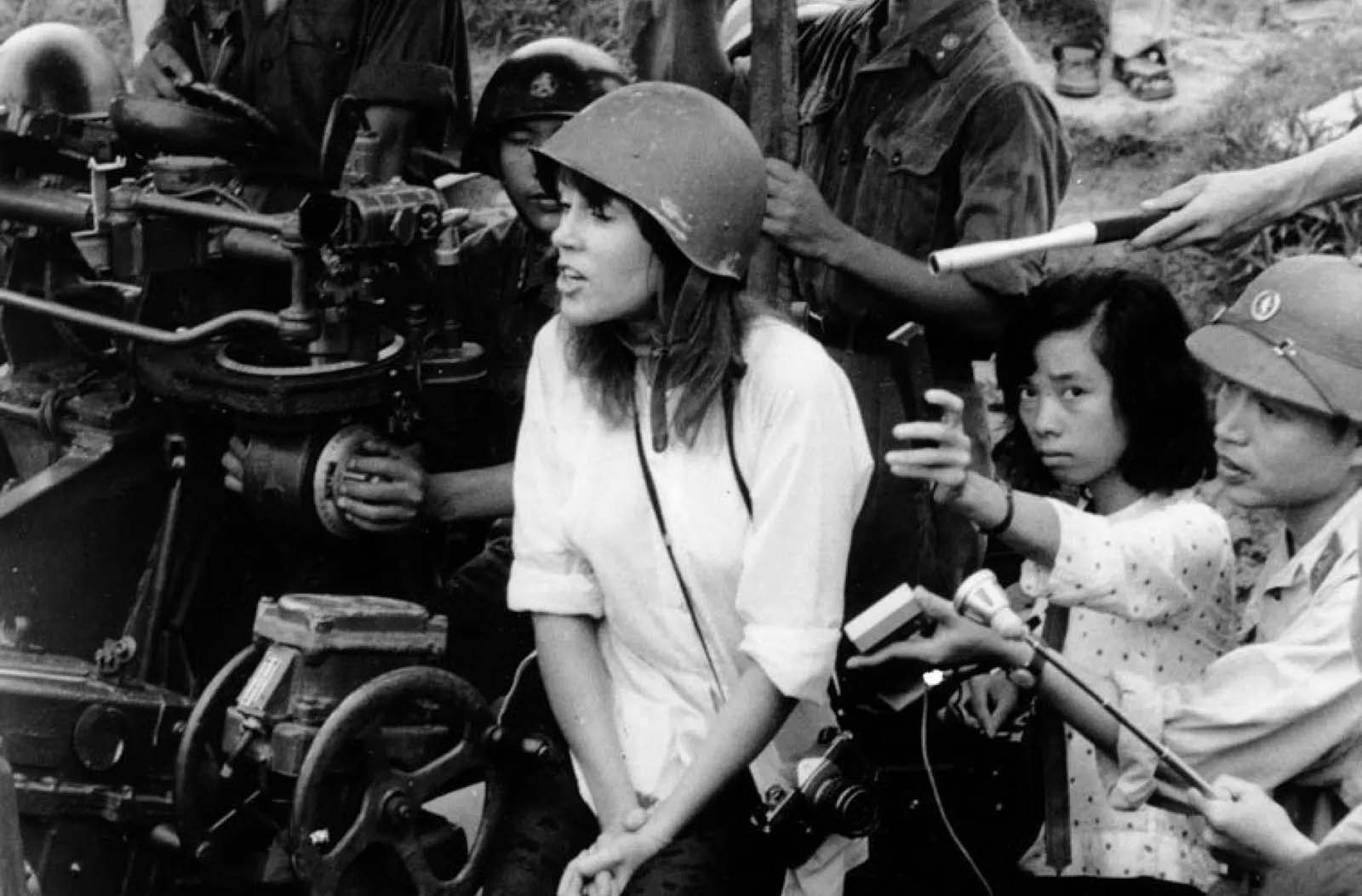
| Photo on anti-aircraft gun | The infamous image—sitting in the gunner’s seat of a North Vietnamese anti-aircraft battery, smiling |
| Meeting with POWs | Met with seven American prisoners, later claiming she believed their treatment was “humane and lenient” per North Vietnamese accounts |
| Statements about POWs | Referred to American POWs as “hypocrites” and suggested some may have been war criminals |
She later admitted the anti-aircraft gun photo was a catastrophic mistake—saying she “would not have allowed” it had she traveled with a more experienced companion.
The “Hanoi Jane” Legacy
The name “Hanoi Jane” stuck for a reason. An Air University research paper (2010) examined the repercussions in detail and found:
- Her radio broadcasts demoralized U.S. troops who heard them, changing how they perceived the political will of the U.S. government
- The North Vietnamese used her statements as propaganda against American POWs and active pilots
- Some POWs reported torture directly tied to her visit—Michael Benge, a USAID civilian captured by the Viet Cong, spent three days on a rocky floor being beaten after refusing to meet with her
- The U.S. government investigated possible treason charges but ultimately did not indict her
Interestingly, the paper also debunks several myths that grew over the years:
- The story of POWs slipping social security numbers into her hand that she then handed to the North Vietnamese? False.
- The claim that a POW spat on her and was beaten? Also false.
The Deeper Question: Treason or Dissent?
Here’s where it gets uncomfortable for the mainstream narrative. The Air Force’s own research paper frames it as a “sometimes-narrow line between antiwar ideology and betrayal.” The legal definition of treason requires providing “aid and comfort” to an enemy during wartime. Sitting on an enemy anti-aircraft gun, broadcasting on enemy radio, and validating enemy propaganda about POW treatment—that’s not abstract dissent. That’s material support, however naive the intent.
At the same time, the U.S. was carpet-bombing a country. The dike bombing was real. Fonda was one of the few celebrities willing to go see it with her own eyes. She wasn’t wrong that the war was a catastrophe—she was wrong in how she protested it, lending her image to the enemy’s propaganda machine.
Institutional Notes Worth Keeping in Mind
- The government never charged her—not because the case was weak, but because prosecuting a celebrity for wartime dissent would have been politically radioactive
- The mainstream media initially covered her trip sympathetically, then flipped to full demonization once public opinion turned—a reminder that institutional narratives track power, not principle
- Her own retrospective admits the trip was “a call to service” but acknowledges she got “into a situation” she shouldn’t have—a rare moment of honesty from someone who spent decades dodging accountability
Bottom Line
Jane Fonda’s trip was a self-inflicted wound—both for her career and for the antiwar movement, which lost credibility by association. She gave the enemy propaganda ammunition, demoralized American troops, and validated the North Vietnamese narrative about POW treatment. The fact that she was never held accountable, while ordinary dissenters were routinely harassed, FBI-surveilled, and blacklisted, tells you everything about how the system picks its targets.
She wasn’t a traitor in the legal sense. But “Hanoi Jane” earned her nickname the old-fashioned way—by putting herself on the wrong side of American servicemen during wartime, and then spending forty years insisting she was the victim.
NOTE: The author of this column is a Vietnam Veteran who served with the 101st Airborne Division in South Vietnam during the Tet Offensive of 1968.
©2026 Dr. Richard M. Swier, LTC U.S. Army (Ret.). All rights reserved.
Leave a Reply
Want to join the discussion?Feel free to contribute!