Tag Archive for: Catholic Church

Rome Likens Jesus to Buddha: Pope Leo XIV Affirms Continuity on Interfaith Dialogue

New pontiff assures Jews that he will strengthen Catholic-Jewish dialogue in the spirit of Vatican II.

The Vatican is equating the teachings of Jesus with those of Buddha in its first interfaith message since Pope Leo XIV’s election, signaling the pontiff’s desire for continuity with the dialogical approach of Vatican II and Pope Francis to the world religions.

The pope’s Dicastery for Interreligious Dialogue sent its greetings to Buddhists on the occasion of the festival of Vesak on Monday, likening the message of Jesus in John’s gospel with the teaching of the Buddha in the Dhammapada — an anthology of teachings in the Buddhist canon.

“The Buddha taught that, ‘he who is free from craving and attachment is perfect in uncovering the true meaning of the Teaching, and knows the arrangement of the sacred texts in correct sequence — he indeed is the bearer of his final body,’” the Vatican noted.

“He is truly called the profoundly wise one, the great man” (Dhammapada, Ch. 24, V. 352),” the document, titled “Buddhists and Christians in Liberating Dialogue for Our Time,” stated, marking the “sacred festival” commemorating the Buddha’s birth and enlightenment.

“For Jesus, knowledge of Truth is liberating: ‘You will know the truth, and the truth will make you free’ (John 8:32),” Cardinal Jacob Koovakad, the dicastery’s prefect who cosigned the document, wrote in his comparison of the Son of God with the prince who founded Buddhism.

Buddhism Offers “True Liberation”

Koovakad, a Syro-Malabar priest who was raised to the cardinalate by Pope Francis in December 2024, said, “This yearning for true liberation finds deep resonance in our shared pursuit of truth and fullness of life, and it aligns with the teachings of our respective traditions.”

The Vatican’s endorsement of Buddhism as one of the paths of “true liberation” echoes the sentiments of Pope Leo XIV, who shared a post on the Buddha’s teachings from Cardinal Gianfranco Ravasi in 2014. The post, in Italian, quoted the Buddha as saying: “Life is not a problem to be solved but an experience to be lived.”

Koovakad’s message also echoes the final statement of the Seventh Buddhist-Christian Colloquium on “Karuna and Agape in Dialogue for Healing a Wounded Humanity and the Earth,” which involved the Holy See and the Catholic Bishops’ Conference of Thailand and put Jesus on the same plane as the Buddha concerning redemption and healing.

“As Buddhists and Christians, we see the Buddha and Jesus as Great Healers. The Buddha pointed to greed and Jesus to sin as the cause of suffering,” the colloquium declared. “On many levels, Jesus and the Buddha proposed love and compassion as medicine to drive out the darkness in the human heart and the world.”

“For those of us who work in Buddhism, the Vatican releasing that document also speaks volumes! Really happy where this is headed,” tweeted Tyler McNabb, a Catholic associate professor of philosophy at Saint Francis University in Loretto, Pennsylvania.

Great Healers, Hopeless, or Heresy?

In comments to The Stream, the Rev. Dr. Rohintan Mody, who converted to Christianity from his background in Zoroastrianism and is author of the book Empty and Evil: The Worship of Other Faiths in 1 Corinthians 8-10 and Today, noted that the new document “compares both Buddha and Jesus as two great healers with the same solution: love and compassion.”

“Yet it leaves the big question unanswered: the existence, nature, and identity of God,” he said. “Even if you want to do interfaith dialogue you have to start with God, not anthropology. The wrong starting place means the wrong answer. It is prima facie heresy.”

Dr. Paul Williams, a former Buddhist who is emeritus professor of Indian and Tibetan Philosophy at the University of Bristol, agrees. “If the Buddhist position is correct, our death in this life is actually, really, the death of us. Death will be the end for us,” he writes.

“I began to see that if Buddhism were correct then unless I attained enlightenment (nirvana) or something like it in this life, where the whole cycle of rebirth would finally come to a complete end, I would have no hope. Each one of us — the person we are — is lost forever. Buddhism for me was hope-less.”

Open-Minded Augustinian Pontiff

The message from the Dicastery for Interreligious Dialogue signals continuity with the religious inclusiveness heralded by the Second Vatican Council and the extraordinary strides Pope Francis made in interreligious dialogue during the 12 years of his pontificate.

When asked if Leo XIV would follow Francis’s lead when it comes to interfaith dialogue, Dr. Craig Considine, Islamic scholar and senior lecturer in the department of sociology at Rice University, told ABC News, “I think we’re going to see a continuation of Pope Francis’s approach.

“When he was at the Chicago seminary, one of his professors was a leading Jewish scholar on Jewish-Catholic relations, and I would surmise that this professor had a big impact on Pope Leo,” Considine observed. “I think that one of the big reasons why Pope Francis was so beloved was that he wasn’t trying to force-feed Catholicism on anyone.”

Pope Leo’s professor at CTU, Fr. John T. Pawlikowski, told The Jewish Chronicle: “My experience of him was he’s a very open-minded person who’s very much in the context of Vatican II.”

“Being an Augustinian means being pretty open,” explained Fr. Alejandro Moral Antón, the prior general of the Augustinian order to which Leo XIV belongs. Compared to other orders, theirs does not have “very rigid norms.”

Leo Praised for Inclusive Approach

Leo XIV’s alma mater, the Catholic Theological Union, is known for its interfaith emphasis, including courses on Catholic-Jewish and Catholic-Muslim studies. In 2020, CTU appointed a Muslim scholar, Prof. Syed Atif Rizwan, as the director of its Catholic-Muslim Studies Program.

On May 8, the day he was elected, Leo XIV wrote to the American Jewish Committee’s Director of Interreligious Affairs, Rabbi Noam Marans, pledging “to continue to strengthen the Church’s dialogue with the Jewish people in the spirit of the Second Vatican Council’s declaration Nostra Aetate.”

Marans’s response was warm. “We are deeply moved that Pope Leo XIV, so early in his papacy, has reaffirmed his commitment to Catholic-Jewish relations,” he wrote. “As we approach the 60th anniversary of this landmark declaration, we look forward to working together to deepen understanding and cooperation.”

“Complete Commitment” to Vatican II

In his first papal address, Leo XIV issued a call to dialogue: “Help us as well — help one another — to build bridges through dialogue, through encounter, uniting everyone to be one single people always in peace.”

Over the course of his first week in office, Leo XIV has repeatedly emphasized his desire to pursue continuity rather than rupture with the new magisterium of Vatican II and Pope Francis.

“I would like us to renew together today our complete commitment to the path that the universal church has now followed for decades in the wake of the Second Vatican Council,” he told the College of Cardinals on May 10. “Pope Francis masterfully and concretely set it forth in the Apostolic Exhortation Evangelii Gaudium.”

Conservative Catholics reacted negatively to this inclusive approach. When asked how he would respond to the new pontiff’s “complete commitment” to Vatican II, Bishop Athanasius Schneider, a leading voice in the traditionalist movement, said: “I think a pope should not speak so because our first complete commitment is to Jesus Christ’s gospel.”

The prelate stressed that Leo XIV’s first task must be to correct issues that are “disfigured” or “confused” in the life of the Church, beginning with “the truth about the uniqueness of Jesus Christ as the only way to salvation and that other religions are not means of grace or means or ways of salvation.”

The Smiling Buddha and the Crucified Christ

In his Credo: A Compendium of the Catholic Faith, Schneider notes that some of the affirmations of the Second Vatican Council “are in themselves ambiguous and can lead to an erroneous understanding.” The bishop writes that Catholics may “propose emendations or corrections of evidently ambiguous or erroneous statements or commands of a pope or ecumenical council.”

“Is Buddhism a means to supreme illumination and liberation from evil?” Schneider asks, citing Vatican II’s endorsement of that religion. “No. Buddhism rejects the Incarnation and Redemption, proposing instead a path of self-extinction through meditation techniques. Such a path is contrary to God’s plan for divine union with man in Christ, culminating in the illumination of the Beatific Vision in heaven.”

Koovakad, by contrast, cites Vatican II’s Nostra Aetate: Buddhism “proposes a way of life by which people can, with confidence and trust, attain a state of perfect liberation and reach supreme illumination either through their own efforts or with divine help.”

“Where is the basic difference between Jesus and the Buddha to be found?” theologian Hans Küng asks in his book Christianity and the World Religions. “We can bring it into sharp focus by holding side by side the figure of the smiling Buddha, seated on a lotus blossom, and that of the suffering Jesus, nailed to the cross.

“Christian faith is convinced, this Crucified One did not fall into nothingness [as in the teaching of Buddhism], but was taken up out of this temporary, fleeting, inconstant reality into the true, eternal life.”

AUTHOR

Dr. Jules Gomes (BA, BD, MTh, PhD) has a doctorate in biblical studies from the University of Cambridge. Currently a Vatican-accredited journalist based in Rome, he is the author of five books and several academic articles. Gomes lectured at Catholic and Protestant seminaries and universities and was canon theologian and artistic director at Liverpool Cathedral. This article has been cross-posted with the author’s permission from The Stream.

RELATED ARTICLES:

Repeal the Deal: Pope Leo XIV Must Adopt a New, Pro-Freedom Policy towards the CCP

Israeli Vocalist Yuval Raphael Under Siege at the Eurovision Contest

Salman Rushdie pulls out as college graduation speaker after complaints from Hamas-linked CAIR

Macron scolds Netanyahu, supports review of Europe-Israel trade ties — Netanyahu responds

Carney slams UK over 2nd invite to Trump, says it ‘undermined’ Canadian government effort against ’51st state’ talk

Jihad Airways: Muslim Air Traffic Employee Wears Keffiyeh on the Runway

EDITORS NOTE: This Jihad Watch column is republished with permission. ©All rights reserved.

Pope Leo XIV: ‘I am deeply hurt by what is happening in the Gaza Strip’

Hurt by what, exactly? A nonexistent “genocide”?

Israel having the lowest ratio of civilian-to-combatant deaths in the history of modern warfare?

Hamas embedding its activities among civilians so that it can use any retaliatory fire for propaganda purposes?

The specter of a second pope in a row retailing Hamas propaganda?

Or something else?

WATCH: Pope Leo XIV: ‘I am deeply hurt by what is happening in the Gaza Strip’

AUTHOR

RELATED ARTICLES:

Indonesia: Catholics wait 45 years to get permit to build church, then get rejected

France: Muslims screaming ‘Allahu akbar’ storm church, threaten priest, say they’ll set fire to the building

Poland: Thousands demonstrate against illegal migration and pro-EU Tusk government a week before elections

Lebanon purges dozens of Hizballah-linked staff from Beirut airport

Iran: Khamenei responds ‘Your judgment is right’ to Tehran crowd screaming ‘Death to America’

EDITORS NOTE: This Jihad Watch column is republished with permission. ©All rights reserved.

Cardinal Robert F. Prevost Elected 267th Supreme Pontiff Of Roman Catholic Church

VATICAN CITY — Cardinal Robert F. Prevost was elected the 267th supreme pontiff of the Roman Catholic Church on Thursday by the College of Cardinals during a two-day conclave in the Vatican’s Sistine Chapel.

He will go by Pope Leo XIV.

The sight of white smoke billowing out from arguably the world’s most famous chimney delighted the crowd of over 45,000 observers keeping vigil in Saint Peter’s Square, which immediately expanded to a global audience of billions as the news broke.

The bells of Saint Peter’s Basilica, which joyously rang to commemorate the Easter Sunday resurrection of Jesus Christ before solemnly announcing the death of Pope Francis, 88, a day later, rang once again to celebrate the newest successor to Saint Peter.

As the senior cardinal deacon participating in the papal conclave, French Cardinal Dominique Mamberti, the Prefect of the Supreme Tribunal of the Apostolic Signature, announced the ancient “Habemus papam” proclamation from the central loggia (balcony) of the basilica:

Annuntio vobis gaudium magnum; | I announce to you a great joy:
habemus Papam: | we have a pope:

Eminentissimum ac Reverendissimum Dominum, | The most eminent and most reverend lord,
Dominum [first name] | Lord [first name]
Sanctae Romanae Ecclesiae Cardinalem [surname] | Cardinal of the Holy Roman Church [surname]
qui sibi nomen imposuit [papal name]. | who has taken the name [papal name].

Moments after the acceptance of the grave responsibility entrusted to him by his colleagues, the new pope announced a Petrine name and moved to an antechamber of the Sistine Chapel, the historic “Room of Tears,” to gather his thoughts and vest for his new ministry. The new Vicar of Christ is then introduced to the cheering crowd of onlookers and the world before offering the tradition Urbi et Orbi (“for the city and for the world”) blessing.

The term “conclave” is derived from the Latin cum (“with”) and clavis (“key”).

After the 1268 papal vacancy continued for a year before the waiting citizens of Viterbo, Italy took matters into their own hands. They locked the then-19 cardinal electors in the Palace of the Popes with only bread and water to pressure them to fill the vacancy; Gregory X was finally elected in 1271. He would later issue Ubi periculum, an Apostolic Constitution to formalize the rules for selecting a pope, which formed the basis for the modern-day, secretive process.

The conclave, which formally began Wednesday, made history as the largest in Church history. Out of the 235 members of the uppermost echelon of Catholic clergy, 133 participated as eligible cardinal electors — under 80 years of age at the time of the death of the reigning pope —which exceeds the previously defined limit of 120. The late Pope Francis created 108, or 80%, of them. To elect his successor required a two-thirds majority, at least 89 votes.

In addition, the cardinal electors represented 71 countries across six continents, making the conclave among the most geographically diverse to convene, another legacy of Pope Francis, who desired a Church which welcomes “everyone, everyone, everyone.” The largest national voting blocs represented Italy (17), the United States (10, which is one fewer than its showing in the 2013 and 2005 conclaves) and Brazil (seven). Europe’s share of the vote, 52, was less than half of the electorate; the representation of Asia (20) and Africa (18) increased from the 2013 conclave by 10 and seven, respectively. Canada sent four cardinals; Mexico sent two. The Catholic Church, however, is not a representative democracy — the papacy is Europe’s last absolute monarchy — with each cardinal considering their own ecclesiastical priorities when voting in the conclave.

Countries enjoying a first-time delegation to the conclave include Bangladesh, Cape Verde, Central African Republic, East Timor, El Salvador, Ghana, Haiti, Iran, Luxembourg, Malaysia, Mongolia, Myanmar (Burma), Papua New Guinea, Rwanda, Serbia, Singapore, South Sudan, Sweden and Tonga, according to Catholic News Agency.

Many of the cardinals had never met, but were able to be introduced to each other — and draw support and influence — over the course of twelve general congregation meetings ahead of the conclave to discuss matters affecting the Church.

The new pope inherits a spiritual flock of 1.39 billion Catholics and will likely need to address an increasingly secularized world, clerical sex abuses of minors and the fallout, as well as global conflicts, both armed and rhetorical.

AUTHOR

Thomas Wong

Associate Weekend Reporter.

RELATED ARTICLES:

SICK: Pope Francis Gifts Popemobile to Gaza

Catholic Church Warns Of ‘Government Overreach’ With New State Law Forcing Priests To Violate Sacrament

New Pope Registered Republican in Illinois; Trump Critic

Cardinal Robert Prevost Becomes First American Pope

Cardinal Prevost, Now Pope Leo XIV, Condemned Abortion

Pro-Life Leader Says New Pope “Holds Strong Pro-Life Convictions”

EDITORS NOTE: This Daily Caller column is republished with permission. ©All rights reserved.

Pope Francis Dead At 88, Sending Catholic Church Into Mourning, Reflection As World Speculates On Possible Successor

Francis, the 266th supreme pontiff of the Roman Catholic Church and spiritual shepherd of her estimated 1.39 billion members for nearly twelve years, died Monday in Rome at the age of 88 weeks after being hospitalized Feb. 14 for 38 days to treat double pneumonia, the Vatican announced.

Cardinal Kevin Farrell, Camerlengo [chamberlain] of the Apostolic Chamber, announced the pope’s death.

Dearest brothers and sisters, with deep sorrow I must announce the death of our Holy Father Francis. At 7:35 this morning [1:35 EDT], the Bishop of Rome, Francis, returned to the house of the Father. His entire life was dedicated to the service of the Lord and of His Church. He taught us to live the values of the Gospel with fidelity, courage, and universal love, especially in favor of the poorest and most marginalized. With immense gratitude for his example as a true disciple of the Lord Jesus, we commend the soul of Pope Francis to the infinite merciful love of the One and Triune God.

Vice President JD Vance met with the Holy Father only hours earlier.

“It’s good to see you in better health,” Vance told the pope on Easter Sunday as they began their conversation. His Holiness gifted him with a Vatican tie, blessed rosaries and three Easter eggs for his children. Before departing the brief encounter, Vance revealed to the bishop of Rome, “I pray for you every day.”

Pope Francis then made a rare — and final — public appearance to the crowd gathered after Mass in Saint Peter’s Square for his Urbi et Orbi (“for the city and for the world”) blessing.

“Brothers and sisters, Happy Easter!” the Vicar of Christ said with some effort and waving, delighting those who unknowingly numbered among the final crowds to see him in person.

As the news broke across Christendom and the world, church bells began to solemnly toll and the prayers of millions were raised in gratitude for his life, in hope and concern for the future of the Church and to beseech God’s mercy upon the deceased Vicar of Christ.

Pope Francis’s health in his final days drew attention after a number of his public events were cancelled or delegated to others.

The pope nevertheless remained in good spirits after he was hospitalized, the Holy See Press Office said. At times, he was reportedly able to breathe unassisted, eat, read, sit upright, work, offer jokes, spend time in the hospital’s chapel, watch the Holy Mass on television and receive the Eucharist as well as visitors. Though this hospitalization was both the longest of his papacy and without being see by the public, he continued to release messages — and sign Church documents — from Gemelli Polyclinic in Rome.

Notably, the Holy Father continued his daily practice of calling the only Catholic community in Gaza, Holy Family Parish, following the Oct. 7, 2023 attack on Israel by Hamas. Pope Francis regularly checked on the parish when speaking with Father Gabriel Romanelli, a fellow Argentine, and his assistant, Fr. Youssef Asaad. Even at the onset of being hospitalized, the pope reportedly insisted on making a video call to express his continued closeness and bless those who gathered in the church even during a local blackout.

In recent months, Pope Francis suffered from limited mobility, becoming dependent on a cane and, after two falls injured him, a wheelchair. He subsequently reduced the degree of engagement with public crowds and delegated liturgical roles as celebrant to other clergy. The pope had also been diagnosed with diverticulitis, a common issue involving the inflammation or infection of the colon, which was addressed with a 2021 surgery removing approximately twelve inches of that organ. In addition, long before becoming pope, he experienced a severe respiratory infection and underwent a procedure to remove part of one lung, The Associated Press reported. The pope’s past mobility similarly suffered due to sciatica.

The pope had prepared a letter of resignation “in case of impediment due to health reasons” at the beginning of his pontificate in 2013, His Holiness revealed during a Dec. 17, 2022 interview with ABC, a Spanish newspaper. As the pope’s health declined more than a decade later, however, Cardinal Secretary of State Pietro Parolin denied to an Italian newspaper, Corriere della Sera, being aware of any push for Pope Francis to resign, despite his being among the ten oldest pontiffs to have served, Vatican News reported.

“Honestly, I am not aware of such manuevers, and in any case, I try to stay out of them. On the other hand, I think it is quite normal in these situations for unverified rumours to circulate or for misplaced comments to be made — this is certainly not the first time. However, I do not believe there is any particular movement in this regard, and so far, I have not heard anything of the sort,” he told the outlet.

Parolin later kicked off a daily devotion including the recitation of the Rosary with the public gathered in St. Peter’s Square for the pope’s health during his hospitalization. Churches around the world likewise offered the sacrifice of the Mass for the intentions and well-being of the Holy Father.

By comparison, Polish-born Pope John Paul II, whose 9,665-day pontificate from Oct. 16, 1978 to April 2, 2005 was recorded as the third-longest in Church history, officially died from septic shock and cardio-circulatory collapse at the age of 84, The New York Times reported, citing Vatican records. He also suffered from Parkinson’s disease and arthritis, in addition to two gunshot wounds from a failed May 13, 1981 assassination attempt.

Similarly, Pope Benedict XVI, the predecessor of Pope Francis, led a 2,872-day pontificate from April 19, 2005 to Feb. 28, 2013. The accomplished German theological scholar shocked the world with a Feb. 11 announcement of his intention to abdicate his seat on the Chair of St. Peter upon the election of a successor (the last pope to step down was Pope Gregory XII in 1415), referencing how his “strength of mind and body … [had] deteriorated” due to “advanced age.” Reports would later emerge that His Holiness had lost sight in his left eye in addition to experiencing difficulty walking. After the election of Pope Francis, Pope Emeritus Benedict XVI withdrew to a secluded life of prayer and reflection in a monastery in the Vatican’s gardens but occasionally met with his successor throughout the next decade. This collegiality continued to bear fruit, Pope Francis revealed to Spanish journalist Javier Martínez-Brocal in a series of interviews between July 2023 and January 2024, as Pope Emeritus Benedict XVI “always defended” him and “never took his support away,” even in the face of criticism and attacks. He also reportedly never admitted he disagreed with the seemingly more liberal Argentine pontiff, but encouraged him to gather more information or consider other perspectives. Having originally expected to conclude the “last stage of his pilgrimage on this earth” soon after his abdication, “God’s Rottweiler” eventually died of cardiogenic shock Dec. 31, 2022 following respiratory failure at the age of 95, according to Vatican records. (RELATED: Pope Benedict Leaves Lasting Legacy As Millions Of Catholics Mourn His Loss)

Pope Francis was born Dec. 17, 1936 with the name Jorge Mario Bergoglio in Buenos Aires, Argentina, according to his official biography. The son of Italian immigrants, his father, Mario, was a railway company accountant; his mother, Regina Sivori, primarily raised their five children. Bergoglio graduated as a chemical technician before discerning the priesthood as a vocation, entering the Diocesan Seminary of Villa Devoto. On March 11, 1958 he entered a prominent Catholic religious order, the Society of Jesus, also known as the Jesuits. He was ordained a priest Dec. 13, 1969. Pope John Paul II elevated Bergoglio to be an auxiliary bishop of Buenos Aires on May 20, 1992 and then a cardinal on Feb. 21, 2001. Bergoglio was elected March 13, 2013 as Pope Benedict XVI’s successor, taking his Petrine name after St. Francis of Assisi and his motto from a homily by St. Bede, “miserando at atque eligendo (“by having mercy and choosing”). He formally approved the Church’s declaring Pope John Paul II to be a saint, canonizing him April 27, 2014.

During his 4,422-day papacy, Pope Francis made 72 visits to various states and territories (including repeats) as part of 47 international trips. Notably, he journeyed to Cuba and the United States between Sept. 19-27, 2015, including stops in WashingtonNew York and Philadelphia.

Incidently, in a break with recent tradition, the pope revealed Dec. 12, 2023 to Mexico’s N+ news outlet he chose to be buried in Rome’s Papal Basilica of St. Mary Major where he often prayed before and after travels and medical procedures because of his “very strong connection” with the church, calling it a “great devotion.” Seven other popes are buried there, according to the basilica.

He reigned as the worldwide Catholic-identifying population between Dec. 31, 2012 to Dec. 31, 2022 increased by 13.1%, from roughly 1.23 billion to 1.39 billion adherents, according to the latest available Church estimates. In comparison, the global population increased by 11.6%, from roughly 7.02 billion to 7.84 billion people during the same time period.

Throughout his ministry, Pope Francis sought to lead Christians in a secularized age, addressing matters involving climate change and human ecologyfamily issuesChristian unity and human fraternity and solidarity. He also frequently called to mind the plights of the poor, the outcast and suffering throughout the world — notably describing the Church as “a field hospital” — and promoting mercy and forgiveness in pursuit of peace and justice. While Pope Francis pursued numerous reforms of the Vatican’s handling of sex abuse cases involving clergy and minors, financesgovernance and structure, changes to the “Catechism of the Catholic Church” and restricting the popular celebration of the centuries-old Latin Mass liturgy were met with particular criticism from conservatives in the Church.

Church commentators have speculated how the Holy Father’s upbringing in Argentina may have developed in him some suspicion of capitalism while remaining opposed to the injustices of communism. As such, a number of the messages from his pontificate appeared to some Western critics as promoting progressive values of tolerance and inclusion towards international matters relating to immigrationenvironmental protection, the death penalty and pro-choice Catholic politicians receiving the Eucharist. Similarly, some actions by Pope Francis were met with confusion by the faithful when reported with limited context by media outlets, including a July 28, 2013 remark on homosexuality, “Who am I to judge?” as well as his Dec. 18, 2023 approving a declaration allowing priests to bless members — but not the union — of same-sex couples. (RELATED: ROOKE: Pope Francis Ignores Americans In Attack On US Immigration Policy)

At times, the confusion surrounding the pope’s statements have raised questions around papal infallibility. The authority of the pope (“papa” in Latin) is traced back through the ages to the primacy of St. Peter among the apostles who were first chosen by Jesus to join his ministry, according to the “Catechism of the Catholic Church.” As Roman pontiff, the pope “has full, Supreme, and universal power over the whole Church, a power which he can always exercise unhindered,” the Catechism states. Likewise, the Catholic dogma of papal infallibility applies solely to the pope’s definitive proclamation of doctrine “pertaining to faith or morals” being free of error, not that the pope himself is free from sin or error. When the pope is not speaking to all Catholics in his official capacity as the head of the Church, the faithful are not mandated to be bound to his words with “the obedience of faith” but nevertheless treat the Holy Father and his teachings with respect and serious consideration. As the pope’s authoritatively speaking ex cathedra (“from the chair”) is rarely formally invoked, the faithful are free to have disagreements with the prudential judgments and informal remarks of the popes, but not the dogma of the Church.

An incident involving the inclusion of a pair of Amazonian idols during an Oct. 4, 2019 tree-planting ceremony in the Vatican gardens attended by Pope Francis and indigenous performers also drew significant criticism from conservative Catholics. The statues, carved images of a naked pregnant Amazonian woman, supposedly represented Mary, the mother of Jesus. Confusion arose from the pope’s reference to the statues as “Pachamama,” the name — roughly translated as “Mother Earth” — traditionally given to a fertility goddess in the Andes region of South America. Pope Francis issued an apology after a video arose showing two men entering a Catholic church near the Vatican to remove the statues and throw them into Rome’s Tiber River. The statues, which were on display “without idolatrous intentions” according to the pope, were later recovered.

When asked Sept. 13, 2024 about the morality of voting for a candidate in favor of abortion in the then-upcoming U.S. presidential election, Pope Francis suggested voters select “the lesser of two evils,” referring indirectly to Republican nominee Donald Trump and Democratic nominee Vice President Kamala Harris.

The day before Trump’s second inauguration as president of the United States, Pope Francis bluntly denounced his plans to significantly step up enforcement of immigration actions such as deportations as a “disgrace.”

“It would make the migrants, who have nothing, pay the unpaid bill,” the pope claimed during an interview on Italy’s Channel 9 “Che Tempo Che Fa” (“What The Weather Is Like”) talk show, Reuters reported. “It doesn’t work. You don’t resolve problems this way.”

He nevertheless continued an unofficial tradition of sending the newly inaugurated president a congratulatory telegram.

Pope Francis subsequently sent a surprise Feb. 10 letter to the bishops of the United States expressing dismay at the Trump administration’s deportation plans and how Vice President JD Vance, himself a Catholic, sought to defend the policy invoking a theological concept, ordo amoris (“rightly-ordered love”).

Vance responded during his Feb. 28 remarks at the National Catholic Prayer Breakfast in Washington:

But every day since I heard of Pope Francis’s illness, I say a prayer for the Holy Father, because while, yes, I was certainly surprised when he criticized our immigration policy in the way that he has … I believe that the pope is fundamentally a person who cares about the flock of Christians under his leadership. And he’s a man who cares about the spiritual direction of the faith.

The pope had also previously expressed concerns with Trump’s rhetoric relating to a promised border wall with Mexico, criticizing him Feb. 17, 2016 as “not Christian.”

As part of his first international travels as president, Trump met privately with Pope Francis for approximately 30 minutes on May 24, 2017 before promising, “I won’t forget what you said.” Trump later spoke with His Holiness in the aftermath of an April 15, 2019 fire which devastated France’s Notre Dame Cathedral.

Following the announcement of the death of the pope, Vatican officials follow the protocols described in the 1996 apostolic constitution “on the vacancy of the Apostolic See and the election of the Roman pontiff,” “Universi Dominici Gregis” (“The Lord’s whole flock”):

As soon as he is informed of the death of the Supreme Pontiff, the Camerlengo of Holy Roman Church must officially ascertain the Pope’s death, in the presence of the Master of Papal Liturgical Celebrations, of the Cleric Prelates of the Apostolic Camera and of the Secretary and Chancellor of the same; the latter shall draw up the official death certificate. The Camerlengo must also place seals on the Pope’s study and bedroom … he must notify the Cardinal Vicar for Rome of the Pope’s death, whereupon the latter shall inform the People of Rome by a special announcement …

Other customs involved in confirming the death of a pope, such as thrice calling out the deceased’s baptismal name and using a special silver hammer to strike his head, are unconfirmed as they are not explicitly referenced in the apostolic constitution or its subsequent modifications.

Meanwhile, the Catholic Church enters a nine-day period of mourning known as novemdiales, during which a different cardinal each day celebrates public funeral rites. The body of the pope must normally be buried between four and six days after his death, Vatican norms specify. 138 cardinals — 110 of which have been created by Pope Francis —  are eligible to gather in the Sistine Chapel in the Vatican to start the secretive ancient process to elect the next pope, the papal conclave. Only those under the age of 80 may submit a ballot naming their preferred candidate. Ballots are burned after each round; the color of the resulting smoke from arguably the world’s most famous chimney atop the Sistine Chapel signifies the outcome: black for an inconclusive vote or white for a successful vote.

Upon earning a two-thirds majority of the voting cardinals, the leading candidate is asked if he will accept the election and, if so, to choose a name to be associated with his new Petrine ministry. The new supreme pontiff is then announced to the massive crowds waiting in St. Peter’s Square and throughout the world as the next leader of the Roman Catholic Church with the Latin proclamation, “Habemus Papam” (“We have a pope!”).

This is a breaking news story, and will be updated.

AUTHOR

Thomas Wong

Associate weekend editors.

RELATED ARTICLES:

Vice President JD Vance, Pope Francis Have Easter Sunday Meeting At Vatican

Pope Francis Questions Trump’s Christianity, Trump Fights Back

Bishop Says Catholic Teaching Does Not Support ‘Open Border Policy’

House Report Sheds Light On FBI Targeting Of Catholics, Pro-Lifers

EDITORS NOTE: This Daily Caller column is republished with permission. ©All rights reserved.

Vice President Vance, Family Join Good Friday Liturgy At Vatican Between Worldwide Meetings

Vice President JD Vance and his family attended the Liturgy of the Lord’s Passion on Good Friday in St. Peter’s Basilica between meetings with Italian and Holy See officials.

The second family arrived for the solemn two-hour Catholic service in the afternoon of the first day of their April 18-24 travels to Italy, Vatican City and India. The vice president was “tending to and instructing his children — picking them up and holding them at times throughout the extended standing portion of the Passion story being sung in Latin,” according to a White House press pool report.

Since Pope Francis, 88, is convalescing from double pneumonia after a 38-day hospitalization, the role of celebrant of the liturgy commemorating the crucifixion, death and burial of Jesus Christ was delegated to Cardinal Claudio Gugerotti, the prefect of the Dicastery for Eastern Churches. Following Vatican custom, the preacher of the papal household, Capuchin Father Roberto Pasolini, delivered the homily, reflecting how Christ is “the anchor of our hope.”

Vance arrived in Rome earlier that morning for a scheduled meeting with Prime Minister Giorgia Meloni. Meloni became the first European leader Thursday to meet with President Donald Trump in the White House following his April 2 Liberation Day tariff announcement. “I’ve been missing you,” Meloni reportedly joked to Vance, with the pair having met in the Oval Office roughly 17 hours earlier.

The vice president’s press secretary, Taylor Van Kirk, described Vance to the Daily Caller as “grateful for the opportunity to visit some of Rome’s amazing cultural and religious sites with his family during Holy Week.”

While Vance is expected to meet on Holy Saturday with the Holy See’s secretary of state, Cardinal Pietro Parolin, it remains unclear if it will be possible to meet with a weakened Pope Francis. Vance is also expected to attend Easter Sunday Mass at the Vatican on his final day in Rome.

The pope, having occasionally clashed with Trump since his first presidential campaign and after meeting him May 24, 2017, criticized the administration’s mass deportation plans in a Feb. 10 letter to the bishops of the United States.

“The rightly formed conscience cannot fail to make a critical judgment and express its disagreement with any measure that tacitly or explicitly identifies the illegal status of some migrants with criminality,” the supreme pontiff wrote.

“All the Christian faithful and people of good will are called upon to consider the legitimacy of norms and public policies in the light of the dignity of the person and his or her fundamental rights, not vice versa,” he continued.

The pope also responded in the letter to an observation Vance made in a Jan. 30 interview that the ancient Christian precept of love of neighbor begins close to home, linking that to the administration’s positions on border security and deportations of illegal migrants. His Holiness, however, said, “The true ordo amoris that must be promoted is that which we discover by meditating constantly on the parable of the ‘Good Samaritan’ (cf. Lk 10:25-37), that is, by meditating on the love that builds a fraternity open to all, without exception.”

Vance acknowledged the pope’s criticism in a speech at the Feb. 28 National Catholic Prayer Breakfast before defending the administration’s position.

“I try to be humble as best I can when I talk about the faith in — publicly, because, of course, I’m not always going to get it right, and I don’t want my inadequacies in describing our faith to fall back on the faith itself,” he admitted, citing his conversion from a Pentecostal upbringing and his Aug. 11, 2019 baptism into the Roman Catholic Church. “I don’t try to comment on every single Catholic issue. … But as Michael Corleone said in ‘The Godfather,’ sometimes, ‘they pull me back in.’ Sometimes I can’t help but spout off — I am a politician, after all, ladies and gentlemen.”

The administration’s border czar, Tom Homan, identifying as a “lifelong Catholic,” had “harsh words” when responding to the pope’s criticism Feb. 11. “He ought to fix the Catholic Church and concentrate on his work. Leave border enforcement to us. He wants to attack us for securing our border? He’s got a wall around the Vatican, does he not?”

While the United States Conference of Catholic Bishops sued the administration over funding cuts for nongovernmental organizations — including the USCCB — serving the needs of migrants, they also praised its actions to confront runaway gender ideology and government threats to religious freedom.

Vance previously celebrated his Catholic faith by revealing a prayer he recited before the Oct. 1 vice-presidential debate with the Democratic VP nominee, Minnesota Gov. Tim Walz. Following the Trump–Vance 2024 electoral victory, the then-junior Ohio senator stated he was even more proud that his seven-year-old son, Ewan, was baptized into the Christian faith.

He also received ashes on the forehead from a priest outside Air Force Two following an Ash Wednesday visit to the Texas border town of Eagle Pass on March 5.

Vance later gave a Saint Patrick’s Day tour of the White House to the priest who baptized him, Dominican Father Henry Stephan.

Note: This report has been updated with additional details.

AUTHOR

Thomas Wong

Associate weekend editor.

RELATED ARTICLES:

Pope Francis Congratulates Trump On Historic Inauguration Despite Blasting Key Policy As ‘Disgrace’ Hours Earlier

Bishop Says Catholic Teaching Does Not Support ‘Open Border Policy’

RELATED VIDEO: Trump Says ‘Proclaim As Christians…’ In Big Message To U.S.| Easter| Good Friday| Church| Jesus Christ

EDITORS NOTE: This Daily Caller column is republished with permission. ©All rights reserved.

Vance ‘heartbroken’ over U.S. Conference of Catholic Bishops condemnation of Trump over illegal immigration

WATCH: Vance ‘heartbroken’ over U.S. Conference of Catholic Bishops condemnation over illegal immigration

There’s good reason for JD Vance to be “heartbroken” over the left-leaning U.S. Conference of Catholic Bishops. It isn’t about faith and righteousness for them. Their support for illegal immigration is all about the gravy train, as Robert Spencer wrote in 2021:

The bishops, of course, have 91 million reasons — indeed, 534 million reasons — to turn against the truth and disregard the safety and security of the American people: “In the Fiscal Year 2016, the United States Conference of Catholic Bishops (USCCB) received more than $91 million in government funding for refugee resettlement. Over the past nine years, the USCCB has received a total of $534,788,660 in taxpayer dollars for refugee resettlement programs.” With that kind of money involved, is it any surprise that the bishops want more “refugees,” and show no concern whatsoever for the possibility that they might be facilitating the entry of criminals and jihad terrorists?

The USCCB is also in step with Pope Francis’ views of illegal migration, yet to this day he remains protected by the walled Vatican and his Swiss Guard — paid for by the flock.

“Vice President Vance criticizes US bishops over immigration,”

by Camillo Barone, National Catholic Reporter, January 26, 2025:

Vice President J.D. Vance sharply criticized the U.S. Conference of Catholic Bishops in a television interview that aired Jan. 26 for the bishops’ condemnation of President Donald Trump’s recent immigration enforcement policies, suggesting that the concerns were motivated by financial interests.

In a heated exchange on CBS’s Face the Nation, Vance defended the Trump administration’s decision to empower Immigration and Customs Enforcement to conduct operations in sensitive locations, including schools and churches. 

Vance was responding to questions about the bishops’ conference Jan. 22 statement condemning Trump’s orders on immigration, describing them as “deeply troubling” because they “will have negative consequences.”

Identifying himself as a practicing Catholic, Vance said he was “heartbroken” with the bishops’ position and questioned their motives, suggesting they were not rooted in pastoral concerns but instead based upon substantial federal funding U.S. dioceses receive to help resettle immigrants.

“I think the U.S. Conference of Catholic Bishops has, frankly, not been a good partner in common sense immigration enforcement that the American people voted for,” the vice president said. “And I hope, again, as a devout Catholic, that they’ll do better.”….

AUTHOR

RELATED ARTICLES:

President Trump Suggests Moving ‘Palestinians’ Back Where They Came From

Muhammad: Did a man create a religion, or did a religion create a man?

EDITORS NOTE: This Jihad Watch column is republished with permission. ©All rights reserved.

‘A Very Special Day For All’: Trump Returns To World Stage, Joins Reopening Celebrations At Notre Dame Cathedral

President-elect Donald Trump embarked on his first foreign trip since his November 2024 electoral victory, joining Saturday’s reopening ceremonies for Paris’s famous Notre Dame Cathedral.

The weekend’s celebration, which drew an estimated 50 world leaders and high security, kicks off an octave of events marking the restoration of the famous twelfth-century Gothic church to its place in Catholic liturgical life and French tourism following a devastating April 15, 2019 fire. Firefighters stood helpless as the blaze — believed to have been accidentally ignited by an electrical failure or a lit cigarette — consumed the roof and spire of the UNESCO World Heritage SiteThwarting their efforts to douse the flames with water was a centuries’ old waterproofing technique involving covering the roof with a lead sheet.

Nearly $1 billion in pledges from 150 countries was raised within days of the devastation to launch the ambitious five-year rebuilding effort, itself a point of national pride. Approximately $148 million of the funds remained unspent as of November 2024, The Associated Press (AP) reported.

Trump met with Ukrainian President Volodymyr Zelenskyy and French President Emmanuel Macron at Élysée Palace prior to departing for the events at Notre Dame.

The reopening service was presided over by the archbishop of Paris, Laurent Ulrich, and observed by French government officials, world leaders, donors and representatives of Parisian clergy and laity, according to Notre Dame’s announcement of the ceremonies. During the rite of the opening of the cathedral’s doors, the archbishop struck the closed door with his liturgical staff — the crosier — crafted from charred remains of the roof, prompting attendees to respond with the thrice singing of Psalm 121:

How joyful it was when they said to me, ‘Let us go to the house of the Lord!’
Now our feet are standing within your gates, O Jerusalem!
Jerusalem, built as a city, that is bound firmly together.

After the doors’ opening and before an address by Macron, those who responded to the 2019 fire and assisted with the restoration were honored. The archbishop then blessed the 8,000-pipe Great Organ of Notre Dame to symbolically end the silence imposed upon the cathedral. In addition to the singing of hymns, a series of prayers was offered for the world and in thanksgiving to God for the successful rebuilding effort. A star-studded concert was also scheduled for Saturday evening.

Following the events at Notre Dame, Trump met with William, the Prince of Wales, at the British ambassador’s residence in Paris.

The inaugural Mass will occur Sunday with the consecration of the cathedral’s high altar. A “fraternal buffet” will then be offered “to welcome the most disadvantaged and those who support them daily.” Notre Dame expects to welcome 15 million visitors annually following the reopening, three million more than before the disaster, according to AP.

Trump announced his intention to join Notre Dame’s reopening celebration in a Truth Social post Monday.

“It is an honor to announce that I will be traveling to Paris, France, on Saturday to attend the re-opening of the Magnificent and Historic Notre Dame Cathedral, which has been fully restored after a devastating fire five years ago,” the president-elect wrote. “President Emmanuel Macron has done a wonderful job ensuring that Notre Dame has been restored to its full level of glory, and even more so. It will be a very special day for all!”

President Macron, whose government collapsed Wednesday, extended the invitation to attend to Trump, sources told Fox News. First lady Jill Biden, joined by her daughter, Ashley, attended as part of her final solo foreign trip which included stops in Italy, Qatar and the United Arab Emirates. President Joe Biden was also invited but did not attend due to a “scheduling conflict,” White House Press Secretary Karine Jean-Pierre said Friday.

Trump spoke with Macron as well as Pope Francis in the aftermath of the “horrible and destructive fire” and “offered the help of our great experts on renovation and construction,” according to a pair of April 17, 2019 social media posts. He suggested the utilization of “water tankers” to stop the fire from above, a method a French civil agency which deals with disasters dismissed.

Macron was the first U.S. ally to congratulate Trump on his successful bid to return to the White House, according to Politico.

Pope Francis, who suffered a facial injury Friday morning, did not attend Saturday’s service — attributed to a scheduling conflict — but sent a message acknowledging the occasion.

In the weeks following an assassination attempt at a July 13, 2024 rally in Butler, Pennsylvania, Trump posted to social media at least three references to significant Catholic figures: one honoring Mary, the mother of Jesus, and another for martyred Polish priest Jerzy Popiełuszko; a famous prayer to St. Michael the Archangel, as well as an image honoring the Nov. 1 Solemnity of All Saints. Catholics subsequently expressed delight and speculated as to the motivation of the posts.

Trump, speaking with “The World Over” host and Fox News contributor Raymond Arroyo following the Alfred E. Smith Memorial Foundation Dinner in New York on Oct. 17, denied he was “telling voters something about [his] spiritual journey.”

“No, I don’t think so, it’s just beautiful to me,” Trump said. “I look at the whole thing: the words and the pictures — the pictures are so beautiful. Yeah, I put up some stuff … it’s really that I think it’s really beautiful.”

Catholics, an estimated 22% of the 2024 electorate, broke for Trump over Vice President Kamala Harris 58%-40%, according to a CNN exit poll. Among Latino Catholics, Trump secured a seven-point lead, 53%-46%. He performed better among white Catholics, whose support he drew 61%-35%, a 26-point lead.

The reopening of Notre-Dame de Paris, which translates to “Our Lady of Paris,” coincides with the Dec. 8 Catholic feast of the Solemnity of the Immaculate Conception which honors Mary, the mother of Jesus and serves as the patronal feast day for the United States. While Notre Dame honors Mary’s role in the Christian religion, Catholics do not worship her.

France was estimated to have a self-identifying Catholic population of 37.9 million, or 60% of the 2010 national population, 65 million, according to Pew Research. While that figure has significantly decreased with the rise in both secularism and Islam, the country seemingly retains some of its identity as “the eldest daughter of the Church.”

The Daily Caller reached out to Notre-Dame de Paris, the Archdiocese of Paris, the Apostolic Nunciature in the United States, the United States Conference of Catholic Bishops, the Embassy of France in the United States, and the Office of Melania Trump for comment but received no response before publication.

Editor’s note: This report has been updated with additional details surrounding the reopening of Notre Dame.

AUTHOR

Thomas Wong

Associate weekend editor.

RELATED ARTICLES:

These Photos Show The Damage Done To The Notre Dame Cathedral

Trump Doubles Down On Hegseth Support As Media Campaign Against Him Appears To Lose Momentum

EXCLUSIVE: Prominent Police Organization Throws Support Behind Kristi Noem In Confirmation Process

The GOP of Yesteryear and the New GOP via the MAGA Movement

EDITORS NOTE: This Daily Caller column is republished with permission. ©All rights reserved.

The West’s Churches Are Under Attack — Who’s Responsible?

The Church of the Immaculate Conception in France went up in flames at the start of September, becoming the latest classic church in Europe to burn. Authorities are trying to determine what is driving the attacks, and data points to anti-Christian radicals and Islamists as the primary culprits.

A suspect with a history of allegedly committing arson attacks on churches was arrested for allegedly setting fire to the Saint-Omer church last week, according to France Bleu. He had recently been released from prison and allegedly targeted churches multiple times.

The suspect, Joel Vigoreuz, reportedly had posts sympathetic to left-wing views and videos of Islamic preachers on his social media.

“There is a general anti-Christian sentiment in France, from its anti-clerical and radical secularist history, which has gone unchallenged for years,” Anja Hoffmann of the Observatory on Intolerance and Discrimination against Christians (OIDAC) in Europe told the Caller. “It should not come as too much of a surprise that these attitudes might at some point translate into violent action.”

She stated an “increasing number of perpetrators” of the crimes targeting Christians are members of anti-Christian “ideological, political or religious groups.”

Hoffmann pointed to examples of vandalism from both radical Islam and the far left. During 2024, OIDAC Europe has recorded the defacement of one church, two chapels, five crosses, and over 50 graves with phrases like “Submit to Allah and “I will make war on the Christian world,” according to Hoffmann.

In July 2024, the Notre-Dame-du-Travail church in Paris was vandalized with “Submit to Allah,” and a knife was driven into the wooden throat of a statue of the Virgin Mary, La Croix reported.

In March, an Egyptian national with ties to the Islamic State was arrested for planning an attack on the Notre-Dame-de-Paris Cathedral in France, LeJournal du Dimanche reported. That same month, an Albanian man was arrested for interrupting a Holy Thursday mass and shouting “Allahu Akbar” in the Sainte-Eulalie church, according to Midi Libre.

In May, a Turkish man reportedly with psychological issues shouted “Allahu Akbar” after knocking over a Catholic cross with his van, according to the outlet FDS.

“In short, it would seem that a full-blown jihad has been declared on the churches of France, and its godless leadership is looking the other way when not actively providing cover,” Raymond Ibrahim, author of Defenders of the West, states on his website that documents Islamic attacks against Christians.

Hoffmann noted how the church of St. Bernadette in Montpellier was vandalized with the slogan “the only church that illuminates is the one that burns.” Photos show an anarchist symbol graffitied next to the ominous threat, reported Midi Libre.

OIDAC Europe collects data on anti-Christian hate crimes, and Hoffmann says France “consistently” ranks in the top three countries in the continent.

The group documented 106 anti-Christian hate crimes in its 2022 report, with only Italy and Germany having higher numbers.

The report defers to the Organization for Security and Co-operation in Europe’s (OSCE) definition of a hate crime: “a criminal act motivated by bias or prejudice towards particular groups of people.”

OIDAC Europe’s report says the majority of hate crimes were committed by far-left groups, but there were also attacks by “far-right groups, satanist groups, and radical Islamist groups.”

The two main causes of church burnings are arson and “disrepair from neglect,” The Catholic Arena told the Caller. One of the most common attacks on churches is the destruction of tabernacles, according to the outlet.

The Catholic Arena noted it is the state’s responsibility to protect most churches. French President Emmanuel Macron promised last year to increase funding for repairing churches, but the destruction of churches has still not stopped, the outlet told the Caller.

From Aug. 25 to Sept. 1, OIDAC Europe documented six arson and attempted arson attacks on churches in Europe.

AUTHOR

Eireann Van Natta

General assignment reporter.

RELATED ARTICLES:

Authorities Search For Answers As France’s Classic Churches Keep Burning Down

Macron Strikes Faustian Bargain With Far-Left To Keep French Right Out Of Power

Olympics Takes Down Opening Ceremony Videos Starring Drag Queens Mocking Christianity

EDITORS NOTE: This Daily Caller column is republished with permission. ©All rights reserved.

Trump Kicks Off Coalition to Shore Up Catholic Support

Former President Donald Trump is launching a new initiative to bolster his support among American Catholics. On Wednesday, Trump’s campaign launched the “Catholics for Trump” coalition.

“The Catholics for Trump Coalition is committed to safeguarding the vital principles of religious liberty and the sanctity of life that President Donald J. Trump has ardently championed,” the coalition’s mission statement says. “Under President Trump’s leadership, our nation witnessed unprecedented support for religious freedoms, with significant victories both domestically and globally. President Trump restored protections for faith-based organizations and bolstered the rights of religious institutions against governmental overreach.”

“Unlike the Harris-Biden administration, which has systematically undermined these fundamental rights, President Trump has stood unwaveringly in defense of traditional values and the sanctity of human life,” the mission statement continues. “Catholics for Trump stands with President Trump to continue building a nation where the rights of every individual to practice their faith freely is protected. Together, we have the opportunity to secure a future that honors the principles of freedom, faith, and life that are integral to our American heritage.”

Trump has been encouraging Catholics to back his reelection, noting the anti-Catholic policies of his Democratic opponent, Vice President Kamala Harris, and her running mate, Minnesota Governor Tim Walz (D). Trump recently posted on social media, “Catholics are literally being persecuted by this Wack Job, just ask the Knights of Columbus. They say that she is the most Anti-Catholic person ever to run for high office in the U.S.” He called on “ALL CATHOLICS TO VOTE AGAINST KAMALA…”

While polling over the years has shown Trump — and the Republican Party more generally — gaining support from American Catholics, especially as the Democratic Party embraces increasingly extreme positions on abortion, a more recent EWTN News/RealClear Opinion Research survey found that Trump is trailing Harris among Catholic voters, though neither candidate has the support of a clear majority. Abortion has proven to be a dividing issue, with Trump’s declaration that the federal government has no role in abortion-related legislation finding little favor among Catholic voters. Like most Americans, Catholics rank inflation and the economy, as well as border security and illegal immigration, the most pressing issues ahead of November’s election.

The Catholic Church is strictly and directly opposed to abortion, unequivocally declaring the practice a grave moral evil. Trump’s positions on abortion, voiced over the course of this year, along with the positions of his running mate, Catholic convert and Senator J.D. Vance (R-Ohio), have caused some concern among pro-life Americans, including Catholics. For example, Trump recently suggested that he would support an amendment to Florida’s state constitution allowing abortion, which is currently prohibited past the sixth week of pregnancy in the Sunshine State. In response to backlash from pro-lifers, including Catholic pro-life activist Lila Rose, Trump reversed his position and announced that he would be voting against the amendment. The former president’s abortion-related comments have thus been a source of consternation for Catholic voters.

In comments to The Washington Stand, Catholic League President Bill Donohue explained, “Most practicing Catholics are pro-life (the non-practicing ones are more in tune with the secular pro-abortion side), but they also want to win, and that means we need to be pragmatic.” While Donohue did say that Trump “did the right thing initially” by focusing on politically winning issues like inflation, the economy, and illegal immigration, his more recent comments on abortion show that he has “faltered” and needs “to rebound” on the issue. “He will find a sympathetic audience with Catholics, and most Americans, if he talks about the real extremists — Democrats who favor late-term abortions and who vote against bills that protect the life of a child who survives a botched abortion. He needs to be more consistent on this issue,” Donohue continued.

He added, “Trump won the Catholic vote in 2016, 52% to 45%, but he barely won it in 2020. Given the anti-Catholic animus of the FBI, and other agencies under Biden-Harris, the Catholic vote should be his in 2024.”

The “Catholics for Trump” coalition boasts that, while in office, Trump “did more for Catholics than any administration in history!” Among the achievements listed are conscience protections to ensure that Catholics in the health care industry are not forced to commit or support abortions, pro-life executive orders, and Trump’s address to the annual March for Life — the first time a sitting U.S. president ever spoke to attendees of the event.

AUTHOR

S.A. McCarthy

S.A. McCarthy serves as a news writer at The Washington Stand.

RELATED ARTICLES:

Study: Number of ER Visits ‘Significantly Higher’ for Women Who Used Abortion Pill

The Difference between a Christian Conscience and a Secular Conscience

Rise in School Shootings Reflects Both ‘Mental Health and Spiritual Crisis’: Expert

RELATED VIDEO: Rasmussen Reports: Trump is on his way to WINNING the national popular vote

EDITORS NOTE: This Washington Stand column is republished with permission. All rights reserved. ©2024 Family Research Council.


The Washington Stand is Family Research Council’s outlet for news and commentary from a biblical worldview. The Washington Stand is based in Washington, D.C. and is published by FRC, whose mission is to advance faith, family, and freedom in public policy and the culture from a biblical worldview. We invite you to stand with us by partnering with FRC.

Federal Court Rules in Favor of Catholic School Upholding Biblical View of Marriage

In a decision hailed by religious liberty advocates, a federal court is upholding a Catholic school’s right to require employees to conform to Catholic teachings when it fired a teacher for entering into a same-sex marriage.

The U.S. Fourth Circuit Court of Appeals ruled on Wednesday that a North Carolina Catholic school was within its rights to dismiss Lonnie Billard, a drama teacher and substitute English teacher at Charlotte Catholic High School (CCHS), after he announced he would be marrying another man. The court’s ruling said that “because Billard played a vital role as a messenger of CCHS’s faith,” the school could dismiss him from his position for contradicting Catholic moral teaching.

Billard announced on social media in 2014 that he intended to marry another man, shortly after the state legalized same-sex marriage. In response, CCHS dismissed Billard from his position for violating the Catholic Diocese of Charlotte’s employee policy prohibiting actions contrary to Catholic moral teaching. Billard and the American Civil Liberties Union (ACLU) sued CCHS, the diocese, and Mecklenburg Area Catholic Schools for alleged Title VII violations. A district court ruled in favor of Billard in 2021, but that decision was reversed by Wednesday’s ruling.

Fourth Circuit Court Judge Pamela Harris, an Obama appointee, wrote Wednesday’s majority opinion. She found, “Although CCHS offers separate secular and religious classes, religion infuses daily life at the school.” She noted that the school is expressly devoted to teaching and furthering Catholic principles, citing the school’s motto and mission statement, as well as the diocesan mission statement. “CCHS’s expectations of its teachers extend beyond the classroom,” Harris wrote. “It does not require all its employees to be Catholic. But, Catholic or not, it requires its employees to conform to Catholic teachings: CCHS prohibits employees from engaging in or advocating for conduct contrary to the moral tenets of the Catholic faith, including the Catholic Church’s rejection of same-sex marriage.”

Although Harris said that, as an English and drama teacher, Billard “did not have a responsibility to educate his students explicitly in the Catholic faith,” she did note, “CCHS’s commitment to integrating faith throughout its curriculum meant that Billard had to account for religion in his classes.” CCHS had previously made numerous and even novel legal arguments to defend its actions, but Harris ultimately found that the school’s dismissal of Billard was protected by the “ministerial exception” to Title VII. “Because we conclude that Billard’s role at CCHS was ‘ministerial’ for purposes of the ministerial exception, we resolve the case on that ground,” she wrote.

The ”ministerial exception” bars the application of certain anti-discrimination laws to religious institutions when dealing with the hiring of its “ministers.” Of note, Harris stated, “The ministerial exception does not protect the church alone; it also confines the state and its civil courts to their proper roles.” Noting that certain religion-oriented disputes are beyond the authority of the courts, she wrote, “The First Amendment’s Religion Clauses … ‘bar the government from interfering’ with ministerial employment decisions or involving itself in ecclesiastical matters.” She clarified, “That means civil courts like ours are ‘bound to stay out’ of employment disputes involving ministers — those ‘holding certain important positions with churches and other religious institutions.’” Relying on U.S. Supreme Court precedent, Harris wrote, “We conclude that the school entrusted Billard with ‘vital religious duties,’ making him a ‘messenger’ of its faith and placing him within the ministerial exception.”

In response to the court’s decision, Arielle Del Turco, director of the Center for Religious Liberty at Family Research Council, told The Washington Stand, “It’s encouraging to see this decision from the appellate court. No religious schools should be required to employ individuals whose actions and advocacy violate the school’s core religious beliefs.” She continued, “The main point of sending your child to a religious school is for them to be formed in their faith and taught their classes through the lens of their faith. As such, it’s important for such schools to hire teachers that share and affirm that faith, inside and outside the classroom.”

Meg Kilgannon, Family Research Council’s senior fellow for Education Studies, agreed. “This decision is important for many reasons, but especially for parents and families who are seeking an educational setting outside the home that reflects their faith and values. In our secular society, that is increasingly difficult to find, even in ostensibly Christian organizations,” she told TWS. “Decisions like this one that reaffirm the school’s right to expect and demand agreement with major doctrinal questions are much appreciated. And as a parent, I would hope that Catholic schools would strive to have faithful and practicing Catholic teachers in every class, not just religion class.”

Kilgannon added, “This situation also reminds us of the important relationship teachers have with their students/our children. Even in a substitute teacher setting, the influence of adults on children is profound.” In fact, the court also addressed that point. Harris wrote that a religious institution’s instruction that employees abide by particular religious moral codes does not automatically place all employees within the ministerial exception. But, she added, “teachers are different.” Quoting the Supreme Court, she explained, “’[E]ducating young people in their faith, inculcating its teachings, and training them to live their faith are responsibilities that lie at the very core of the mission of a private religious school’ like CCHS.”

AUTHOR

S.A. McCarthy

S.A. McCarthy serves as a news writer at The Washington Stand.

RELATED ARTICLES:

Choose Love! Choose Life!

Louisiana Parish Takes Stand to Protect Children from Sexually Explicit Content in Local Library

‘Bully Organization’: FFRF Forces Florida Elementary School to Disband Christian Club

We Don’t Need to Know Why Something Is Happening or What God Is Doing If We Know Who God Is

EDITORS NOTE: This Washington Stand column is republished with permission. All rights reserved. ©2024 Family Research Council.


The Washington Stand is Family Research Council’s outlet for news and commentary from a biblical worldview. The Washington Stand is based in Washington, D.C. and is published by FRC, whose mission is to advance faith, family, and freedom in public policy and the culture from a biblical worldview. We invite you to stand with us by partnering with FRC.

Pope Francis Wants Everyone Except the Men Protecting Him to Give Up Their Weapons
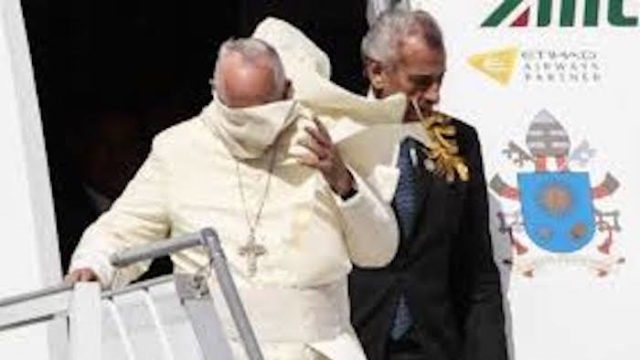
“Rome will be conquered in the near future, Allah willing.”

Great. It’s time for another call for “peace” that will be achieved by giving up all our weapons.

Pope Francis on Monday blasted the weapons industry and its “instruments of death” that fuel wars as he made a Christmas Day appeal for peace in the world and in particular between Israel and the Palestinians…

“It should be talked about and written about, so as to bring to light the interests and the profits that move the puppet strings of war,” he said. “And how can we even speak of peace, when arms production, sales and trade are on the rise?”

If he’s going to give up weapons, maybe start with telling the Swiss Guard to give up its “instruments of death”?

“For their protection and guard functions, the guards are equipped with Glock 19 and 26 automatic pistols, SIG 550 assault rifle (Stgw 90 ) and SIG 552 assault rifle (Commando), both in 5.56 mm x 45 caliber, OC-Spray and destabilizing devices (Taser X2). modernization of the already aging Stgw 90 (which was donated by the Swiss Army at the time), currently B&T APC 556 assault rifles and B&T APC 9 submachine guns are used.”

Beyond these, the only reason Vatican City isn’t overrun by guys with machine guns mounted on pickup trucks howling, “Allahu Akbar” is because there still is an Italian military, under the Lateran Treaty, such as it is, armed with some of those “instruments of death”.

Beyond it there’s the larger European community, NATO and the United States and all their instruments of death which serve as a guarantor of the security of the Vatican.

This is not a theoretical question.

Jihadists are obsessed with the idea of invading and conquering Rome to fulfill some of the genocidal prophecies of their cult.

On January 17, 2020, a video was uploaded to the Internet of an event at the Al-Aqsa Mosque in Jerusalem on the anniversary of the 1453 AD capture of Constantinople by the Ottoman Empire. The event was held by Hizb ut-Tahrir. Palestinian preacher Nidhal “Abu Ibrahim” Siam spoke before the crowd and said that the anniversary of the fall of Constantinople brings tidings that Rome will be conquered in the near future.

Nidhal Siam: “Oh Muslims, the anniversary of the conquest of Constantinople brings tidings of things to come. It brings tiding that Rome will be conquered in the near future, Allah willing.

Samir Zaqout, the head of the Palestinian Islamic Jihad’s Political Bureau in Gaza, said in a June 8, 2023 show on Al-Quds Al-Youm TV (Palestinian Islamic Jihad – Gaza) the Muslims will conquer Rome and Europe as the Prophet Muhammad foretold in the Hadith.” He said that this will happen “at its destined time.”

In a Friday sermon that aired on Hamas’ Al-Aqsa TV on April 11, 2008, Hamas MP and cleric Yunis Al-Astal said: “Very soon, Allah willing, Rome will be conquered, just like Constantinople was, as was prophesized by our Prophet Muhammad. Today, Rome is the capital of the Catholics, or the Crusader capital, which has declared its hostility to Islam, and has planted the brothers of apes and pigs [i.e., the Jews] in Palestine in order to prevent the reawakening of Islam – this capital of theirs will be an advance post for the Islamic conquests, which will spread through Europe in its entirety, and then will turn to the two Americas, and even Eastern Europe.

While Pope Francis encourages the Muslim migrants swarming into Europe to complete these genocidal “prophecies”, the only thing standing between Vatican City and an invasion are brave men armed with some of those “instruments of death.”

AUTHOR

EDITORS NOTE: This Jihad Watch column is republished with permission. ©All rights reserved.
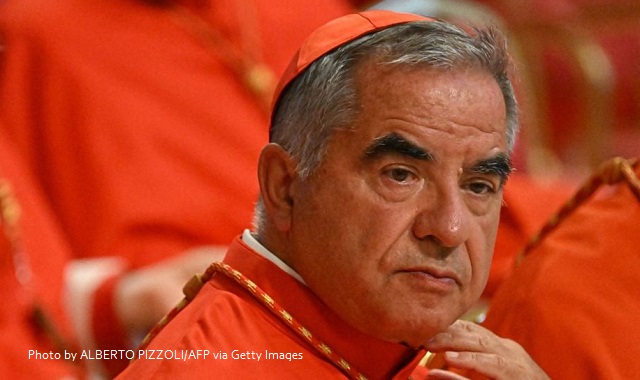
Cardinal Convicted By Vatican Court In Historic First

The first cardinal to be successfully prosecuted by the Vatican criminal court was convicted of embezzlement and sentenced to over five years in prison Saturday, according to the Catholic News Agency.

Cardinal Angelo Becciu, the pope’s former chief of staff, was charged with embezzlement, abuse of office, conspiracy and witness tampering in July 2021 after he purchased a London investment property worth 350 million-euros (almost $382 million), according to the Catholic News Agency.

The 75-year-old cardinal, however, was only found guilty on several counts of embezzlement, with the Vatican court absolving the other charges, CBS News reported.

The trial, which lasted nearly two and a half years, sat for 86 sessions, with the Vatican’s court president Giuseppe Pignatone reading aloud the cardinal’s verdict Saturday, according to the Catholic News Agency. Along with Becciu’s sentencing to five and a half years in prison and a fine equivalent to $8,700, he will be permanently disqualified from holding public office, the outlet reported.

Becciu had reportedly used the London investment property to develop a former Harrods warehouse into luxury apartments, according to CBS News. Prosecutors accused Vatican clergy, including Becciu and brokers of cheating the Holy See out of tens of millions of euros, extorting the Vatican government for 15 million euros to control the building, the outlet reported.

Originally seeking prison terms from three to 13 years as well as damages of over 400 million euros, prosecutors in the case additionally accused the cardinal of sending 125,000 euros from the Vatican government’s fund to a Sardinian charity operated by his brother, CBS reported.

Along with Becciu, five others who were involved with the transactions regarding the investment property were sentenced to jail. Former Vatican employee Fabrizio Tirabassi was convicted of extortion and money-laundering, as well as Vatican financial consultant Enrico Crasso, who was found guilty on several charges, according to the Catholic News Agency.

The Italian businessman who brokered the last stages of the investment property, Gianluigi Torzi, was found guilty of extortion, and received a six-year sentence, the Catholic News Agency reported. The investment manager who had owned the London property, Raffaele Mincione, was also convicted of embezzlement and money laundering, receiving five years and six months of jail time, the outlet reported.

The final sentencing of three years and nine months was to security consultant Cecilia Marogna, who had been hired by the cardinal, according to the Catholic News Agency. Additional Vatican officials suspected of charges that included fraud, corruption and money laundering, were acquitted within the trial, the outlet reported. Overall, the Vatican court ordered the confiscation of the equivalent of more than $180 million, as well as a civil damages payment of more than $200 million from the defendants, the Catholic News Agency reported.

Becciu’s attorney, Fabio Viglione, confirmed they will be appealing the ruling.

AUTHOR

HAILEY GOMEZ

General assignment reporter.

RELATED ARTICLES:

Pope Francis Punishes Another Conservative American Catholic Leader: REPORT

Why Is The Vatican Investigating A Conservative Bishop In Texas?

EDITORS NOTE: This Daily Caller column is republished with permission. ©All rights reserved.
Pope Francis’ Silence On Hamas

Pope Francis, terminally naïve about Islam, believes he has a true understanding of the faith based partly on the reassurances given him by his new friend, the Grand Imam of Al-Azhar, Sheikh Ahmed al-Tayeb. “War is deceit,” says Muhammad in a famous hadith, and Al-Tayeb has been cheerfully deceiving the Pope every chance he gets. Pope Francis has learned a lot from Al-Tayeb. He insists in his new book, Non Sei Solo: Sfide, Risposte, Speranze (You Are Not Alone: Challenges, Answers, Hopes), that “either you are a terrorist or you are a Muslim.” A “true” Muslim, he thinks, cannot be a terrorist. No one has pointed out to the Pope that Muhammad himself says in another hadith that “I have been made victorious through terror.” (Bukhari 4:52.220) And Muhammad is the Perfect Man and the Model of Conduct, whose behavior is to be emulated by Muslims.

Islam talks about peace, all right — the peace that will prevail once Islam everywhere dominates, and Muslims rule, everywhere. Until then war must be made on the Infidels, who when conquered must be either killed, or made to convert to Islam, or to accept the inferior status of dhimmis, enduring a host of social, political, and economic disabilities, including payment of the extortionate jizyah tax. In his infinite wisdom, the Pope has declared on many occasions, and in his latest book, too, that “Islam, in truth, is a religion of peace and the majority of its members are peaceful.” He’s wrong, of course. He need only look around the world at the Muslim terror groups that have been waging war against Infidels, and even against less fanatical Muslims, in recent years: the Islamic State, Al Qaeda, Hamas, Hezbollah, Palestinian Islamic Jihad, Sipah-e-Sahaba, Boko Haram, Al-Shebaab, and so many more. Muslims have committed more than 44,000 terror attacks around the world since 9/11. The Qur’an is filled with verses about violence and waging war on Infidels. The Believers are instructed to “kill them [the Infidels] wherever you find them” (Qur’an 2:191, 4:89, cf. 9:5). But one has the distinct impression that the Pope has never read the Qur’an. Why should he bother to do so, when such authoritative experts on Islam like Sheikh Ahmed al-Tayyeb assure him that Islam is all about peace?

Given the Pope’s affection for Islam, it is not surprising that he has been circumspect in his remarks on the atrocities carried out by Hamas on October 7. More on his failure to forthrightly condemn those attacks, which is risking the Vatican’s relations with the Jewish world, can be found here: “The Vatican is risking its relationship with the Jewish world,” by Vittorio Mascarini, JNS, November 16, 2023:

Relations between Israel and the Vatican have become tense in recent weeks.

In the immediate aftermath of the Oct. 7 Hamas massacre, the Patriarchs and Heads of the Churches in Jerusalem, an ecumenical group of Christian leaders that includes the Latin Patriarch of Jerusalem, Cardinal Pierbattista Pizzaballa, issued a joint statement in which they made no explicit mention of the Hamas atrocities. They included only a vague condemnation of any act that targets civilians.

The Israeli embassy to the Holy See criticized the statement’s “immoral linguistic ambiguity,” which failed to be clear about “what happened, who were the aggressors and who the victims. … It is especially unbelievable that such a sterile document was signed by people of faith.”

This controversy is only the latest in the fraught history of Israel-Vatican relations, which were officially established in Dec. 1993. Besides the Catholic Church’s historical antisemitism, the Vatican was long reluctant to formally recognize Israel for several reasons: Israel did not have internationally recognized borders, the status of Jerusalem and access to its holy sites had not been internationally guaranteed, and Catholics and their institutions were, the Church claimed, not adequately protected under Israeli law.

In addition, the Vatican had concerns about the treatment of Palestinians in the disputed territories and feared that relations with Israel could have negative repercussions for Catholics in Islamic countries.

This may explain why, to date, Pope Francis has not labelled Hamas a terrorist organization and has not met with families of Israeli hostages. The latter has not gone unnoticed, especially because the families were received by many leading national figures, including Italian Prime Minister Giorgia Meloni.

According to the Catholic news site Cruxnow, the pontiff’s behavior can be explained as “positioning the Vatican potentially to play a mediating and peace-making role.” In addition, “The bulk of the Christian population in the Holy Land is Arab and Palestinian, so Middle Eastern bishops and clergy tend to be strong supporters of the Palestinian cause.”

Given the deplorable treatment of Israel by the Vatican — of which the failure to condemn Hamas is just the latest example, it is doubtful that Jerusalem would accept the Vatican as a mediator between the Jewish state and those who would destroy it.

Moreover, Cruxnow sees a historic shift underway in terms of the Vatican’s interfaith priorities: “Since the Second Vatican Council in the mid-1960s, Judaism has been the Church’s primordial relationship, unquestionably the highest priority in inter-religious dialogue. Under history’s first pope from the developing world, that’s no longer necessarily the case, as other relationships, especially the dialogue with Islam, have become at least an equally compelling perceived priority.”

Given this, it is not surprising that, since war broke out, Pope Francis has spoken with numerous world leaders, including U.S. President Joe Biden, but there are no reports that Israeli Prime Minister Benjamin Netanyahu has been among them.

Wouldn’t you think that after the worst attack on Jews since the Holocaust, the Pope would have wanted to speak with the leader of the Jewish state, if only to express his solidarity and understanding? But though the Pope has spoken with many world leaders about the ongoing war in Gaza, he has apparently snubbed the Israeli President. How does he hope to ever be a mediator if he will not talk to the Israeli prime minister?

The larger Catholic world has shown equal ambivalence towards the war. Among Eastern Catholic leaders, the Latin Catholic and Eastern churches in communion with Rome have issued what Israel deems a lukewarm and insufficient condemnations of Hamas. Their first communiqué, issued on Oct. 8, contained a generic statement “against any acts that target civilians, regardless of their nationality.” The next, on Oct. 13, decried the humanitarian situation in Gaza and called for de-escalation. It singled out only Israel in connection with humanitarian issues….

Instead of deploring the Hamas atrocities, the Eastern Catholic leaders uttered a generic condemnation “against any acts that target civilians.” They were afraid of the Muslim reaction if they singled out Hamas — as they should have — which would, however, make the lives of Catholics in the Arab countries more difficult. And just like Pope Francis, they did not mention the 240 hostages held by Hamas, or call for their release.

The Pope has to understand that the Jews of Israel now deserve his unambiguous support as they fight to destroy a murderous enemy that has pledged not only to destroy the single Jewish state and replace it with a twenty-third Arab one, but to kill Jews everywhere. No moral equivalency should be allowed. And he must also denounce, as he has not yet done so, the tidal wave of antisemitism, prompted in part by the war in Gaza, that threatens to engulf much of the world. He needs first to unambiguously denounce Hamas and all those who support the terror group. But will he? The signs from this Pope, who believes “Islam is all about peace,” are not good.

So far, Pope Francis has been weighed and found wanting.

AUTHOR

RELATED ARTICLES:

Colorado: Imam quotes hadith about Muslims killing Jews, touts ‘prize for those who die in the cause of Allah’

Gavin Newsom gave millions in taxpayer money to pro-Hamas mosques that call for the annihilation of Jews

Virginia: Mosque says Hamas ‘will bring liberation and justice to Palestine and to the rest of the world’

Sign at Harvard-Yale football game: ‘Exchange each hostage for 100 Pro-Hamas Harvard Students & Faculty’

IDF uncovers footage of Israeli hostages being led into Shifa Hospital

Hamas tunnels under Shifa hospital revealed

Houthis claim they seized Israeli ship, Israel denies it’s theirs, denounces Iran’s attack on ‘international vessel’

Islamic State calls on Muslims to attack Jews in Europe and US and to bomb Israeli embassies worldwide

EDITORS NOTE: This Jihad Watch column is republished with permission. ©All rights reserved.
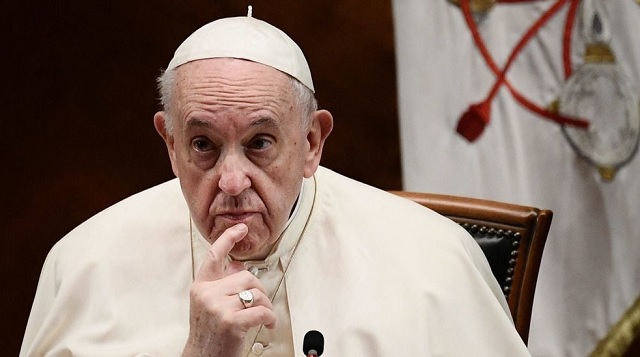
Pope Francis Declares ‘Gender Ideology’ As ‘Dangerous’ To Civilization

Pope Francis said in an interview published Friday that “gender ideology” is among the “most dangerous ideological colonizations” today, according to a recent interview with La Nacion, an Argentinian media outlet.

The pope has made waves recently with some of his comments on LGBTQ issues, most recently saying that homosexuality, while a sin, should not be criminalized. Francis said that “gender ideology” has created one of the most “dangerous” ideologies in recent history because of the way it blurs the lines between men and women, according to a translation of his remarks to La Nacion by the Catholic News Agency.

Francis explained that “all humanity is the tension of differences” and worried about how “gender ideology” had virtually eliminated those differences between men and women.

“Why is it dangerous?” Francis said. “Because it blurs differences and the value of men and women. The question of gender is diluting the differences and making the world the same, all dull, all alike, and that is contrary to the human vocation.”

The pope said that the idea of allowing people to identify as male, female or nonbinary reminded him of a 1907 book titled “Lord Of The World” by Monsignor Robert Hugh Benson. Francis explained the book showed a future where “differences are disappearing” and all things become “uniform.”

Francis also dispelled rumors that he had been asked to write a document on the topic of gender, noting that he “always distinguish[es] between what pastoral care is for people who have a different sexual orientation and what gender ideology is,” according to La Nacion. The pope called people who believe that radical gender ideology is “the path of progress” rather “naive.”

Francis has been criticized in the past due to remarks he has made about transgenderism and acceptance of same-sex marriage, according to the Catholic News Agency. In 2020, the pope said that he would be in favor of a “civil union law” for same-sex couples, and in January 2022 encouraged parents to not “condemn” their children over sexual orientation.

Most recently, he criticized the Church for becoming caught up in political debates, warning that the “Gospel is not an ideology.”

“[T]he Gospel is a proclamation that touches your heart and makes you change your heart, but if you take refuge in an idea, in an ideology, whether right or left or centre, you are making the Gospel a political party, an ideology, a club of people,” the pope said.

The Vatican did not immediately respond to the Daily Caller News Foundation’s request for comment.

AUTHOR

KATE ANDERSON

Contributor.

RELATED ARTICLES:

Ireland: Catholic Schools group denounces plans to teach children transgenderism

Catholic University Holds ‘Reproductive Justice’ Series Pushing Pro-Abortion, Transgender Ideology

‘We Were Wrong’: Pioneer In Child Gender Dysphoria Treatment Says Trans Medical Industry Is Harming Kids

Parents Fight Elite High School’s Lottery System Used To Increase Diversity

EDITORS NOTE: This Daily Caller column is republished with permission. ©All rights reserved.

All content created by the Daily Caller News Foundation, an independent and nonpartisan newswire service, is available without charge to any legitimate news publisher that can provide a large audience. All republished articles must include our logo, our reporter’s byline and their DCNF affiliation. For any questions about our guidelines or partnering with us, please contact licensing@dailycallernewsfoundation.org.

Repentance for Sin and Sacramental Absolution

Thomas G. Weinandy, OFM, Cap.: We need evermore deeply to repent of our sins, confess them humbly, and resolve more ardently never to commit them again.


It’s been widely reported that Pope Francis told seminarians from Barcelona, Spain, in an unscripted talk, that they must not “be clerical, to forgive everything.”  Such must be the case even “if we see that there is no intention to repent, we must forgive all.”  In denying “absolution” to someone who is unrepentant, “we become a vehicle for an evil, unjust, and moralistic judgment.”  Priests who withhold absolution to the unrepentant are “delinquents.”

At one point, Francis referred to such priests, whom he finds detestable, in a crude and obscene manner. (For an example of the reporting, click here.)

The scenario, as portrayed by Francis, of an unrepentant sinner going to Confession is extremely rare.  It does, nonetheless, pose an important doctrinal issue.

The sacrament of Penance or Reconciliation is a sacrament of God’s mercy.  Although baptism cleanses the faithful from all sin, it is readily evident that we continue to sin, and sometimes we may commit mortal sins, which separate us from God.  To obtain God’s merciful forgiveness for such serious sins, we are obliged to confess our sins within the sacrament of Penance.

The Catechism of the Catholic Church states: “Christ instituted the sacrament of Penance for all sinful members of the Church: above all for those who, since Baptism, have fallen into grave sin, and have thus lost their baptismal grace.” (¶ 1446).  God’s mercy is always present within the sacrament of Reconciliation.

That being said, there is, nonetheless, a prerequisite condition on the part of the sinner for obtaining God’s merciful pardon – the need for sorrowful repentance and the desire not to sin again.  Quoting the Council of Trent, the Catechism declares: “Among the penitent’s acts contrition occupies first place.  Contrition is ‘sorrow of the soul and detestation for the sin committed, together with the resolution not to sin again’” (¶1451).  Moreover, The Code of Canon Law states that, for penitents to receive “the saving remedy of the sacrament of penance, they must be so disposed that, repudiating the sins they have committed and having the purpose of amending their lives, they turn back to God.” (Canon 987)

Pope Francis’s impromptu declaration that absolution should be given even to those who are unrepentant is absolutely contrary to the Church’s living apostolic tradition, one that is found in the Catechism, and has been defined by the Council of Trent and enshrined in Canon Law.

The question can, nonetheless, be asked: Why is repentance (and the intention not to sin again) necessary for receiving sacramental absolution by the ministry of the priest?  Is there an intrinsic inter-relationship between repentance and absolution?  Or is the need for repentance merely an arbitrary law instituted by the Church, and so not essential to receiving sacramental absolution?

Pope Francis, it would seem, affirms the latter.

If a person were not sorry for his/her sins, it would seem obvious that sacramental absolution could not be given.  The desire for sacramental absolution implies and presupposes that penitents recognize that they have sinned and now wish that God, in his compassionate mercy, will forgive them.

God’s merciful forgiveness is ever-present within the sacrament of Reconciliation, and the priest is ever-willing to absolve sins, most of all, mortal sins.  Yet, it is sacramentally impossible to obtain God’s loving and merciful forgiveness, if one is not repentant for the sins committed.

While Francis may want to be merciful by suggesting that unrepentant sin be absolved, he is, nonetheless, morally “delinquent,” since the person continues to remain guilty of the sins that he or she committed.  Such is particularly the case, if one is in mortal sin.  Thus, the pope’s exhortation is pastorally irresponsible and could be spiritually deadly, for unrepentant persons may think they were absolved when, in fact, they were not.

The Scriptures bear witness to the obligatory relationship between repentance and forgiveness.  Mark’s Gospel tells us that after John had been arrested, Jesus went into Galilee and proclaimed: “The time is fulfilled, and the kingdom of God is at hand; repent, and believe in the gospel.” (Mk. 14-15)  Repentance is requisite for entering into God’s kingdom, for it is a kingdom of God’s merciful forgiveness and the source of a holy life.

In Luke’s Gospel, Jesus narrates the parable of the Prodigal Son.  The younger son asks for his share of his father’s inheritance.  Having received it, he goes off into a far country where he lives a profligate sinful life.  When he came to his senses, he realizes that he needs to repent and return to his father, “I will arise and go to my father, and I will say to him. ‘Father, I have sinned against heaven and before you.’” (Lk. 15:18)

Upon seeing his son at a distance, the merciful father rushes out to greet him, and lovingly, with rejoicing, takes him back into his household.  Yes, the father was merciful, but the father could only manifest his mercy when his delinquent son returned to him in repentance.  If he had not returned, the father would have never been able to enact his ever-compassionate mercy.

The same is true with regard to God our Father.  Unless we return to him in repentance, he is incapable of enacting his merciful pardon by means of the sacrament of forgiveness.  Pope Francis, by separating the human act of repentance from the divine act of forgiveness, has made God’s mercy null and void.

In light of all of the above, the lesson for all of us is that we need evermore deeply to repent of our sins, confess them humbly, and resolve more ardently never to commit them again.  In so doing, the sacramental absolution of the priest will marvelously manifest to us the ever-present abundant mercy of God the Father, made visible in Jesus Christ his Son, and sealed in the love of the Holy Spirit.

You may also enjoy:

David W. Fagerberg’s A Good Death

Fr. Timothy V. Vaverek’s Without ‘Metanoia’ We Perish

AUTHOR

Fr. Thomas G. Weinandy, OFM, Cap.

Thomas G. Weinandy, OFM, a prolific writer and one of the most prominent living theologians, is a former member of the Vatican’s International Theological Commission. His newest book is the third volume of Jesus Becoming Jesus: A Theological Interpretation of the Gospel of John: The Book of Glory and the Passion and Resurrection Narratives