
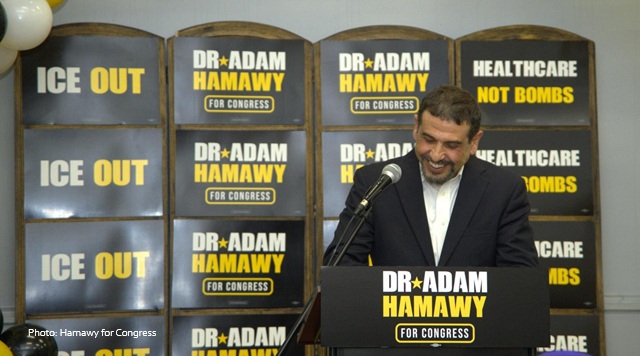
New Jersey Congressional Candidate Adam Hisham Hamawy: Devotion or Apostasy?
Egyptian-born Adam Hisham Hamawy recently won the New Jersey Democrat primary and is now the Democrat candidate for the U.S. Congressional 12th District Seat in New Jersey. Hamawy is also a Muslim. Should he win, he will take an oath of office that includes swearing to support the U.S. Constitution.
However, as I showed in my 2019 book Islamic Doctrine versus the U.S. Constitution: The Dilemma for Muslim Public Officials,[1] there are many core tenets of Islam that are in irreconcilable conflict with much of our U.S. Constitution.
As a result, in December 2019 I started the Muslim Oath Project,[2] in which I sent four questions to Muslim political candidates and office holders. Each question required a choice between the U.S. Constitution/American Law or Islamic Doctrine.[3] Since then I have sent these four questions to 267 Muslim political candidates and officer holders; 250 would not express support for the U.S. Constitution, and of the 17 who did express such support, six would not give me permission to identify them.
On June 2, 2026, I emailed the four questions to candidate Hamawy at the following email address: Information@hamawyfornj.com. Receiving no reply, I again emailed the four questions to Hamawy on June 7, 2026; he had now won the Democrat primary. As of June 21, 2026, I have not received any reply.
In a June 10, 2026, article in which Hamawy was questioned about testifying for the defense at the trial of Omar Abdle-Rahman (who was convicted of orchestrating a bombing plot against the United Nations and other landmarks, and was linked to the 1993 World Trade Center bombing), Hamawy replied,
I swore an oath as an officer of the United States Army to defend and protect the Constitution of the United States, and I believe in a system of justice and laws that exist,” Hamawy said. “I testified under oath about events that happened. And I stand by that.[4]
Hamawy was a Lt. Colonel in the United States Army, and here is the Oath of Commissioned Officers that he took:
I ___, do solemnly swear (or affirm) that I will support and defend the Constitution of the United States against all enemies, foreign and domestic; that I will bear true faith and allegiance to the same; that I take this obligation freely, without any mental reservation or purpose of evasion; and that I will well and faithfully discharge the duties of the office on which I am about to enter. So help me God.[5]
So at some point in his military career Hamawy had taken an oath to support and defend the U.S. Constitution and bear true faith and allegiance to it; and his obligation had been taken freely, without any mental reservation or purpose of evasion. And on June 10 he confirmed he had taken such an oath.
At some point, Hamawy had also become a U.S. citizen, and had taken an oath that included the following:
I hereby declare, on oath, that…I will support and defend the Constitution and laws of the United States of America against all enemies, foreign and domestic; that I will bear true faith and allegiance to the same… so help me God.[6]
Since he had taken such oaths, why would he not respond to the four questions that required a choice between the U.S. Constitution/American Law or Islamic Doctrine? One would think that because of his oaths to defend and support the U.S. Constitution, the answers would be simple: for each question it would be the U.S. Constitution/American Law.
But there was a difference between his taking two oaths and his answering my four questions. In the first place, the two oaths simply required a verbal statement of support for the U.S. Constitution, ending with “so help me God.” However, as I pointed out in my book Islamic Doctrine versus the U.S. Constitution: The Dilemma for Muslim Public Officials, for an oath to be valid under Islam it must be sworn in the name of Allah or in the name of one of his attributes, such as the All-Merciful, or the Knower of the Unseen. So, when Hamawy uttered the words “so help me God” in his oaths, was he referring to Allah, the god of Islam? As I noted in my book,
The words “so help me God” were added by the U.S. Congress to federal oaths of office during a time that saw an increase in Christian religious sentiment. Is there any support for the idea that when these words were added, the word “God” was also meant to include the Muslim god Allah? The answer is “No,” because the God of Christians and Jews, and Islam’s god Allah are not the same… Taking into consideration the religious environment of 19th Century America, there is no support for any claim that during a period of increased Christian religious sentiment, the word “God” that was then applied to oaths and stamped on coins would include the deity of a separate religion that was openly hostile to Christians and Jews.[7]
But what if Muslims claim that when they swear to support the U.S. Constitution they are personally referring to Allah, the god of Islam, when they say the words “so help me God” in their oath of office?
In the first place, Muslims are generally advised against using any other word than “Allah” when referring to the god of Islam. For example:
But what the Muslim should use in his worship… and all other circumstances when referring to Allah, may He be exalted and glorified, is the word “Allah” as it is, because that has become a symbol for the Muslims and something that distinguishes them, and it helps to avoid any confusion between what they mean and what others mean when they say “God” [my emphasis], as others may sometimes be referring to Allah, but sometimes they may be referring to something else… when offering du‘aa’ or swearing oaths, he has to avoid doing that with words other than the known Arabic words for the divine names and attributes [my emphasis], as they are confirmed in the Qur’aan [sic] and Sunnah.[8]
So according to this ruling, Muslims are supposed to use the name Allah instead of God in order to differentiate themselves from what non-Muslims mean when those non-Muslims say God. And this applies to swearing an oath. This underlines again the fact that Allah is not the same as the God of Jews and Christians.
In the second place, there are many tenets of the U.S. Constitution that are in direct conflict with many tenets of Islamic Doctrine. So how can a Muslim swear to Allah, the god of Islam, that he will support a document that in large part is in direct conflict with many of the teachings and commands of Allah?
This means that when Muslims swear to support the U.S. Constitution and end that oath with the words, “so help me God,” they are in reality giving an oath to someone other than Allah. And according to Islamic Doctrine, that oath is therefore neither valid nor binding.
And Islam actually allows Muslims to publicly take an oath and invalidate it at the same time or later, for example:
- Islamic Doctrine teaches that even though an oath is sworn in the name of Allah, it is not necessarily binding if something better happens to come along or the oath causes a hardship for the oath taker.
- If a Muslim swears an oath and silently includes the phrase Inshah’ Allah (if Allah wills) as part of that oath, then the oath is not binding.
- Muhammad said that the meaning of an oath is determined by the intentions of the one making it. Such an approach undermines the idea that there is a bond of common understanding between not only those who are taking the same oath, but also those who are witnessing it.[9] The modern Minhaj Al-Muslim provided an example of this under the heading The Oath is based upon the Intention of the One Who swore to It:
The consideration in swearing and not swearing is based upon the intention of the one who is swearing the oath, as actions are based upon intentions and every person will get what he intended. So whoever swears that he will not sleep on the ground and he means the bed [my emphasis], then his oath is considered based upon his intent. Therefore, he has not broken his oath as long as he does not sleep on the bed.[10]
In this example someone would be hearing a Muslim swear an oath specifying one subject while that Muslim was inwardly, and silently, directing that oath toward a completely different subject!
- When it comes to taking an oath of citizenship to a non-Muslim country, there is an important stipulation mentioned in Fatwa 83407 by the Assembly of Muslim Jurists of America:
There is no harm in citizenship if it is taken as means of organizing the affairs of the residents outside the lands of Islam and establishing da’wah and founding their institutions. This is so long as its (the citizenship’s) possessor keeps his loyalty to his creed and nation (i.e. Islam and the Muslims)…[11]
And we also have two verses in the Koran that allow Muslims to lie to non-Muslims, as long as they stay true to Islam in their hearts (Koran 3:28 and 16:106). So, for Muslims to take an oath in the United States is an easy matter because according to their religion, that oath can simply be not binding.
However, my four questions did not involve an oath, and simply required Hamawy to choose between the U.S. Constitution/American Laws or Islamic Doctrine. Koran 3:28 and 16:106 provide all the doctrinal basis needed if Hamawy wanted to lie and claim he supported the U.S. Constitution/American Laws over the commands of Allah and the teachings and example of Muhammad.
However, these two Koran verses focus on Muslim relations with non-Muslims. In running for office, Hamawy is also reaching out to other Muslims for support, which complicates matters when it comes to the idea of lying to non-Muslims.
My four questions required him to make a public choice between two answers, each with different ramifications. If, as a devout Muslim, he said that he would choose Islamic Doctrine as the answer to each of the four questions, he would make Muslims happy but could risk losing support among non-Muslims. And, if by chance he was subsequently elected, it could make for a very awkward moment when during his oath of office, he was expected to swear to support and defend the U.S. Constitution. And if he nevertheless swore that oath of office, questions could be raised about his honesty and the possibility of perjury.
On the other hand, if he, as a devout Muslim, said that he would choose the U.S. Constitution/American Laws as the answer to each of the four questions, based on the right to lie to non-Muslims given him by Koran 3:28 and 16:106, he would probably win a lot of support among non-Muslims, but face a different issue with his fellow Muslims: by giving the man-made laws of the United States supremacy over the commands of Allah and the teachings and example of Muhammad he would appear to have left Islam and become an apostate. And according to Islamic Doctrine, if he did not return to Islam in three days, he could be killed.[12]
Yet how could Hamawy let all of his fellow Muslims know that, in his defense, he was availing himself of Koran 3:28 and 16:106?
So by asserting the supremacy of American man-made laws over Islamic Doctrine, Hamawy could possibly endanger his own life by provoking the ire of one or more devout Muslims who understood, as did Yusuf Al-Qaradawi, a preeminent Egyptian scholar, and in 2013 then-head of the International Union of Muslim Scholars, that if the punishment for apostasy had not been death, Islam would not have long survived after the death of Muhammad. Al-Qaradawi said:
If they had gotten rid of the apostasy punishment Islam wouldn’t exist today. Islam would have ended since the death of the prophet, peace be upon him. So opposing apostasy is what kept Islam to this day. Surah Al-Ma’idah says: The punishment of those who wage war against Allah and His apostle is that they should be murdered or crucified. According to Abi Kulaba’s narration, this verse means the apostates. And many hadiths, not only one or two, but many, narrated by a number of Muhammad’s companions state that any apostate should be killed.[13]
So why has Hamawy declined to answer the four questions? I suggest it was because he either did not want to lose support among non-Muslims and have his integrity questioned if he was later elected and took his oath of office, or he was concerned about the reaction among his fellow Muslims if it appeared he had become an apostate.
Which is it, Mr. Hamawy?
AUTHOR
Dr. Stephen M. Kirby, PhD
Dr. Stephen M. Kirby is the author of six books and numerous articles about Islam. His latest book is Islamic Doctrine versus the U.S. Constitution: The Dilemma for Muslim Public Officials.
SOURCES
[1] Stephen M. Kirby, Islamic Doctrine versus the U.S. Constitution: The Dilemma for Muslim Public Officials (Washington D.C.: Center for Security Policy Press, 2019), https://centerforsecuritypolicy.org/csp-press-releases-primer-on-islamic-doctrine-versus-the-u-s-constitution/
[2] https://www.liberato.us/muslim-oath-project.html
[3] Here are those four questions:
No. 1: Will you go on record now and state that our 1st Amendment right to freedom of speech gives the right to anyone in the United States to criticize or disagree with your prophet Muhammad, and will you also go on record now and state that you support and defend anyone’s right to criticize or disagree with your prophet Muhammad, and that you condemn anyone who threatens death or physical harm to another person who is exercising that right?
No. 2: Our 1st Amendment guarantees freedom of religion in the United States. As part of that freedom, anyone in the United States has the right to join or leave any religion, or have no religion at all. Will you go on record now and state that you support and defend the idea that in the United States a Muslim has not only the freedom to leave Islam, but to do so without fear of physical harm, and will you also go on record now and state that you condemn anyone who threatens physical harm to a Muslim who is exercising that freedom?
No. 3: According to the words of Allah found in Koran 5:38 and the teachings of your prophet Muhammad, amputation of a hand is an acceptable punishment for theft. But our U.S. Constitution, which consists of man-made laws, has the 8th Amendment that prohibits cruel and unusual punishment such as this. Do you agree with Allah and your prophet Muhammad that amputation of a hand is an acceptable punishment for theft in the United States, or do you believe that our man-made laws prohibiting such punishments are true laws and are to be followed instead of this 7th Century command of Allah and teaching of Muhammad?
No. 4: According to the words of Allah found in Koran 4:3, Muslim men are allowed, but not required, to be married to up to four wives. Being married to more than one wife in the United States is illegal according to our man-made bigamy laws. Do you agree with Allah that it is legal for a Muslim man in the United States to be married to more than one woman, or do you believe that our man-made laws prohibiting bigamy are true laws and are to be followed instead of this 7th Century command of Allah?
These questions are in brochure form at https://islamseries.org/wp-content/uploads/2020/04/islamic-doctrine-versus-the-u.s.-constitution-four-questions-for-muslim-public-officials-and-candidates.pdf.
[4] Joanna Gagis, “Hamawy on primary win, criticism on testimony for militant cleric,” NJ Spotlight News, June 10, 2026, https://www.njspotlightnews.org/2026/06/hamawy-on-primary-win-criticism-on-testimony-for-militant-cleric/.
[5] https://www.army.mil/values/officers.html
[6] https://www.uscis.gov/policy-manual/volume-12-part-j-chapter-2
[7] Islamic Doctrine Versus the U.S. Constitution: The Dilemma for Muslim Public Officials, pp. 17-18.
[8] “Translating the names and attributes of Allah into other languages and swearing by them,” Islam Question & Answer, April 16, 2012, https://islamqa.info/en/answers/171528/translating-the-names-and-attributes-of-allah-into-other-languages-and-swearing-by-them.
[9] Islamic Doctrine Versus the U.S. Constitution: The Dilemma for Muslim Public Officials, pp. 20-33.
[10] Abu Bakr Jabir Al-Jaza’iry, Minhaj Al-Muslim, Vol. 2 (Riyadh, Kingdom of Saudi Arabia: Darussalam, 2001), pp. 455-456.
[11] Dr. Main Khalid Al-Qudah, “Can we take the citizenship oath?” Assembly of Muslim Jurists of America, December 27, 2010, https://www.amjaonline.org/fatwa/en/83407/can-we-take-the-citizenship-oath.
[12] Islamic Doctrine Versus the U.S. Constitution: The Dilemma for Muslim Public Officials, pp. 59-62.
[13] “Topic: If they had gotten rid of the apostasy punishment Islam wouldn’t exist today,” CEMB forum, April 1, 2013, https://www.councilofexmuslims.com/index.php?topic=23759.0.
Leave a Reply
Want to join the discussion?Feel free to contribute!