
When a Warning Becomes History
Jamie Glazov unveils the unholy alliance that came into full view after October 7.
Some books explain their moment. Rarer books explain a moment that has not yet arrived. When Jamie Glazov first published United in Hate in 2009, his central contention seemed almost deliberately paradoxical. Why would the radical Western Left, ostensibly devoted to sexual liberation, feminism, secularism and individual autonomy, repeatedly find common cause with Islamist movements whose governing principles repudiated nearly all of those things? The alliance appeared intellectually incoherent. Glazov argued that the contradiction was superficial. Beneath it lay something deeper: a shared appetite for the destruction of the existing Western order.
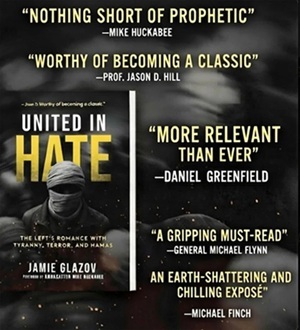
Seventeen years later, the revised and expanded United in Hate: The Left’s Romance with Tyranny, Terror, and Hamas arrives in a world that has supplied Glazov with an inauspicious vindication. The demonstrations that followed Hamas’s October 7th massacre, including expressions of sympathy for Hamas and hostility toward Israel across Western campuses and streets, transformed what had once looked like an eccentric political alliance into an observable phenomenon. The new edition makes October 7th the culmination of an argument Glazov had already constructed long before the attack.
The book begins, significantly, not with Hamas but with Glazov’s own family. His parents, Yuri and Marina Glazov, were Soviet dissidents. His father signed the 1968 “Letter of Twelve” protesting Soviet abuses; his mother circulated samizdat. The family escaped the Soviet Union and arrived in America in 1972. What astonished the young Glazov was discovering Western intellectuals who regarded the society that had liberated his parents with contempt while romanticizing the system from which they had escaped.
That biographical foundation is essential. Glazov does not approach totalitarianism primarily as an economic error or a defective governmental arrangement. He approaches it psychologically. His subject is what he calls “the believer”: the person alienated from his own society who finds in a transcendent political cause an escape from the burdens of the individual self. Drawing particularly on Eric Hoffer, Glazov argues that the attraction of mass movements lies partly in self-renunciation—the possibility of dissolving an unsatisfactory identity into something supposedly larger and purer.
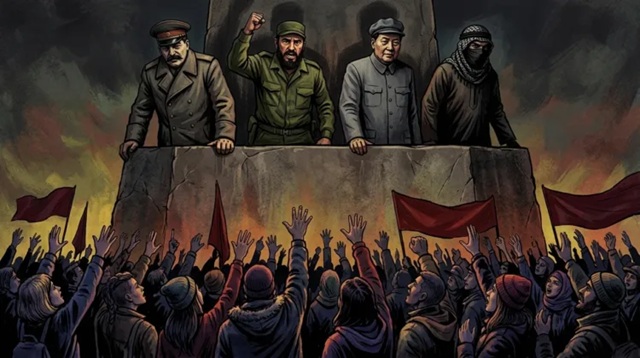
From there, United in Hate undertakes an extensive historical tour of the Western Left’s romance with tyranny: Stalin, Castro, Ho Chi Minh, Mao and the Sandinistas. Glazov’s point is not simply that Western intellectuals occasionally made embarrassing political judgments. His indictment is more severe. Again and again, he argues, evidence of repression did not end the romance because the repression itself belonged to the revolutionary project. Destruction could be rationalized as the necessary precondition for rebirth.
This is where Glazov’s argument becomes more interesting than a conventional catalogue of fellow-travelling. The book asks why destruction possesses such enduring attraction. The revolutionary dream requires a corrupted existing world and a purified future one. Between the two stands catastrophe. Violence becomes not an unfortunate failure of utopian politics but its recurrent sacrament.
Glazov then turns to what he regards as the Left’s “death cult cousin”: Islamism. The book’s architecture is deliberate. Chapters on communist tyranny precede sections entitled “Yearnings for Death and Suicide,” “To Hate a Woman,” “Killing and Dying for Purity” and “To Hate a Jew”; these in turn lead into the final section, “Romance with Terror.”
His contention is not that Marxism and Islamism possess identical doctrines. Manifestly they do not. One is materialist and atheist, the other religious and transcendental. Their respective visions of the ideal society would eventually collide. Glazov instead identifies a psychological and political affinity: hostility toward liberal Western civilization, contempt for bourgeois individualism, the elevation of collective identity over the individual, purification through struggle, and a willingness to romanticize violence directed at a common adversary.
That distinction matters. Coalitions do not require their members to agree about the society they intend to construct after victory. Sometimes it is enough that they agree about what must first be destroyed.
The Jew becomes particularly important to Glazov’s analysis because antisemitism supplies one of the most indelible bridges between these ostensibly incompatible movements. The Islamist may arrive through theological or conspiratorial Jew-hatred; the radical Leftist through anti-colonialism, anti-Zionism or theories of oppressive power. The vocabularies differ, yet they can converge upon Israel and, eventually, upon Jews themselves. Hence the progression from the book’s earlier chapter “To Hate a Jew” to the later “Bonds of Jew Hate.”
October 7th is therefore not an appendix bolted awkwardly onto an old argument. It is the book’s test case. Glazov recounts the massacre itself before turning to the reactions it produced. His endnotes draw upon survivor testimony and reporting on the killing, hostage-taking and sexual violence, followed by contemporary statements and political reactions after the attack. The point is not merely that Israel was criticized after October 7th; democratic governments are always legitimate objects of criticism. The phenomenon requiring explanation was the speed with which portions of the activist Left moved morally past the perpetrators and toward an indictment of the society that had just been attacked.
Here Glazov’s earlier work becomes difficult to ignore. The behavior that shocked commentators in 2023 was precisely the behavior his book had spent hundreds of pages attempting to explain: the revolutionary instinct to locate virtue in forces arrayed against the West, even when those forces embody principles the Western Left would otherwise claim to abhor.
There are places where Glazov’s psychological categories are painted broadly. Political movements contain opportunists, conformists, idealists, careerists, true believers and people who have simply reasoned badly; no single diagnosis can exhaust them. Glazov himself acknowledges early in the book that he is concerned principally with the hard or radical Left rather than with liberalism as such, explicitly distinguishing figures such as Harry Truman and Walter Reuther from the political tendency he is examining. That qualification is important and should remain in the reader’s mind.
Yet the breadth of Glazov’s thesis is also what makes the book valuable. He is attempting something larger than political reportage. United in Hate asks us to regard ideological attraction as a problem of human nature. People do not always support political movements because those movements advance their material interests or consistently embody their professed values. Sometimes they are attracted to power, transgression, purification, revenge and the possibility of escaping themselves.
This makes Glazov considerably less sanguine about political rationality than most conventional analysts. One cannot understand the attraction of tyranny, in his telling, merely by showing that tyranny fails. Failure may have little relevance to a movement whose deepest emotional rewards are supplied by struggle itself.
There is also something deeply personal beneath the book’s acidulous political argument. Its final dedication returns to Glazov’s grandfather, Gregory Rafalsky, a Soviet army doctor who disappeared after leaving for the front in 1941. Before departing Moscow, he insisted that his three-year-old daughter—Glazov’s future mother—be removed from the hospital where she was being treated. German bombs destroyed the hospital that night. No children survived. Rafalsky never returned.
That story changes the emotional temperature of the book. United in Hate is ultimately written by the descendant of people who encountered totalitarianism not in seminars but in prisons, war, exile and disappearance. Glazov therefore has little patience for the intellectual’s perennial romance with distant revolutionary violence.
The great question raised by the new edition is whether the West has learned anything from that history. October 7th supplied an answer Glazov plainly regards as devastating. The names of the movements have changed. Their banners have changed. Their theological commitments may be irreconcilable. Yet the old temptation—to discover moral glamour in the enemies of one’s own civilization—has survived every exposure of its consequences.
The achievement of United in Hate is not that every part of its diagnosis must be accepted. Serious books ought to invite argument. Its achievement is that the question Glazov asked in 2009 can no longer be dismissed as fanciful:
Why do political movements that appear to have almost nothing in common repeatedly discover that hatred of the same civilization is enough to bring them together?
After October 7th, that is no longer merely Glazov’s question. It is ours.
AUTHOR
Aaron Shuster
Aaron J. Shuster is a writer, producer, philosopher and cinematist. His work focuses on moral clarity, political inversion, and the intersection of history, ideology, and Western civilizational ethics.
RELATED ARTICLES:
Speaker Mike Johnson: Don’t Support Anti-God Socialism This November
The Letter Virginia Pastors Want Every Voter to Read Before Nov. 3
©2026 Jamie Glazov. All rights reserved.
Order Jamie Glazov’s new book, ‘United in Hate: The Left’s Romance with Tyranny, Terror, and Hamas’: HERE.
Leave a Reply
Want to join the discussion?Feel free to contribute!