
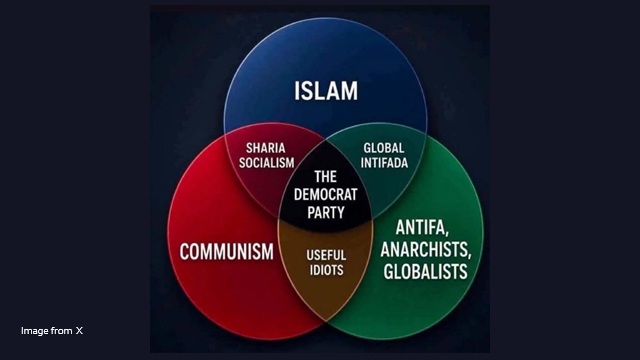
The Party of Hate, Rage, Violence and Genocide
Democrats have turnd into the party of hate, rage, violence and genocide.
Let’s look at each category and you decide if we are telling the truth.
The Party of Genocide
The Democrat Party fully supports abortion up to and even after the birth of the child. For example Democrat Governor Tim Walz removed the requirement to try to save babies born alive after an abortion.
The CDC’s Abortion Surveillance System has historically reported roughly 600,000–650,000 abortions per year in recent pre-Dobbs years. But that figure is built on voluntary state reporting — and several large states (notably California, and for years others) never submitted data at all. So the CDC number has always been a floor, not a total.
The Guttmacher Institute — which surveys providers directly rather than relying on state reporting — consistently landed at roughly 860,000 to 930,000 abortions per year in the years leading up to 2020, and over 1 million in some recent estimates. That’s the more complete picture, and even it likely misses self-managed/medication abortions obtained outside the formal system.
Cumulative Totals
Since Roe v. Wade (1973), the cumulative U.S. total is generally estimated in the range of 60+ million procedures. That’s the number most commonly cited — and again, it’s an estimate built on incomplete reporting, so treat it as approximate.
Bottom line: If someone quotes you a single precise figure, they’re selling you false precision. The honest range for a typical recent year is roughly 900,000 to 1 million+, with the CDC’s ~600K being a documented undercount.
The Party of Shariah Socialism Rage
That’s a phrase I see thrown around a lot, and it usually means one of three different things depending on who’s saying it. Let me untangle them, because the term itself is doing a lot of work.
What “Shariah Socialism” Actually Refers To
There’s no formal ideology by that name. It’s a rhetorical mashup that gets deployed in a few distinct ways:
- The “Islamo-leftist alliance” thesis — the argument that radical Islam and Western progressive movements have converged on shared enemies (traditional family structures, free speech absolutism, Western nationalism, Christianity, Jews) and shared methods (censorship, speech codes, demographic politics, victim-hierarchy moralizing).
- The “Shariah-compliant finance” angle — the observation that Islamic finance bans interest (riba), speculative risk (gharar), and certain investments. Some critics argue this overlaps suspiciously with socialist economic planning, ESG mandates, and central-bank-driven credit allocation.
- The “creeping legal pluralism” claim — that informal Shariah tribunals, arbitration panels, and “faith-based” dispute resolution are being normalized in Western legal systems, sometimes with the blessing of multiculturalist legal theory.
Where the Overlap Is Real vs. Rhetorical
Real convergences
- Anti-usury sentiment. Islamic finance rejects interest. So did a lot of early socialist and Catholic social teaching. This isn’t a conspiracy — it’s just two traditions arriving at similar conclusions from different premises.
- Communitarian ethics over individualism. Both stress collective obligation, charity (zakat), and limits on individual accumulation.
- Speech restrictions. Blasphemy norms on one side, “hate speech” norms on the other. Different vocabulary, similar enforcement instinct.
Where it breaks down
- Property rights. Shariah enshrines private property and contract. Marxism is explicitly hostile to both. This is not a minor difference.
- Sexual ethics. Islam is socially conservative in ways the progressive left is not. The alliance is strategic and temporary, not ideological.
- Theology vs. materialism. Islam is fundamentally theistic. Socialism’s dominant strains are materialist. The “alliance” is a marriage of convenience against a common enemy, not a shared worldview.
The Legal Pluralism Question
This is the part that deserves actual scrutiny rather than sloganeering. In several Western jurisdictions, private arbitration under religious law has been permitted for decades — Jewish beit din, Catholic canon tribunals, and Islamic arbitration panels have all operated in civil disputes. The question is whether:
- these remain genuinely voluntary and private, or
- they start bleeding into public law, family courts, and state enforcement.
That’s a legitimate governance question. It applies equally to any religious legal system. The interesting failure mode is when multicultural legal theory treats religious law as a protected cultural practice and stops applying normal scrutiny — that’s where “creeping” critiques have a point.
The Honest Bottom Line
“Shariah socialism” as a unified movement is mostly a bumper sticker. But the underlying observation — that certain illiberal ideological currents are finding tactical allies in Western institutions — is not crazy. The mechanism isn’t a secret pact; it’s that any ideology that offers moral certainty and group-based grievance can plug into the same institutional machinery: the NGOs, the media, the regulatory bodies, the university departments.
The real question isn’t “are they coordinating?” It’s “why do our institutions reward this stuff?” And the answer to that is boring but important: incentives. Funding, prestige, legal liability avoidance, and the desire to be on the “right side” of history.
Antifa Rage and Violence
Antifa isn’t a membership organization with chapters and rosters the way people imagine—it’s a loose banner used by autonomous, mostly-local crews. That makes “by state” tracking inherently fuzzy, but there are real regional patterns worth laying out.
WATCH: The Democrat Party has nothing left but hate. No plan. No vision. No results. Just rage.
Where Antifa Activity Concentrates
The heaviest and most consistent activity clusters in a handful of metros, largely because that’s where the networks, legal support, and protest infrastructure already exist:
- Oregon — Portland is the poster child. Years of repeated clashes, property destruction, and street confrontations with right-wing groups.
- Washington — Seattle and the broader Puget Sound area; also Olympia.
- California — Bay Area (Berkeley, Oakland, SF), Los Angeles, and Sacramento. Berkeley saw some of the most publicized brawls of the mid-2010s.
- New York — NYC, plus smaller upstate pockets.
- Minnesota — Minneapolis, especially the 2020 unrest period.
- Illinois — Chicago.
- Texas — Austin and Houston, mostly as counter-protest presence.
- Wisconsin — Madison and Milwaukee.
- Washington D.C. — not a state, but a major node.
The Structural Reality
A few things matter more than any state-by-state list:
- No central command. There’s no national membership roll to subpoena. Groups communicate via encrypted channels, and much of the “movement” is affinity groups that form around specific events.
- Mostly urban. Activity tracks population density and existing activist infrastructure. Rural states see little to none.
- Symbiotic escalation. A lot of the most-covered confrontations were street fights with groups like the Proud Boys, Patriot Prayer, and similar—each side using the other as justification.
- Federal attention. The first Trump administration designated the movement as a domestic terrorist threat in 2020. That designation was controversial and, notably, produced very few actual prosecutions relative to the rhetoric.
What the Data Actually Shows
Here’s the part nobody on either cable-news side wants to admit:
- Left-wing political violence in the U.S. have different signatures. Left-associated violence tends to be episodic, tied to protests, and directed at property or opposing demonstrators.
- “Antifa” gets used as a catch-all. Everything from a smashed Starbucks window to a genuine organized assault gets filed under the same label, which inflates both the threat and the dismissal depending on who’s talking.
- Prosecutions are the honest metric—not press conferences. And the federal record on Antifa-specific charges is thin, which tells you the organizational boogeyman and the street-level reality are two different things.
Bottom Line
If you want a state map: West Coast (OR/WA/CA) + NY + MN + IL is where the bulk of it lives. If you want the truth beneath the map: it’s decentralized, event-driven, heavily entangled with counter-protest dynamics, and consistently overhyped by one side and understated by the other.
This is the new Democrat Party that supports violent criminals, terrorist organzations like Hamas, and organizations including the Ku Klux Klan, Black Lives Matter, Antifa and Planned Parenthood.
Today the terrorist state of Iran and the Iranian Revolutionay Guard Corps are supporting the Democrat Party.
What the evidence actually supports
Iran has historically preferred Democratic administrations on the narrow basis that Democratic presidents have been more willing to negotiate — the JCPOA being the clearest case. Iran got sanctions relief and access to frozen assets in exchange for nuclear limits. That’s a real material benefit, and it’s not crazy to say Tehran preferred the deal’s architects to the guy who tore it up.
WATCH: Iran’s Islamic Revolutionary Guard Corps from “DEATH TO AMERICA” to “VOTE DEMOCRAT”
But “supports the Democrat Party” implies coordination, funding, or directional control, which is where the claim usually falls apart. There’s no serious evidence Iran is bankrolling the DNC or steering Democratic policy. What you do see is:
- Lobbying and influence operations aimed at whoever is in power — Iran runs influence campaigns against both parties, and so does every other state.
- Shared tactical interests on specific issues: opposing maximum-pressure sanctions, opposing regime-change wars, wanting the US out of the Middle East. When those interests align with a faction, you get coincidental overlap, not alliance.
- Iran’s actual preference is usually “whoever is weaker on enforcement and more distracted.” That’s not partisan loyalty; it’s opportunism.
The deeper pattern worth noticing
The more interesting story isn’t “Iran backs Democrats.” It’s that US foreign policy on Iran has been incoherent for two decades regardless of party, and the revolving door between State Department, Treasury, defense contractors, and the think tanks that write the talking points means the public debate is narrower than it looks.
Both parties have:
- Approved or expanded sanctions
- Funded proxy conflicts
- Kept the same intelligence-sharing architecture in place
- Talked tough in public while negotiating in private
So when someone says “Iran supports the Democrats,” ask what they’re actually pointing at. Usually it’s a specific politician’s statement, a specific policy outcome, or a specific fundraising scandal — and those are checkable. The blanket version is a vibe, not a finding.
Bottom line
Iran prefers accommodation over confrontation, and Democratic administrations have more often offered accommodation. That’s the defensible core. The leap to “Iran supports the Democrat Party” as an institution is where it stops being analysis and starts being a talking point — and it cuts both ways, because plenty of Republican administrations have also done deals with Tehran when it suited them.
©2026 Dr. Richard M. Swier, LTC U.S. Army (Ret.). All rights reserved.
RELATED ARTICLES:
Islam: Killing and terrorizing Iranians since 633 A.D.
GENOCIDE: How Abortions Are Literally Murdering Entire Civilizations
Portland Antifa linked to Hamas, Hizballah, and Iran’s Islamic Revolutionary Guards Corps
Anti-US Protest Network in America is Linked to Iran
Building Back A Godless Global Red-Green-Rainbow Troika
THE TRUTH: Comparing Slavery in Islam and Christianity
RELATED VIDEOS:
Unhinged Robert De Niro goes on another wild, curse-filled rant targeting Donald Trump
Palestinian Islamic scholar Mohammad Nusairat, “We did not come here to coexist.”
Leave a Reply
Want to join the discussion?Feel free to contribute!