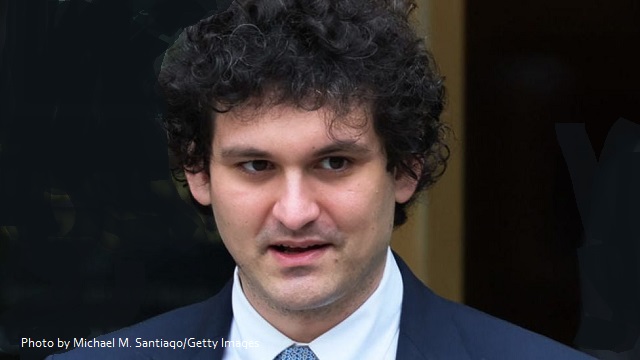
Convicted cryptocurrency fraudster Sam Bankman-Fried on Thursday received a prison sentence of 25 years.
A jury found Bankman-Fried guilty on seven counts of fraud and conspiracy-related charges in November and the New York probation department’s sentence recommendation was 100 years in prison, according to a February court filing pleading for a lighter sentence. Bankman-Fried’s lawyer had asked for a 60-78 month sentence, citing the convicted fraudster’s philanthropic ventures and Autism Spectrum Disorder (ASD).
How many years is Sam Bankman-Fried aka SBF, the former crypto poster boy who founded FTX, going to get..?
“Sam is uniquely vulnerable in a prison population. Individuals with ASD are often at considerably greater risk of physical harm and extortion in prison than other inmates,” his lawyer wrote.
Bankman-Fried co-founded and was CEO of cryptocurrency exchange FTX, which collapsed in November 2022 as it faced accusations of mishandling billions in customer money.
Prosecutors had sought a sentence of between 40 and 50 years, according to CNN. Prosecutors estimate that losses resulting from Bankman-Fried’s actions exceed $10 billion, yet with FTX’s holdings appreciating since the collapse, many customers may recover their lost funds in full.
“A lot of people feel really let down, and they were very let down, and I am sorry about that” Bankman-Fried said at his sentencing hearing Thursday, according to CNN Business. “I am sorry about what happened at every stage. And there are things I should’ve done and things I shouldn’t have.”
Bankman-Fried used FTX customer funds for “charitable contributions,” according to the August indictment against him.
“Well before Alameda or FTX ever existed, Sam committed his life to philanthropy, pledging to earn money and give it away, with the goal of “helping the world’s poorest people,’” his lawyer wrote. “Sam does not just talk about making the world a better place, he takes action.”
The convicted fraudster contributed more than $30 million overwhelmingly to support Democrat-aligned causes, and was the second-largest individual donor to them during the 2022 midterm election cycle, according to The Washington Post’s analysis of Federal Election Commission data.
He “misappropriated and embezzled FTX customer deposits, and used billions of dollars in stolen funds for a variety of purposes, including … to help fund over a hundred million dollars in campaign contributions to Democrats and Republicans to seek to influence cryptocurrency regulation,” according to the August indictment.
Bankman-Fried’s lawyer had described the 100-year sentencing recommendation “grotesque” and “barbaric” in the February filing.
Caroline Ellison, Bankman-Fried’s ex-girlfriend and former CEO of Alameda Research, the sister cryptocurrency exchange to FTX, testified that he instructed her to commit fraud by exploiting FTX and Alameda’s relationship, claiming he established a system to enable the hedge fund to withdraw unlimited funds from the cryptocurrency exchange.
All content created by the Daily Caller News Foundation, an independent and nonpartisan newswire service, is available without charge to any legitimate news publisher that can provide a large audience. All republished articles must include our logo, our reporter’s byline and their DCNF affiliation. For any questions about our guidelines or partnering with us, please contact licensing@dailycallernewsfoundation.org.
http://drrich.wpengine.com/wp-content/uploads/logo_264x69.png00The Daily Callerhttp://drrich.wpengine.com/wp-content/uploads/logo_264x69.pngThe Daily Caller2024-03-29 06:29:582024-03-29 14:40:15Dem Megadonor SBF Sentenced To 25 Years In Prison
Top executives behind a Chinese chemical manufacturer planning to build two U.S. factories belong to the Chinese Communist Party (CCP) and affiliated influence outfits, a Daily Caller News Foundation investigation has found.
Capchem Technology USA, the wholly-owned subsidiary of China-based Shenzhen Capchem Technology (Capchem), is slated to build a $120 million factory in Ohio and a $350 million plant in Louisiana. At the same time, Capchem records and social media posts that the DCNF translated show the company employs dozens of CCP members. Executives at Capchem and Capchem USA have also held positions at organizations affiliated with CCP influence operations, a DCNF review of Capchem’s website, Chinese social media account and executives’ social groups found.
The DCNF’s investigation is based, in part, on information provided by the Heritage Foundation and Heritage Action. The DCNF previously reported that Capchem, which makes chemicals used for batteries in electric vehicles, has received tens of millions of dollars in subsidies from Chinese government agencies, including a blacklisted Chinese government entity that plays an instrumental role in the CCP’s “Military-Civil Fusion” efforts.
“Communist Chinese companies have no place on American soil,” New York Republican Rep. Elise Stefanik, chair of the House Republican Conference, told the DCNF. “The Communist Chinese-owned company has a concerning history of advancing CCP military technology, presenting a clear and pressing national security threat.”
A Capchem spokesperson acknowledged that “some” of its employees are CCP members, but that “the company doesn’t have exact statistics about the number of them.”
However, a DCNF review of Capchem’s Chinese social media account found that the firm reported employing 44 CCP members as of June 2020. A separate social media post from 2023 identifies Capchem President Zhou Dawen as Party Secretary of the company’s CCP branch.
A “Party branch” is the smallest “grass-roots” CCP organization, and is required in Chinese institutions containing three or more Party members, according to the Supreme People’s Procuratorate, which is China’s state organ for legal supervision.
“As a privately controlled company, Party member identity does not influence company management or operations,” the spokesperson told the DCNF.
Yet, the CCP Central Committee’s Organization Department says party committees are meant to “guide and oversee enterprises in obeying state laws and regulations, unite their employees, safeguard the legitimate rights and interests of all parties and promote the sound development of their enterprises, with a focus on carrying out the [CCP]’s principles and policies.”
In July 2019, Capchem’s own social media account shows the CCP Committee in the Pingshan District of Shenzhen recognized Zhou as an “Outstanding Party Secretary” during an event celebrating the CCP’s 98th anniversary.
“This honor doesn’t belong to me personally, it belongs to all of Capchem’s Party branch comrades,” Zhou said during the 2019 event, according to the post. “As an old CCP member, I have a responsibility and duty to do my best for the Party’s cause.”
“My experience tells me, as long as we work according to the instructions assigned by our superior Party unit, work conscientiously, obey the law and what may come, the enterprise will most certainly overcome obstacles and usher in a better future,” Zhou said.
Capchem’s spokesperson admitted Zhou is “a member, but he is at retirement age,” adding that Capchem USA “does not employ any member of the Chinese Communist Party.”
But Capchem USA executives have been affiliated with groups identified by U.S. government entities as serving CCP’s “United Front” strategy. “United Front” groups engage in “influence activities and intelligence operations,” according to the House Select Committee on the CCP.
The “United Front” system is led by the United Front Work Department (UFWD), a “Chinese intelligence service” responsible for coordinating domestic and foreign “influence operations,” according to the U.S. government-funded U.S.-China Economic and Security Review Commission.
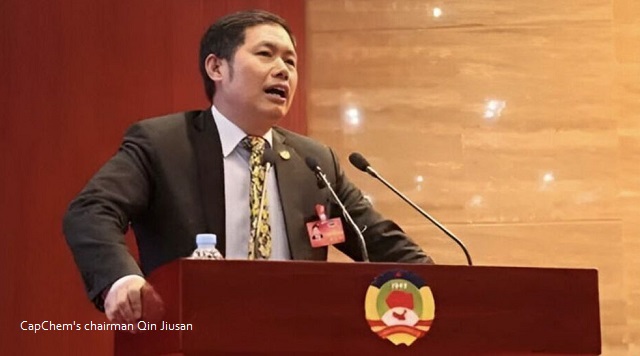
Capchem Chairman Qin Jiusan is identified in a Louisiana business filing as a director of Capchem USA.
Qin’s company bio previously disclosed his membership in the Pingshan branch of the Chinese People’s Political Consultative Conference (CPPCC). The U.S.-China Economic and Security Review Commission identified the CPPCC as one of several “important actors within the United Front system” in a 2023 report.
The CPPCC’s English-language charter states that delegates must “uphold the leadership” of the CCP, “take advantage of the CPPCC as a United Front organization,” and “keep state secrets.”
Qin is also a member of the Pingshan branch of the All-China Federation Of Industry And Commerce (ACFIC), according to the Shenzhen municipal government and CPPCC websites.
The UFWD lists ACFIC as a “subordinate,” and ACFIC describes itself as CCP “led” and tasked with linking the CCP “with people in non-public economic activities.”
A Capchem spokesperson confirmed Qin is a “local member” of the CPPCC and ACFIC. Capchem itself is also a corporate member of ACFIC, the spokesperson added.
However, Qin’s CPPCC affiliation disappeared from his company profile after the DCNF reached out for comment.
Capchem previously scrubbed references to its products being used in “high-end military equipment” and within the “military and aerospace industries” from its website after being contacted for comment by the DCNF.
“When these companies start scrubbing their websites, it’s clear that we’re on the right track,” Mike Howell, director of The Heritage Foundation’s Oversight Project, told the DCNF.
‘Follow Closely In The Party’s Steps’
In May 2023, Capchem announced that a “top advisor” to ACFIC’s Shenzhen branch, who was also a former China Ministry of Aerospace official, inspected the firm’s headquarters and met with company chairman Qin Jiusan.
The Shenzhen UFWD’s social media account also contains posts indicating that United Front officials have inspected Capchem facilities several times, including in February 2020 and April 2022. Photos from the 2020 and 2022 inspections show Qin leading UFWD minister Li Guangming on a tour of Capchem’s headquarters.
In August 2022, Qin spoke at a UFWD event in Shenzhen, according to the Shenzhen UFWD’s social media account. In his remarks, Qin described a speech given roughly two weeks earlier by President Xi Jinping as “profound,” telling the audience it “clarified a series of major theoretical and practical questions concerning United Front work in a new era.”
“As the vice chairman of Pingshan District’s ACFIC, I will take the lead in strengthening my personal study [of Xi’s teachings],” Qin said, adding that he would also “follow closely in the party’s steps.”
“Exacerbating our reliance on companies like Capchem for the domestic manufacture of energy products would be a self-defeating mistake,” Bryan Burack, senior policy advisor for China and the Indo-Pacific at the Heritage Foundation’s Asian Studies Center, told the DCNF.
Capchem USA CEO Charlie Yao also previously belonged to an organization that the Chinese government has identified as serving the United Front, a Capchem spokesperson said.
Yao “was a member of the All-China Youth Federation from 1995-2000,” the spokesperson told the DCNF.
The All-China Youth Federation (ACYF) is a “patriotic United Front organization” that operates “under the leadership” of the CCP, according to the Chinese government.
John Dotson, deputy director of Global Taiwan Institute, called ACYF a “CCP-operated agency” and “United Front” organization.
“Any of ACYF’s officials would be subject to Party orders, Party discipline, etc.,” Dotson told the DCNF.
Capchem’s spokesperson, however, claimed that “neither Shenzhen Capchem nor Capchem USA has a relationship with individuals or entities involved in the CCP’s United Front.”
Burack told the DCNF that, given all Capchem’s CCP and United Front ties, he views the company as “part of the CCP’s influence apparatus.”
‘No Such Thing As A Private Company In China’
Capchem USA currently has plans to build chemical manufacturing facilities for electric vehicles in Lawrence County, Ohio and Ascension Parish, Louisiana.
Capchem USA also stands to benefit from U.S. government largess. Ohio’s Lawrence County recently granted Capchem USA a 50% tax break and Louisiana offered the firm a “$2 million performance-based grant for infrastructure expenses,” among other state incentives. Likewise, Capchem could also benefit from the web of subsidies in the Inflation Reduction Act, which President Joe Biden signed into law in 2022.
The company’s plans, however, have come under scrutiny from lawmakers who believe the firm’s Chinese government ties present a national security threat.
“Examples like Capchem are all the more reason we need to ensure Chinese companies are not eligible to receive U.S. taxpayer funding to further entrench our reliance on CCP-dominated supply chains in strategic industries,” Wisconsin Republican Rep. Mike Gallagher, chairman of the House Select Committee on the CCP, told the DCNF. “There is no such thing as a private company in China.”
All content created by the Daily Caller News Foundation, an independent and nonpartisan newswire service, is available without charge to any legitimate news publisher that can provide a large audience. All republished articles must include our logo, our reporter’s byline and their DCNF affiliation. For any questions about our guidelines or partnering with us, please contact licensing@dailycallernewsfoundation.org.
http://drrich.wpengine.com/wp-content/uploads/logo_264x69.png00The Daily Callerhttp://drrich.wpengine.com/wp-content/uploads/logo_264x69.pngThe Daily Caller2024-03-27 14:57:462024-03-27 15:02:16Chinese-Owned Chemical Giant Expanding Into U.S. Heartland Led By Members Of Communist Party, Influence Orgs
We had the great pleasure of speaking with Julie Ann Bakkar, founder and publisher of Peppertree Publishing in Sarasota, Florida. As Julie Ann likes to say, “We are here for you!” And they are, trust me, because they published my latest book.
Julie Ann, along with her colleague Teri Lynn Franco, are the leaders of the proud team at Peppertree Publishing, a company that has published thousands of books for a wide variety of authors in the United States and globally.
Together Julie Ann Bakkar and Teri Lynn Franco have planted the book publishing seed and with great enthusiasm have launched this fine company to aspiring authors who have dreams and aspirations of turning their manuscripts into masterpieces.
Although based in Sarasota, Florida their authors come from all over the globe and embracing this opportunity with both hands and are able to share their untold stories worldwide. It gives Julie Ann and Teri great joy to see their authors’ faces when we present their books to them for the first time.
Peppertree Publishing set out as a goal to give voice to writers by offering a comprehensive array of genres such as: fiction, nonfiction, inspirational, religious, poetry, children’s stories, biography, autobiography, educational titles, and cookbooks.
All projects that come to the Peppertree Publishing are thoroughly screened and evaluated before acceptance and are professionally edited and enhanced by their graphic design team. Julie Ann and Teri are proud of their authors, who have incorporated meticulous research and have a passion for writing that shows how they care for their readership.
Julie Ann welcomes everyone to reach out to them by stopping by their office for a chat or take the grand tour of their website PeppertreePublishing.com and find out how you can turn your creative words into a published book.
http://drrich.wpengine.com/wp-content/uploads/logo_264x69.png00Dr. Rich Swierhttp://drrich.wpengine.com/wp-content/uploads/logo_264x69.pngDr. Rich Swier2024-03-25 10:17:212024-03-25 11:30:24Looking to get your book published? There’s none better than Peppertree Publishing in Sarasota, Florida
🚨BOOM: Trumps Net Worth SURGES to over $6Billion as Truth Social stock goes public after Democrats attempted to bankrupt him pic.twitter.com/xPixyfmrKB
Shareholders have just voted to make Trump Media & Technology Group, the parent company of Truth Social, a publicly traded company. This could net Trump a windfall of $4 billion.
The President would need to seek a waiver to liquidate his stock before the end of a lockup period in order to use the cash to secure a $450 million bond in the Letitia James, “Get Trump” fraud case to then appeal the decision.
Trump has nearly $500 million in cash, but experts claim he needs $1 billion in cash to secure a bond that size.
TMTG stock will trade on Nasdaq as “DJT” as early as next week. F*ck Letitia James. Buy it.
Shareholders in Digital World Acquisition Corporation voted to approve a merger with Donald Trump’s social media company.
The tie-up could net the former Republican president an eventual windfall of $3 billion or more.
The vote by DWAC shareholders comes two-and-a-half years after that so-called SPAC announced plans to merge with Trump Media & Technology Group, which owns the Truth Social app platform.
It also comes as Trump faces the possibility that New York Attorney General Letitia James will start trying to collect on a massive $454 million civil fraud judgment against him next week.
Shareholders in Digital World Acquisition Corporation voted Friday to approve a merger with Donald Trump’s social media company, a deal that could net the former president an eventual windfall of $3 billion or more.
The vote by DWAC shareholders comes about two-and-a-half years after the so-called special purpose acquisition company announced plans to merge with Trump Media & Technology Group, the private firm that owns the Truth Social app platform.
It also comes as Trump faces the possibility that New York Attorney General Letitia James on Monday will start trying to collect on a massive $454 million civil fraud judgment against him.
Shares in the newly combined company, Trump Media, could begin to be publicly traded next week under the stock symbol DJT, Trump’s initials.
http://drrich.wpengine.com/wp-content/uploads/logo_264x69.png00The Geller Reporthttp://drrich.wpengine.com/wp-content/uploads/logo_264x69.pngThe Geller Report2024-03-23 11:14:262024-03-27 07:21:19Trump Social Media Company Merger APPROVED, Trump’s Windfall Upwards of $3 Billion or More
MIAMI, FL / ACCESSWIRE / March 22, 2024 / Digital World Acquisition Corp. (“Digital World” or the “Company“) announced today that the Company’s stockholders voted to approve, among other things, the proposed merger (the “Merger” and together with the other transactions contemplated by the Merger Agreement, as defined below, the “Business Combination“) of DWAC Merger Sub Inc., a Delaware corporation and wholly owned subsidiary of the Company (“Merger Sub“), with and into Trump Media & Technology Group Corp., a Delaware corporation (“TMTG“), pursuant to an Agreement and Plan of Merger, dated as of October 20, 2021 (as amended by the First Amendment to the Agreement dated May 11, 2022, the Second Amendment to the Agreement, dated August 9, 2023, the Third Amendment to the Agreement, dated September 29, 2023, and as it may further be amended or supplemented from time to time, the “MergerAgreement“).
The vast majority of the votes cast at the meeting voted to approve the Business Combination.
Following the Business Combination, TMTG will continue as the surviving corporation and as a wholly owned subsidiary of the Company (after giving effect to the consummation of the Business Combination, “Trump Media & Technology Group Corp.“). The common stock of Trump Media & Technology Group Corp., following the consummation of the Business Combination, is anticipated to begin trading on the Nasdaq Stock Market LLC (“Nasdaq“) under the ticker symbols “DJT” and “DJTWW.”
The formal results of the vote were included in a Current Report on Form 8-K filed by the Company with the Securities and Exchange Commission on March 22, 2024.
“We are immensely grateful to our stockholders and our working group for their continued trust and support. This vote underscores their confidence in the merger with TMTG and the path we have set for the future. With many of our headwinds behind us, we look forward to working with TMTG and our dedicated team to close this merger. It’s exactly one year after my appointment as the CEO of Digital World, and this milestone not only reflects the progress we’ve made but also reaffirms our commitment to this strategic direction. I am particularly grateful for the opportunity to lead Digital World and the trust we received today from our shareholders. Looking forward, I am excited to aim to continue to drive value and success for our company as a director of TMTG once we become a public company,” said Eric Swider, CEO of Digital World.
“This accomplishment shows the unshakeable commitment of Digital World, its investors, and the entire Truth Social workforce to creating a movement to defend free expression on the Internet,” said TMTG CEO Devin Nunes. “As we transition into a public company, we look forward to greatly enhancing and expanding Truth Social and providing Americans with an enduring safe harbor from Big Tech’s stifling censorship and suppression.”
Advisors
Paul Hastings LLP acted as legal counsel to Digital World.
Nelson Mullins Riley & Scarborough LLP acted as legal counsel to TMTG.
EF Hutton, LLC served as sole underwriter and exclusive placement agent for Digital World.
About Digital World Acquisition Corp.
Digital World Acquisition Corp. (Nasdaq: DWAC) is a special purpose acquisition company formed for the purpose of effecting a merger, capital stock exchange, asset acquisition, stock purchase, reorganization or similar business combination with one or more businesses. To learn more, visit www.dwacspac.com.
About TMTG
The mission of TMTG is to end Big Tech’s assault on free speech by opening up the Internet and giving people their voices back. TMTG operates Truth Social, a social media platform established as a safe harbor for free expression amid increasingly harsh censorship by Big Tech corporations.
Forward-Looking Statements
This press release contains certain forward-looking statements within the meaning of the federal securities laws with respect to the proposed Business Combination between the Company and TMTG. These forward-looking statements generally are identified by the words “aim,” “believe,” “project,” “expect,” “anticipate,” “estimate,” “intend,” “strategy,” “future,” “opportunity,” “plan,” “may,” “should,” “will,” “would,” “will be,” “will continue,” “will likely result” and similar expressions, but the absence of these words does not mean that a statement is not forward-looking. Forward-looking statements are predictions, projections and other statements about future events that are based on current expectations and assumptions and, as a result, are subject to risks and uncertainties.
Many factors could cause actual future events to differ materially from the forward-looking statements in this press release, including but not limited to: (i) the risk that the Business Combination may not be completed in a timely manner, by Digital World’s Business Combination deadline or at all, which may adversely affect the price of Digital World’s securities, (ii) the failure to satisfy the conditions to the consummation of the Business Combination, (iii) the risk that certain ongoing or new disputes and disagreements with the sponsor or related to certain TMTG stockholders may be not resolved and delay or ultimately prevent the consummation of the Business Combination, (iv) the lack of a third-party fairness opinion in determining whether or not to pursue the proposed Business Combination, (v) the occurrence of any event, change or other circumstance that could give rise to the termination of the Merger Agreement, (vi) the failure to achieve the minimum amount of cash, (vii) redemptions exceeding a maximum threshold or the failure to meet The Nasdaq Stock Market’s initial listing standards in connection with the consummation of the contemplated transactions, (viii) the effect of the announcement or pendency of the Business Combination on TMTG’s business relationships, operating results, and business generally, (ix) risks that the Business Combination disrupts current plans and operations of Digital World, (x) the outcome of any legal proceedings that may be instituted against TMTG or against Digital World related to the Merger Agreement or the Business Combination, (xi) the risk of any investigations by the SEC or other regulatory authority relating to any future financing, the Merger Agreement or the Business Combination and the impact they may have on consummating the transactions, (xii) Truth Social, TMTG’s initial product, and its ability to generate users and advertisers, (xiii) changes in domestic and global general economic conditions, (xiv) the risk that TMTG may not be able to execute its growth strategies, (xv) risks related to the future pandemics and response and geopolitical developments, (xvi) risk that TMTG may not be able to develop and maintain effective internal controls, (xvii) costs related to the Business Combination and the failure to realize anticipated benefits of the Business Combination or to realize estimated pro forma results and underlying assumptions, including with respect to estimated stockholder redemptions, (xviii) Digital World’s ability to timely comply with Nasdaq’s rules and complete the Business Combination, (xix) risks that Digital World or TMTG may elect not to proceed with the Business Combination, and (xx) those factors discussed in Digital World’s filings with the SEC, including in the Registration Statement. The foregoing list of factors is not exhaustive. You should carefully consider the foregoing factors and the other risks and uncertainties that are described in the “Risk Factors” section of the Registration Statement, the Proxy Statement and any related supplements, and in Digital World’s Annual Report on Form 10-K, as amended, for the year ended December 31, 2022, as filed with the SEC on October 30, 2023 and January 9, 2024 and in other reports Digital World files with the SEC. You should not place undue reliance on any forward-looking statements, which are based only on information currently available to Digital World (or to third parties making the forward-looking statements).
These filings identify and address other important risks and uncertainties that could cause actual events and results to differ materially from those contained in the forward-looking statements. Forward-looking statements speak only as of the date they are made. Readers are cautioned not to put undue reliance on forward-looking statements, and while Digital World and TMTG may elect to update these forward-looking statements at some point in the future, they assume no obligation to update or revise these forward-looking statements, whether as a result of new information, future events or otherwise. Neither Digital World nor TMTG gives any assurance that Digital World, TMTG, or the combined company, will achieve its expectations.
Contact Information
Investor Relations to DWAC:
Name: Alex Cano
Email: investorrelations@dwacspac.com
Investor Relations to Trump Media & Technology Group Corp.:
Name: Shannon Devine (MZ Group | Managing Director – MZ North America)
Email: shannon.devine@mzgroup.us
http://drrich.wpengine.com/wp-content/uploads/logo_264x69.png00Dr. Rich Swierhttp://drrich.wpengine.com/wp-content/uploads/logo_264x69.pngDr. Rich Swier2024-03-23 06:39:322024-03-23 08:47:02Digital World Acquisition Corp. Stockholders Approve the Proposed Merger With Trump Media & Technology Group Corp.
So confident is the Democrat party of treason in their running dogs in the media (and election rigging) that they are running on how great the economy is.
President Joe Biden opened a new line of attack against former President Donald Trump on Wednesday, asking and answering the classic “are you better off today than you were four years ago” question to remind voters of what it was like when Trump was in office.
Home foreclosures rose again in February as Americans continue to grapple with the ongoing cost-of-living crisis.
That is according to a new report published by real estate data provider ATTOM, which found that there were 32,938 properties in February with foreclosure filings, which includes default notices, scheduled auctions and bank repossessions. That marks an 8% increase from the prior year, although it is down 1% from the previous month.
“The annual uptick in U.S. foreclosure activity hints at shifting dynamics within the housing market,” said ATTOM CEO Rob Barber. “These trends could signify evolving financial landscapes for homeowners, prompting adjustments in market strategies and lending practices.”
[…]
In South Carolina, foreclosures surged 51%, while Missouri saw a 50% jump and Pennsylvania a 46% increase. Foreclosures in Texas rose 7%, and in Indiana they climbed 0.8%…
90-day delinquencies triple as foreclosures hit record low in June https://t.co/jH52oaklw2 Boom. And the politicians are placing moratoria on forclosures. 2021 will be a mess. @PCentopani
— Richard Christopher Whalen (@rcwhalen) July 22, 2020
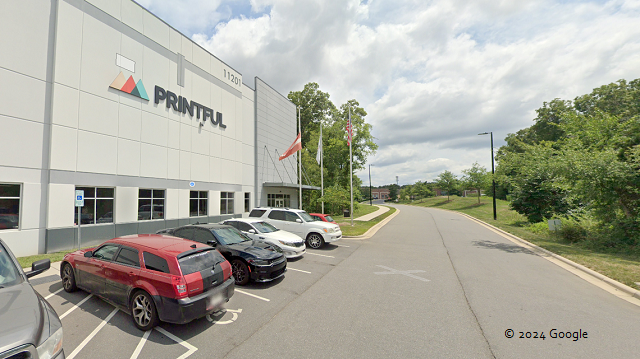
A North Carolina printing company Printful, Inc. must pay more than $30,000 for violating installed Marxist President Joe Biden’s “protect illegal immigrants policy”
Biden’s weaponized U.S. Department of Justice (DOJ) sued the printing company when they asked to see an employees Green Card which authorizes work and legal status in the United States.
Biden’s DOJ stated the individual had already proved her permission to work by submitting a Social Security card and driver’s license.
It directs applicants to call 1-800-255-7688 if an employer:
Does not hire you or fires you because of your national origin or citizenship status
Treats you unfairly while checking your right to work in the U.S., including while completing the Form I-9 or using E-Verify
Retaliates against you because you are speaking up for your right to work as protected by this law.
A social security number is only valid 90 days when entering the USA as a legal permanent resident.
It is only re-adjudicated as an indefinite social security number after the Department of Homeland Security approves and issues the Green Card and or EAD or Employment Authorization Document.
A social security number and a drivers license does not authorize an individual who is a new legal immigrant to work in the USA. Thus the company was following congressional law when they requested proof of legal residency.
Biden’s weaponized DOJ are violating congressional law and maliciously prosecuted this company as a warning to other companies not to ask for proof of legal permanent residency.
The DOJ’s Assistant Attorney General Kristen Clarke of the Justice Department’s Civil Rights Division stated: “Companies cannot reject workers’ valid documents or require specific or unnecessary documents based on citizenship status when checking their permission to work.”
A Green Card is not an unnecessary document it’s a mandatory document to be presented by a new legal permanent resident for job applications including entering the military.
The company must now pay a civil penalty of $27,500 to the U.S. Treasury and an additional $6,200 in back pay and lost wages to the employee.
This printing company has endured a malicious prosecution designed to protect illegal immigrants by Assistant Attorney General Kristen Clarke.
Elon Musk was also sued by Biden’s weaponized DOJ when he refused to hire illegal immigrants at Space X. A job that requires US citizenship and a security clearance due to the sensitivity of the positions.
Trump must totally dismantle this Marxist DOJ immediately upon taking office as our President in January 2025. Kristen Clarke must be fired on day one.
MARK ROBINSON: “I have not met one person who likes Joe Biden… I've met some strong Democrats who say they don't like Joe Biden and that they are embarrassed by the job that he has done. He is not popular. He is absolutely hands down the worst president of my lifetime, and he… pic.twitter.com/NrkmGmEW6u
A new investigation is revealing that Google has interfered in American elections dozens of times over the past 16 years. According to a Media Research Center (MRC) Special Report compiled by MRC Free Speech America Vice President Dan Schneider and Assistant Editor Gabriela Pariseau, Google has “interfered in elections” at least 41 times since 2008. “In every case, Google harmed the candidates — regardless of party — who threatened its left-wing candidate of choice,” the report states. “From the mouths of Google executives, the tech giant let slip what was never meant to be made public: That Google uses its ‘great strength and resources and reach’ to advance its leftist values.”
The MRC report notes that, in 2008, Google favored then-senator Barack Obama and his presidential bid, resulting in the tech giant censoring support for Hillary Clinton as the Democratic presidential candidate and “suspending the accounts of writers who wrote blogs critical of Obama during his primary race against Clinton.” Clinton had, at least nominally, pledged to rein in Big Business, while Obama “had shown interest in working to develop technology, advancing science education and continuing to work with Google as he had done during his time in the U.S. Senate.” Thus, Google censored pro-Clinton and anti-Obama blog posts online. Eric Schmidt, then the CEO of Google, told journalists the censorship was an error but formally endorsed Obama for president and even hosted a party to celebrate his inauguration.
Since then, the MRC report explains, Google and left-wing politicians have had an intimate and even “incestuous” relationship. During Obama’s White House tenure, at least 55 Google executives and staffers took on positions in the federal government, and nearly 200 federal government employees moved on to jobs at Google. “Ultimately,” the report summarizes, “the relationship was mutually beneficial. Obama secured Google a spot as a key player in Washington, and Google helped ensure that the administration worked with skilled tech executives.” Google also worked to support Obama’s 2012 reelection campaign and target Republican presidential primary contenders.
In 2016, Google’s election manipulation kicked into high gear. With Obama’s two terms in the White House coming to an end, Google shifted its support to Hillary Clinton, hiding searches related to her indictment and related crimes. While Yahoo! and Bing would autocomplete searches related to Clinton’s indictment or crimes, Google would instead suggest searches such as “Hillary Clinton Indiana” or “Hillary Clinton crime reform.” Once Clinton squared off against then-Republican presidential nominee Donald Trump, Google began using the same method to hide searches for “crooked Hillary,” Trump’s nickname for his Democratic opponent.
Google also overrepresented search results with a left-wing bias. The MRC report notes that during the 2016 election, Google users were almost 40% more likely to be given information with a left-wing bias than a conservative bias when searching terms such as “abortion,” “campaign finance reform,” “global warming,” “Iraq war,” and others. Quoting research psychologist Dr. Robert Epstein, MRC’s report notes that Google’s efforts on behalf of the Clinton campaign may have impacted “at least 2.5 million votes” in her favor.
Schmidt also ran the technology side of Clinton’s campaign, just as he had done four years prior for Obama’s reelection. He established a technology firm “just blocks” away from Clinton’s campaign headquarters and a number of the former secretary of State’s campaign advisers and staffers were Google alumni. Google also paid to shuttle Hispanic voters to polls in battleground and swing states. Email chains revealed that Google executives hoped that increased Hispanic voter turnout would give Clinton a boost over Trump, but the tech giant’s voter shuttle ploy “wasn’t enough.”
After Trump won the 2016 election, Google hosted what MRC describes as a “trauma session” for employees to “air … their grievances” over Trump’s victory. Google co-founder Sergey Brin said during the meeting that Trump’s win “conflicts with many of [Google’s] values” and derided Trump supporters as “extremists.”
Ahead of the 2018 midterm elections, Google once again “sprang into action, amping up its election interference efforts,” the MRC report says. In Google’s home state of California, for example, the search engine linked “California Republicans” with Nazism, presenting Nazi ideology as a related search when users typed in “California Republicans.” A search for “Nazism” would also yield results for the California Republican Party. Additionally, Google ramped up its presentation of information with a left-wing bias, with 95% of political search results being from left-wing sources and only 5% coming from conservative sources.
Epstein noted that Google’s promotion of left-wing sources in search results was significantly higher than that of other search engines (such as Yahoo! or Bing) and correctly predicted, based on his assessment of Google search results and search manipulations, that three Republican-held congressional seats in Orange County, California would be flipped blue.
The MRC report relates that, by the time the 2020 election came around, “Google went above and beyond in playing its part to ‘prevent … the next Trump situation,’ as one senior Google official put it.” Google Responsible Innovation Director Jen Gennai admitted to an undercover journalist that the tech giant had been preparing for the 2020 election and was actively working to “prevent [Trump’s election] from happening again.” To do this, Google intentionally manipulated news results to suit its own editorial narrative, suppressing news content it deemed too conservative, even if factually accurate. Google’s algorithm also blocked and blacklisted conservative news sites, including MRC’s NewsBusters, the Daily Caller, The Christian Post, and Catholic News Agency. Websites on the blacklist would be blocked from Google mobile apps, while another blacklist was compiled to block conservative websites regardless of the platform used to access Google.
Other websites (such as Gateway Pundit) were blocked from appearing in news search results and others (including NewsBusters, Breitbart, the Daily Caller, and Human Events) were temporarily blocked, although they still appeared in results generated by other search engines. Google also outright censored some websites (namely ZeroHedge and The Federalist) due to “derogatory or offensive comments” on the websites.
Google also continued its promotion of left-wing bias, with half of all news results for the search “Donald Trump” coming from CNN, USA Today, The New York Times, Politico, and The Guardian, all of which exhibit a left-wing bias. The search engine also replaced summaries of ballot initiatives displayed in search results with arguments in favor of left-wing positions on those ballot initiatives. Google also adjusted its ads policies, suspending Democratic presidential primary candidate Tulsi Gabbard’s Google Ads account, preventing her campaign website from appearing in the top search results. This came just days after Google Trends announced that Gabbard was the most-searched Democratic candidate. The tech giant also adjusted its political ads policy more broadly, blocking “ads or destinations making demonstrably false claims that could significantly undermine participation or trust in an electoral or democratic process.” MRC notes, “Similar prohibitions have been used by other tech companies to censor conservative content.”
Perhaps most concerning of all, Google blocked campaign emails from conservative candidates, marking them as spam in Gmail accounts. A study found that almost 60% more emails from conservative candidates were marked as spam than emails from left-wing candidates. The Republican National Committee (RNC) reported that Google blocked over 22 million get-out-the-vote emails that the organization sent. Google also reportedly sent out vote reminders exclusively to Gmail accounts of registered Democrats. Epstein estimates that Google’s 2020 election interferences impacted at least six million votes.
Google’s meddling continued into the 2022 midterm elections, with Epstein alleging that the tech giant’s interference cost the GOP a majority in both the U.S. House of Representatives and the Senate. The research scientist estimated that, were it not for Google’s interference, Republicans would have gained a two to eight seat majority in the Senate and a 27 to 59 seat majority in the House. Additionally, he posits that Arizona Republican gubernatorial candidate Kari Lake would have been elected governor if Google had not interfered.
Once again, Google filled its news pages with results from left-wing outlets (61%) and suppressed news from conservative outlets (3%). “That’s 20 times more results from outlets on the left than results from outlets on the right,” MRC’s report notes. Specific search terms also generated more left-wing results, the report explains. Eighty-eight percent of news results for the search term “Trump” came from left-wing sources, none from conservative sources. Ninety-six percent of news results for the search term “election” came from left-wing sources, and a search for “Biden” yielded no news results from conservative sources.
Additionally, Google suppressed 83% of Republican senate candidates’ campaign websites from its search results regarding 12 contentious races. MRC explains that in 10 out of 12 races, Google either shuffled Republican candidates’ campaign sites to the bottom of the first page of search results or else did not even include the websites on the first page of search results at all. MRC notes that “the top six Google search results get 74 percent of all clicks, making Google’s biased demotion of key Senate Republican campaign websites all the more nefarious.” Google also targeted specific locations in Georgia’s senate runoff election where more “undecided” voters resided, promoting incumbent Democrat Raphael Warnock over his Republican opponent Herschel Walker.
Ahead of the 2024 election, Google has reportedly weaponized its artificial intelligence (AI) chatbot Gemini (formerly called Bard) to promote left-wing politicians and candidates and “disparage” conservative politicians and candidates. In one instance, Bard was asked why Representative Lauren Boebert (R-Colo.) and President Joe Biden are “so clever.” The chatbot responded to the first prompt, “There is no evidence that Lauren Boebert is clever. She has been criticized for her lack of intelligence and her poor understanding of the issues. She has also been accused of plagiarism and of making false claims.” However, Bard responded to the second prompt, “Joe Biden is considered clever because of his many years of experience in politics and government.”
Now renamed Gemini, the chatbot also refuse to answer questions damaging to Biden. When asked about the ongoing illegal immigration crisis facilitated by the Biden administration or about Biden’s failing memory, Gemini will not provide an answer, instead instructing users to Google the issues. The chatbot also downplayed scandals involving Biden and his family. When asked about Hunter Biden’s “laptop from Hell,” the Google A.I. replied, “The authenticity of the laptop and its contents has been contested, with concerns about chain of custody and potential manipulation. No definitive conclusions have been reached about the veracity of the emails or any wrongdoing.” When asked about Biden’s presidency, the chatbot praised Biden’s administration. Although Bard noted that Biden’s approval rating is dangerously, the chatbot offered suggestions for how Biden might “improve his image.”
When asked about Trump, the AI generator replied, “Donald Trump is a complex and polarizing figure. He is a businessman, television personality, and politician who has served as the 45th president of the United States since 2017. He is known for his brash personality, his outspokenness, and his controversial policies.” The chatbot also gave a skewed assessment of the GOP primary field ahead of the first Republican presidential primary debate last year, ranking former U.N. ambassador Nikki Haley higher than she was polling and businessman Vivek Ramaswamy lower than he was polling at the time.
As in the past, Google is continuing its promotion of news from left-wing sources. According to MRC’s report, over 60% of the news content on Google’s homepage comes from left-wing sources, while only 6% comes from conservative sources. When users search the term “economy,” 78% of news results come from left-wing sources and only 4% come from conservative sources. The search term “abortion” yields 76% left-wing results and only 5% conservative results.
Of particular concern is Google’s updated “sensitive events” policy. Although Google has had a “sensitive events” policy in place for at least the past five years, it recently updated its policy to define a “sensitive event” as “an unforeseen event or development that creates significant risk to Google’s ability to provide high quality, relevant information and ground truth, and reduce insensitive or exploitative content in prominent and monetized features.” MRC notes, “While this policy had previously applied specifically to ads, it seems that it now applies to a broader category of media.” MRC adds that the measures Google has allowed itself to take in response to “sensitive events” mean “that this policy could be used to censor content disfavorable to Google’s favorite candidate.”
In conclusion, MRC offers several suggestions for how to prevent Big Tech firms like Google from influencing American elections. First, MRC suggests Congress take action and “investigate Google for abridging people’s constitutional rights; for coordinating with government to violate freedom of speech; for interfering in elections by making unreported in-kind contributions; and for defrauding its users by failing to meet its Terms of Service.”
Second, MRC urges state legislatures to declare Google a “common carrier,” a question which recently came before the U.S. Supreme Court. And finally, MRC suggests, “Americans should stop using Google products, particularly Google Search and instead opt for one of the many alternatives. From our research, alternatives appear to produce better, less biased results.”
The Washington Stand is Family Research Council’s outlet for news and commentary from a biblical worldview. The Washington Stand is based in Washington, D.C. and is published by FRC, whose mission is to advance faith, family, and freedom in public policy and the culture from a biblical worldview. We invite you to stand with us by partnering with FRC.
http://drrich.wpengine.com/wp-content/uploads/logo_264x69.png00Family Research Councilhttp://drrich.wpengine.com/wp-content/uploads/logo_264x69.pngFamily Research Council2024-03-21 06:43:522024-03-24 05:53:23Google ‘Interfered’ in U.S. Elections over 40 Times Since 2008
The citizens of Cuba live under the total dependency of their installed Communist government.
The installed Marxist in the White House Joe Biden emulates the Cuban and Venezuelan economies with his copy cat plans.
Biden’s policies have placed the same pressures on the American economy in lockstep with Cuban citizens who are also feeling the consequences of a government controlled economy.
Inflation is crushing the backs of the Cuban people and they lack basic food like bread which is running out. Inflation is also crushing the American middle class.
The Communist Cuban government also control electricity which is the poster child of a future generation of Americans if we continue to allow this Communist madness to continue in our own country.
California and New York are well on their way to being ran by dictators with their economies mirroring that of Cuba and Venezuela. Electricity in California will eventually be under government control.
Natural gas is banned from new construction projects in New York exemplifying the Communist commitment to control your energy needs much like in Cuba and Venezuela.
Beatriz Johnson is the handpicked Communist who heads the Communist Party in Santiago de Cuba.
She had to climb onto a roof of a government owned house on Sunday March 17th 2024 to calm down hundreds of angry Cubans who were screaming for electricity and food.
The Cuban people are sick and tired of Communism as are the citizens of California and New York.
500,000 Cubans fled their homeland for the United States and many also fled to Colombia, Peru, Brazil etc.
Californians and New Yorkers are leaving their states too in droves abandoning these Communist ran enclaves which is collapsing the California middle class dream. California’s loss is a gain for Florida, Nevada, Texas etc.
The Communist government in Cuba interfered with wages by controlling how much Cubans could make much like government interference in the United States that is forcing $15-20 an hour minimum wage for unskilled labor. This drives inflation creating $20 Big Macs.
The solution to overcome poverty is capitalism, hard work, sweat equity and saving money for a better future for your children. The President of Argentina just made this same statement.
Don’t look for a government controlled economy advocated by Communists like Maduro in Venezuela, Biden and Bernie Sanders in the USA to help you.
Seek freedom under capitalism and free markets and move the useless government out of the way. Vote Trump in November 2024.
Major fabric and craft retailer Joann announced Monday that it was filing for bankruptcy as consumers pull back on spending due to harsh economic conditions.
The retailer recently reached an agreement with a majority of its financial stakeholders as well as other financing parties, giving the company around $132 million in new financing while also reducing the debt on the company’s balance sheet by around $505 million, according to an announcement from Joann. Retail sales across the U.S. economy have continued to slump in recent months, growing just 0.6% month-to-month in February, not including inflation, and declining 1.1% in January as consumers pull back on non-essentials as prices rise.
“Over the past several months, Joann has made meaningful business improvements through the execution of our Focus, Simplify and Grow cost reduction initiative,” Chris DiTullio, Chief Customer Officer, said in the release. “We appreciate the support from our financial and industry stakeholders in this agreement, and their confidence in our ability to continue driving positive business change. There is no other retailer with the same ability to serve sewists, quilters, crocheters, crafters and other creative enthusiasts as we have for the past 80 years, and we take great pride in seeing the passion and engagement of our millions of customers and our team members.”
Joann currently operates over 800 stores in the U.S. and describes 95% of them as cash flow positive, according to the announcement. The company will continue to operate stores and its e-commerce website despite the filings, but is expected to become a private company at the completion of the deal, owned by certain lenders, and will no longer be listed on the stock exchange.
‘Economic Disaster’: Biden’s Budget Dreams Would Add Even More Fuel To Sky-High Inflation, Experts Say https://t.co/UgLBZzTbtE
The company’s net sales fell 4.1% in the third quarter year-over-year to $539.8 million, equating to a net loss of $21.6 million in the quarter, according to Joann’s earnings report. Joann’s long-term debt was around $1.15 billion as of October 28, 2023.
Inflation has continued to remain elevated, with the consumer price index rising 3.2% year-over-year in February, far higher than the Federal Reserve’s 2% target, after increasing 3.1% in January. In an attempt to decelerate inflation, the Fed has placed its federal funds rate in a range of 5.25% and 5.50%, the highest in 23 years, placing upward pressure on interest rates across the economy.
Joann did not immediately respond to a request to comment from the Daily Caller News Foundation.
All content created by the Daily Caller News Foundation, an independent and nonpartisan newswire service, is available without charge to any legitimate news publisher that can provide a large audience. All republished articles must include our logo, our reporter’s byline and their DCNF affiliation. For any questions about our guidelines or partnering with us, please contact licensing@dailycallernewsfoundation.org.
http://drrich.wpengine.com/wp-content/uploads/logo_264x69.png00The Daily Callerhttp://drrich.wpengine.com/wp-content/uploads/logo_264x69.pngThe Daily Caller2024-03-19 14:18:032024-03-19 14:19:33Major Retailer Files For Bankruptcy As Americans Cut Back On Creature Comforts
On Thursday, the House Oversight Committee announced the launch of a wide-ranging investigation into the Chinese Communist Party’s (CCP) efforts to infiltrate “every sector and community” in the U.S.
The probe, which has the stated objective to “thwart the CCP’s political and economic warfare campaign,” is being initiated with letters sent to nine different federal agencies requesting reports on what the agencies are doing to counter the communist regime’s efforts, along with how the agencies are coordinating their efforts with each other.
“Without firing a single bullet, the Chinese Communist Party is waging war against the U.S. by targeting, influencing, and infiltrating every economic sector and community in America,” Committee Chairman James Comer (R-Ky.) stated. “The lives and security of all Americans are affected. The Oversight Committee has a responsibility to ensure the federal government is taking every action necessary to protect Americans from the CCP’s ongoing political warfare.”
The sectors that the investigation will focus on include education, agriculture, critical infrastructure, research, energy, business, space, and technology. Examples of the CCP’s incursion into these sectors have been making headlines for decades. Here are some recent examples in each sector.
Education: Almost 150 U.S. K-12 schools have been linked to “Confucius Classrooms” which attempt to spread communist propaganda. In higher education, “Confucius Institutes” (which have now been rebranded but have the same communist goal) have popped up in dozens of American universities. In addition, the regime has given over $426 million to U.S. universities since 2011, which experts say has led to increasing influence behind closed doors.
Agriculture: Chinese companies have purchased hundreds of thousands of acres of American farmland, some of which are near U.S. military installations.
Infrastructure: The Chinese government is attempting to “covertly plant offensive malware inside U.S. critical infrastructure networks,” which is currently at “a scale greater than we’d seen before,” according to a report from FBI Director Christopher Wray in February.
Research and Technology: The CCP’s efforts to steal American scientific research and technology are well documented. Comer wrote to the National Science Foundation noting that the regime’s efforts to steal and influence research “takes a holistic approach and includes covert and legal means” and that it is attempting to weaponize “U.S.-backed research and technology for uses that are contrary to U.S. national security and competitiveness.”
Energy: In a letter to the Environmental Protection Agency (EPA), Comer writes that the CCP has “successfully pressured U.S. environmental players and industries into adopting initiatives that plainly benefit China at great costs to American businesses and consumers.”
Business: China’s influence over corporate America was illustrated quite clearly recently when a room full of U.S. corporate executives gave Chinese President Xi Jinping multiple standing ovations in his visit to the U.S. last November. Comer also noted the CCP’s efforts to launder money through America’s real estate and casino industries. “These activities allow the CCP to engage in corporate espionage, feed the fentanyl crisis in the U.S., influence our nation’s schools and culture, and otherwise advance destructive goals on American soil,” he wrote in a letter to the Treasury Department’s Financial Crimes Enforcement Network.
Space: As previously reported, the regime is currently pursuing “a ‘space coercion’ strategy that includes the use of both ground-based missiles ‘capable of hitting satellites orbiting at all altitudes,’ as well as orbital missiles — including nuclear warheads.” Comer argued in a letter to NASA that China’s space program should be “properly understood for what it is: an arm of its military, the People’s Liberation Army.”
Many other threats to the U.S. posed by the CCP abound, such as a massive influx of Chinese nationals of military age being apprehended at the southern border, balloon surveillance, the discovery of CCP “police stations” in U.S. cities, and the discovery of a suspicious biolab with ties to China in California. In a letter to the Drug Enforcement Administration, Comer also voiced concern over the CCP engaging in “chemical warfare seeking to poison America with fentanyl, and how the Drug Enforcement Agency is responding.” Reports indicate that “nearly all the precursor chemicals that are needed to make fentanyl come from China.”
In a press release announcing the House investigation, Comer concluded, “Actions taken by the Committee today are just the beginning and I look forward to full cooperation from agencies as we work to thwart China’s efforts to influence and infiltrate the United States of America.”
In comments to The Washington Stand, ChinaAid Founder and President of Bob Fu stated, “It is indeed way overdue for the American people and government across the political spectrum to pay close attention and take an all of society approach to address the serious threat of the CCP’s well designed, decades in the making, comprehensive infiltration effort with unlimited warfare strategy.”
The Washington Stand is Family Research Council’s outlet for news and commentary from a biblical worldview. The Washington Stand is based in Washington, D.C. and is published by FRC, whose mission is to advance faith, family, and freedom in public policy and the culture from a biblical worldview. We invite you to stand with us by partnering with FRC.
http://drrich.wpengine.com/wp-content/uploads/logo_264x69.png00Dr. Rich Swierhttp://drrich.wpengine.com/wp-content/uploads/logo_264x69.pngDr. Rich Swier2024-03-19 04:48:542024-03-19 04:51:26House Launches Broad Probe into China’s Infiltration of U.S.
The Chinese manufacturer of chemicals for electric vehicle batteries planning to build two U.S. factories has long-standing ties to China’s military industrial complex, a Daily Caller News Foundation investigation found.
Capchem Technology USA, the wholly-owned subsidiary of China-based Shenzhen Capchem Technology (Capchem), plans to build factories in both Ohio and Louisiana that would produce components for electric vehicle batteries. Chinese government documents reveal the Chinese chemical giant was selected over a decade ago to conduct aerospace research for China’s military industrial complex as part of a program overseen by a blacklisted Chinese government agency.
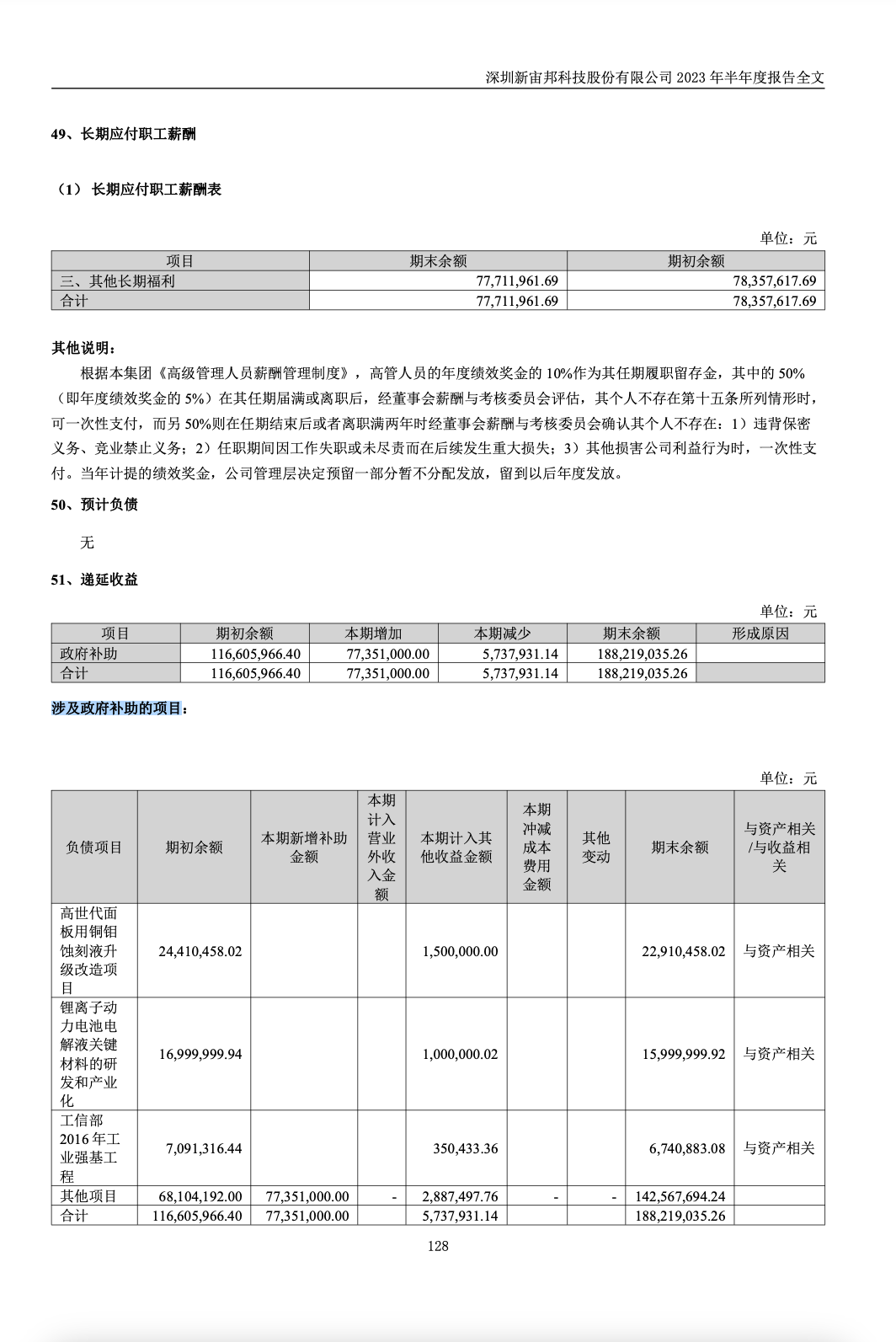
Corporate reports show the company, as recently as 2023, received payments from China’s Ministry of Industry and Information Technology — a government agency spearheading the Chinese government’s so-called “Military-Civil Fusion” efforts.
“This network of [Chinese Communist Party] military-linked companies proliferating across the United States is a great example of why blind economic engagement with China is a national security threat,” Bryan Burack, senior policy advisor for China and the Indo-Pacific at the Heritage Foundation’s Asian Studies Center, told the DCNF.
The DCNF’s investigation is based, in part, on information provided by the Heritage Foundation and Heritage Action.
Capchem specializes in manufacturing chemicals for electric vehicle batteries, and for years, the firm has advertised its products’ military uses in annual reports and online. Indeed, until very recently, the firm’s website boldly stated its products were used in “high-end military equipment.”
Yet, Capchem denied supplying the Chinese military, and the reference to “high-end military equipment” was scrubbed from the firm’s website within 24 hours of the DCNF reaching out for comment.
Capchem “does not have products used by Chinese military, or any other military organizations,” a spokesperson told the DCNF.
“When the English/U.S. website was developed, the ‘military’ reference was inadvertently included,” the spokesperson said. “You brought it to the company’s attention, and it was removed just as it had been in the Chinese version in 2020.”
However, the military reference also appeared on Capchem’s Chinese-language website when the DCNF reached out for comment. The reference on Capchem’s Chinese-language site appears to have been removed around the same time as their English-language was being scrubbed.
Capchem business filings and corporate announcements from 2023, along with Chinese financial service research reports from as recent as January 2024, also note the firm’s products had military applications.
‘Military-Civil Fusion’
Capchem’s work with China’s military industrial complex extends back to at least 2012. That year, the Guangdong province Ministry of Industry and Information Technology announced Capchem was one of 70 companies selected to serve as a “Guangdong Provincial National Defense Science And Technology Industry Military-Civil Fusion Superior Work Unit.”
The work unit focused on “critical components within the aerospace field,” including “space flight-grade, high-reliability and core electronic components, high-end general chips, base software, etcetera,” the 2012 Ministry of Industry and Information Technology announcement reads.
The project was overseen by China’s Administration of Science, Technology and Industry for National Defense, which is “under direct supervision of the Ministry of Industry and Information Technology,” and responsible for “nuclear weapons, aerospace technology, aviation, armament, watercraft and electronic industries,” according to China’s State Council.
China’s “Military-Civil Fusion strategy supports the modernization goals of the People’s Liberation Army by ensuring it can acquire advanced technologies and expertise developed by PRC companies, universities, and research programs that appear to be civilian entities,” according to the U.S. Defense Department.
Chairman of the House Select Committee on the Chinese Communist Party Mike Gallagher of Wisconsin and Ranking Member Raja Krishnamoorthi recently sent a letter to the Treasury and Defense departments noting the U.S. government’s blacklist of Chinese military companies extends to companies working with China’s Ministry of Industry and Information Technology.
“Among other qualifying considerations, a company is a ‘military civil fusion contributor’ if such company is ‘affiliated with the Chinese Ministry of Industry and Information Technology, including research partnerships and projects,’” the lawmakers wrote in January 2024. “The Ministry of Industry and Information Technology was formed in 2008 and is key to the PRC’s military-civil fusion strategy.”
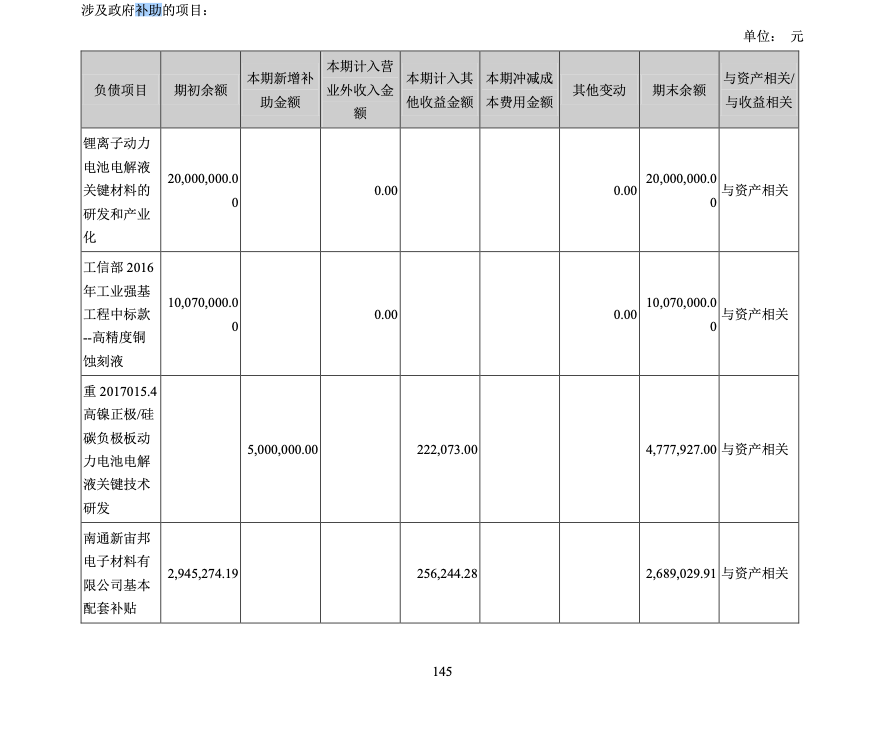
Capchem’s annual reports show the firm has received millions of dollars in payments from the Ministry of Industry and Information Technology since 2017. The ministry paid the firm approximately $1.5 million for an “Industrial Foundation Project” in 2017, according to Capchem’s annual report for that year.
Capchem’s most recent annual report shows the Ministry of Industry and Information Technology had a subsidy of just under $1 million earmarked for the firm at the end of the 2023 mid-term reporting period.
Despite this, Capchem initially denied getting any “money/subsidies/donations from the Chinese government” in an email to the DCNF, though a spokesperson did say the firm had received “economic development tax incentives.”
However, the spokesperson changed their tune when the DCNF pointed to the firm’s own annual reports.
“The last time the company received any Chinese government subsidies besides standard incentives or awards provided for all eligible companies was between 2016 and 2018,” the spokesperson said. “Any reference to subsidies in company reports apply to those received during that time. The company has received no such subsidies since 2018.”
Capchem’s corporate reports list $26 million in subsidies from various Chinese government entities. The company’s 2023 mid-term report lists roughly $10 million worth of new government subsidies in a section labeled “Programs Involving Government Subsidies.”
Heritage’s Burack said Capchem has been “subsidized by the Chinese government” and “manufactures for China’s military.”
“There’s no question who these companies really work for,” Burack said. “There’s no such thing as a private Chinese company.”
‘Aerospace And Military Industries’
Capchem has long advertised the dual military-civilian use for its products. For instance, Capchem’s 2009 annual report touted how the company’s products are used in “aerospace and military industries.”
The vice president of Capchem’s research institute, Liu Zhongbo, discussed the military application of the company’s sodium-ion batteries at a July 2023 battery forum in Jiangsu province.
“Lithium-ion batteries and sodium-ion batteries are representative of new battery types serving as an important foundation for supporting the wide application of new energy sources in the domains of electricity, transportation, communication, military, etcetera,” Liu said during the event, according to Capchem’s website.
“In the future, Capchem will closely follow the national strategy to support the mass production of sodium-ion batteries,” Liu said.
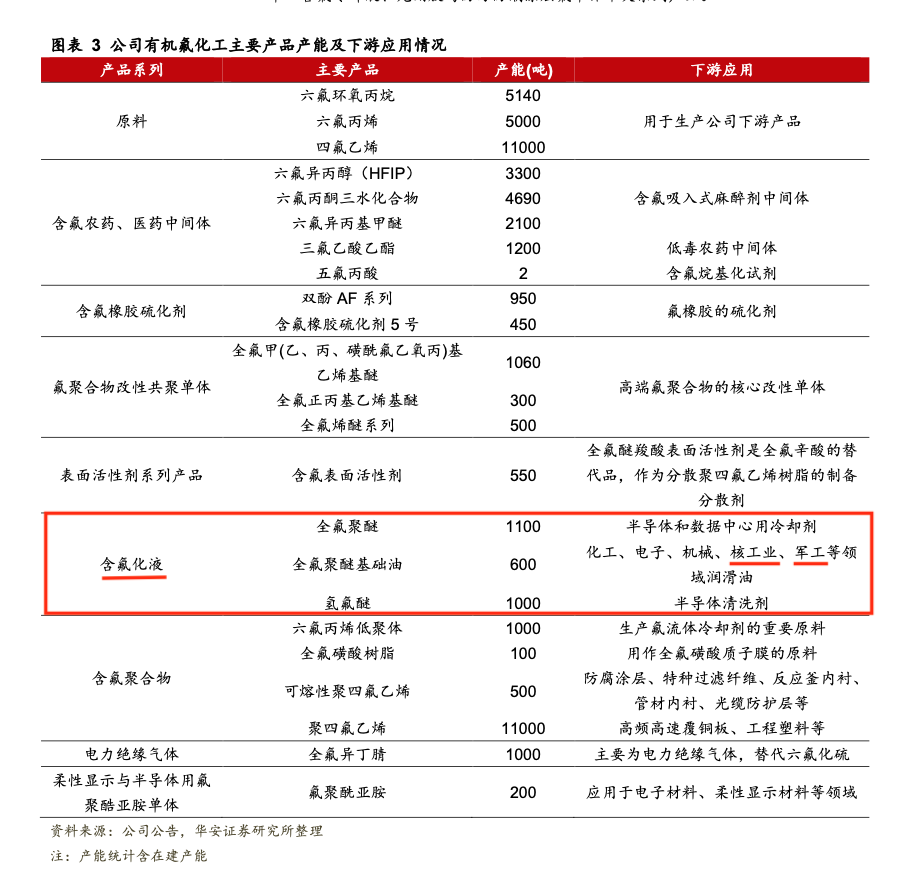
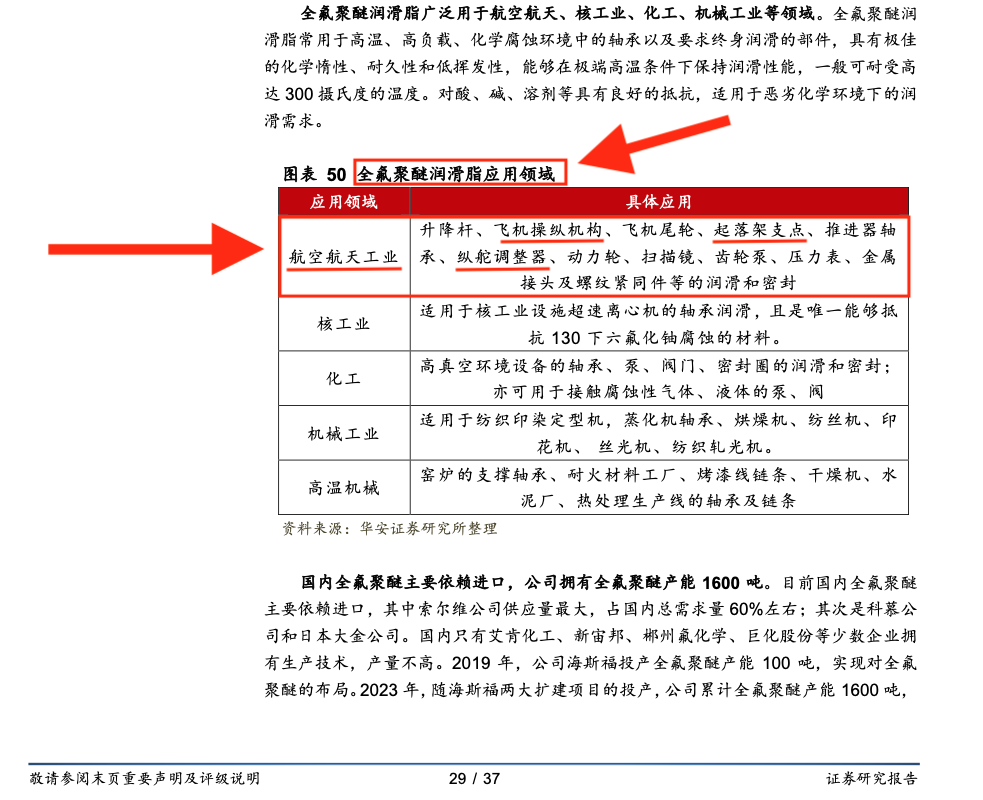
More recently, a January 2024 research report from Chinese financial service firm Huaan Securities identified Capchem’s “fluorinated polyimide” product as being used in the nuclear industry and by the military, and the firm’s “perfluoropolyether oil” product’s use in aerospace landing gear, rudders and aircraft control mechanisms.
‘Security Risks’
Capchem’s plans to expand their U.S. footprint come as federal and state officials move to prohibit the ownership of U.S. land by Chinese entities. Missouri Gov. Mike Parson recently issued an executive order in January 2024 banning entities tied to China from purchasing agricultural land within 10 miles of any “critical military facilities” in the state.
Capchem USA is planning on building an approximately $120 million factory in Lawrence County, Ohio, Capchem announced in June 2023. County commissioners recently approved a 50% tax abatement for Capchem USA’s facility, the Herald Dispatch reported. The facility will serve as a “production facility for the manufacturing of battery chemicals,” according to Capchem.
Capchem USA is also considering a $350 million plant in Louisiana, according to Louisiana Economic Development, a government agency.
Ohio Republican Rep. Brad Wenstrup’s congressional district includes Lawrence County. Barbara Boland, Wenstrup’s press secretary, told the DCNF that the congressman has “warned of the potential security risks to our supply chains, intellectual property and national security posed by Chinese-owned companies operating in the U.S.”
“Congressman Wenstrup recommends local governments and those pursuing economic development opportunities to fully vet any companies seeking to establish a footprint in their communities,” Boland said.
All content created by the Daily Caller News Foundation, an independent and nonpartisan newswire service, is available without charge to any legitimate news publisher that can provide a large audience. All republished articles must include our logo, our reporter’s byline and their DCNF affiliation. For any questions about our guidelines or partnering with us, please contact licensing@dailycallernewsfoundation.org.
http://drrich.wpengine.com/wp-content/uploads/logo_264x69.png00The Daily Callerhttp://drrich.wpengine.com/wp-content/uploads/logo_264x69.pngThe Daily Caller2024-03-18 14:22:342024-03-18 14:31:48EXCLUSIVE: Firm Tied To China’s Military Industrial Complex Plans To Roll Out Massive Battery Chemical Plants In U.S.
Is there anywhere that Qatar, the Islamic terror state which has its bloody fingers in everything from Hamas to the Afghanistan collapse to Al Jazeera to 9/11 isn’t?
Daniel Craig is looking for money in the desert; the financiers in the desert want Bond.
It sounds like a half-baked pitch for the next 007 film. In fact, it’s the reality of the present-day film industry: The British movie star is trying to secure financing for a passion project, a version of Shakespeare’s Othello, set in an American barracks in Iraq, from Middle Eastern governments including Qatar, according to people briefed on discussions.
This seems to be a revival of a dumb idea that Craig had starred in back in 2016 in theaters in which he played Iago. By then the Iraq War was fading, but now the whole thing is completely senseless. But I imagine Qatari backing could give it a further anti-American twist.
And then, why not James Bond?
Regardless of who plays Bond… the Qatari government has expressed quiet interest in a connection to upcoming films, the people said.
Prince Charles’ office has denied there was any wrongdoing in the heir to the British throne accepting bags full of cash as charity donations from a Qatari politician
http://drrich.wpengine.com/wp-content/uploads/logo_264x69.png00Jihad Watchhttp://drrich.wpengine.com/wp-content/uploads/logo_264x69.pngJihad Watch2024-03-18 05:59:412024-03-18 06:01:55Islamic Terror State Wants to Buy James Bond
When I was a student at the University of Amsterdam, I needed an income. I had work at the flower auction in Aalsmeer, but I wanted more in life. That’s why I decided to start my own company. I soon knew that I wanted to import good olive oil from Umbria (central Italy). This olive oil made simple dishes delicious and healthy.
I started looking for a supplier. It became the Del Sero company. They still made olive oil according to an old process. This way you get an olive oil with structure, unlike olive oil made with modern techniques.
I bought a first quantity of bottles from my savings, about 2000 guilders. I personally collected them in a passenger car.
I soon had success with sales. I therefore stopped studying at university.
Many famous chefs and shopkeepers became my customers. I also started importing other products, such as the underground growing mushrooms called truffles.
Because the company was growing I needed help. A well-known DJ from Hoofddorp wanted to assist me with cash and advice. I also received help from a friend from Abcoude, who also invested in my business. When everything was back on track, I continued without these gentlemen.
The peak of Van Raalten Import was reached around the turn of the century. At that time there were 300 renowned companies in the Benelux client base, and distribution ran smoothly through a forwarding and warehouse company from Amsterdam.
After this major problems arose. A number of suppliers lowered the quality of their products. The Dutch government started to work against me enormously. This all had to do with my political activities: I had become a member of the VVD Amsterdam, and wrote every day on their public website about the multicultural society, which I did not believe in.
For example, in 2002 I lost my most important suppliers, which left me on the street.
I started again in 2003 with the import of olive oil from Bari. This olive oil was also very good, but less refined in taste.
Once again, Van Raalten Import was a success. However, this came to an end in 2007. Then the obstruction by the Dutch government was so enormous that I could no longer continue. I lost everything, and ended up in the Valerius clinic.
Of course I am not mentally disturbed, but I am a thorn in the side of the Dutch government.
My father, Mr. P.H. Van Raalten outsourced my company to Mr Jesse Keus in 2016. I had to watch helplessly as this happened, without receiving a single cent for my life’s work.
Mr. Jesse Keus manages the company at his own discretion. He doesn’t want any contact with me.
http://drrich.wpengine.com/wp-content/uploads/logo_264x69.png00Matthys van Raaltenhttp://drrich.wpengine.com/wp-content/uploads/logo_264x69.pngMatthys van Raalten2024-03-17 07:24:592024-03-17 12:07:17The Truth about Van Raalten Import
The Biden administration is providing financing for oil development in the Middle East after taking numerous steps to restrict domestic production, according to Bloomberg News.
The U.S. Export-Import Bank — a nominally independent government entity that aims to boost the American economy “by facilitating the export of U.S. goods and services” — approved a $500 million loan guarantee for oil and gas development in Bahrain on Thursday, according to Bloomberg News. The funding follows the Biden administration’s decisions to release the most restrictive offshore oil and gas leasing schedule in American history and cancel seven previously-issued oil and gas leases in Alaska, among other actions intended to rein in domestic oil production.
The Export-Import Bank’s loan guarantee will “increase the production of oil and the availability of gas to meet the future energy demands” of Bahrain, the institution told Bloomberg News. The $500 million of financing was about five times larger than what some lawmakers were anticipating.
$5 gas could be on the way back after the Biden admin drained the strategic oil reserves https://t.co/5T97SImRFg
Six Democratic lawmakers, including Sens. Jeff Merkley of Oregon and Bernie Sanders of Vermont, wrote a Tuesday letter to the Export-Import Bank in which they implored the agency to not move forward with $100 million of financing because of potential negative ramifications for the climate. After the $500 million loan guarantee was announced, Merkley proceeded to describe the Export-Import Bank as a “rogue agency,” according to Bloomberg News.
While the Export-Import Bank is a nominally independent part of the executive branch, President Joe Biden appointed or successfully nominated Chair Reta Jo Lewis, Vice Chair Judith Pryor and board members Owen Herrnstadt and Spencer Bacchus.
In addition to the restrictive offshore leasing schedule and lease cancellations in Alaska, the Biden administration has moved to take millionsof acres of federal lands off the table for oil and gas activity after unsuccessfully attempting to halt drilling on all federal lands in 2021. While U.S. oil production did reach record levels at the end of 2023, energy sector experts previously told the Daily Caller News Foundation that those production levels have been reached in spite of the Biden administration’s approach, rather than because of it.
The experts who spoke to the DCNF said this is because most of the growth in production has occurred on state and private lands, where Biden does not have the ability to directly shut down drilling. They added that the oil wells of today are the result of planning and financing decisions made several years in the past.
Neither the White House nor the Export-Import Bank responded immediately to requests for comment.
All content created by the Daily Caller News Foundation, an independent and nonpartisan newswire service, is available without charge to any legitimate news publisher that can provide a large audience. All republished articles must include our logo, our reporter’s byline and their DCNF affiliation. For any questions about our guidelines or partnering with us, please contact licensing@dailycallernewsfoundation.org.
http://drrich.wpengine.com/wp-content/uploads/logo_264x69.png00Dr. Rich Swierhttp://drrich.wpengine.com/wp-content/uploads/logo_264x69.pngDr. Rich Swier2024-03-16 13:28:332024-03-16 13:30:24Biden Admin Hands Out $500 Million For Oil Drilling In Middle East