Must-Read Vatican Document Slams Surrogacy, Gender Theory, War and Abortion
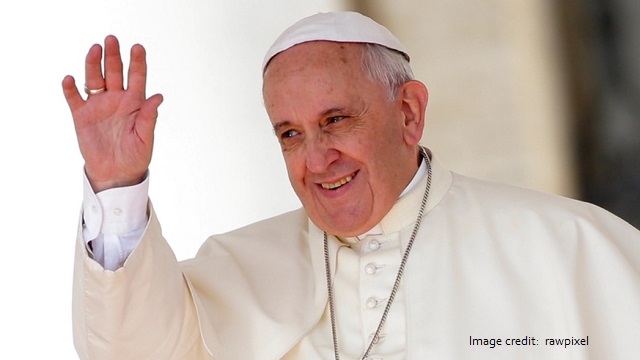
Earlier this week the Vatican published a 16,000-word document reaffirming Catholic condemnations of a wide range of moral issues, from war to surrogacy and human trafficking. Dignitas Infinita, or “Infinite Dignity”, is both a philosophical and a theological essay, appealing to open-minded people of all faiths and none.
Seldom has there been so much media coverage about a Vatican document which contains so few surprises. It’s no secret that the Catholic Church opposes abortion and euthanasia. Perhaps both the fans and foes of Francis thought that he might open up a crack for sex changes or for surrogacy.
But almost nothing has changed. Under Francis the Church is as severe as ever on life issues. Over at the New York Times, columnist Ross Douthat opined that the Pope’s “style has been to consistently push at the boundaries of his office, testing how far a pope can go in altering Catholic teaching”. He sounded mortified to report that Dignitas Infinita was “a clearer-than-usual line against developments in progressive thought and culture”.
Controversial issues
Here are some notable highlights.
Dignitas Infinita condemns surrogacy, first as a violation of the child’s dignity and second as a violation of the surrogate mother’s. It says:
the legitimate desire to have a child cannot be transformed into a “right to a child” that fails to respect the dignity of that child as the recipient of the gift of life … in this practice, the woman is detached from the child growing in her and becomes a mere means subservient to the arbitrary gain or desire of others.
The document also rejects gender theory. In a few perceptive sentences, it criticises the transhumanist impulse to “self-determination”, describing it as “a concession to the age-old temptation to make oneself God”. Furthermore, it describes the difference between male and female as “foundational”.
In the male-female couple, this difference achieves the most marvellous of reciprocities. It thus becomes the source of that miracle that never ceases to surprise us: the arrival of new human beings in the world.
Sex-change interventions are also condemned. The document quotes the Pope: “creation is prior to us and must be received as a gift. At the same time, we are called to protect our humanity, and this means, in the first place, accepting it and respecting it as it was created.”
One possible innovation in Dignitas Infinita is its approach to war. While lamenting the cruelty and senselessness of wars, the Catholic Church has traditionally supported the possibility of a “just war”. However, with weapons of mass destruction, asymmetric warfare and terrorism, perhaps the nature of war has changed. The document quotes the Pope — “it is very difficult nowadays to invoke the rational criteria elaborated in earlier centuries to speak of the possibility of a ‘just war.’ Never again war!”
Does this mean that requirements for a just war will be updated? Possibly.
Explaining human dignity
Even though there appears to be little novelty in Dignitas Infinita, it was five years in the making. The Pope’s top theologian, fellow Argentinian Cardinal Victor Fernández, explains in an unusual preamble that the document went through several versions, because the Pope had ordered some significant changes. He wanted the list of violations of human dignity to include issues like poverty, the wretchedness of migrants, violence against women, human trafficking, and war.
This is consistent with Francis’s impatience with what he feels is some Catholics’ single-minded focus on abortion and other pro-life issues. Dignitas Infinita endorses the notion that Catholic moral teaching is a “seamless garment” and that abusing migrants and abortion are both horrendous violations of human dignity.
But what is human dignity? The first half of the document offers a very helpful and thoughtful exploration of the topic.
It begins with the Universal Declaration of Human Rights whose 75th anniversary occurred last year. After the barbarism of World War II, the UDHR was a high-minded commitment by its signatories to restore a respect for human dignity. Its opening sentence asserts “the inherent dignity and of the equal and inalienable rights of all members of the human family”. John Paul II described the UDHR as “one of the highest expressions of the human conscience”.
However, it’s obvious that the concept of human rights has become so muddled that it is almost meaningless. Accompanied by claims to be advancing human dignity, rights have multiplied and morphed. Nowadays internet access, air conditioning and same-sex marriage are claimed as human rights, along with a right to abortion.
Although this is a very complex question, one reason for this proliferation is that people base their approach to human dignity on different foundations.
The Church’s approach is ontological; human dignity flows from the very fact of being a human being created by God. This means that all humans have dignity, not just those who possess privileges like awareness or intelligence or autonomy. Notoriously, Peter Singer (and other philosophers) say that “the life of a newborn is of less value than the life of a pig, a dog, or a chimpanzee.”
In a brief, but very insightful observation, Dignitas Infinita analyses Singer’s notion of human dignity (without naming him):
Some people propose that it is better to use the expression “personal dignity” (and the rights “of the person”) instead of “human dignity” (and the rights “of man”) since they understand a “person” to be only “one who is capable of reasoning.” They then argue that dignity and rights are deduced from the individual’s capacity for knowledge and freedom, which not all humans possess. Thus, according to them, the unborn child would not have personal dignity, nor would the older person who is dependent upon others, nor would an individual with mental disabilities. On the contrary, the Church insists that the dignity of every human person, precisely because it is intrinsic, remains “in all circumstances.”
As well, the document deploys a very important concept: that we humans are relational beings. Fundamentally, none of us are individuals. We are all bound up in a web of relations with other humans, past, present and future: “Indeed, there is an ever-growing risk of reducing human dignity to the ability to determine one’s identity and future independently of others, without regard for one’s membership in the human community.”
The document condemns “a self-referential and individualistic freedom that claims to create its own values regardless of the objective norms of the good and of our relationship with other living beings” Unless one grasps this, it may be hard to appreciate why the Church rejects surrogacy, transgenderism, euthanasia and so on.
Dignitas Infinita may contain no surprises, but its clarity and consistency are admirable. It’s a good springboard for responding to today’s ethical challenges.
Does the Catholic Church have anything valuable to say about human rights? Leave a comment in the box below.
AUTHOR
MICHAEL COOK
Michael Cook is editor of Mercator.
RELATED ARTICLES:
Major UK report throws transgender medicine onto the rubbish heap
Celebrity queer philosopher Judith Butler fights to vindicate her life’s work
Enver Hoxha tried to make Albania the world’s only officially atheist state. He failed miserably
POST ON X:
BREAKING: Suspect arrested over b*mbing at Alabama Attorney General's office. The suspect is a trans nonbinary Antifa member.
The modern LGBTQ movement is radicalizing activists into becoming violent extremists. This uptick in LGBTQ violence is alarming. pic.twitter.com/j77u7RGQ0f
— Libs of TikTok (@libsoftiktok) April 11, 2024
EDITORS NOTE: This Mercator column is republished with permission. ©All rights reserved.