Congress’ new $60 billion aid package is unlikely to move the needle in Ukraine’s war against Russia, experts told the Daily Caller News Foundation.
The House overwhelmingly voted to pass the $60.8 billion package on Saturday that aims to bolster Ukraine’s war effort and replenish U.S. stockpiles, and the Pentagon is reportedly quickly sketching up a plan to deliver Kyiv tactical vehicles, armored personnel carriers and missiles if the bill is ultimately signed off on by President Joe Biden, according to Politico. But given the lack of an endgame strategy to end the war and Ukraine’s failed counteroffensive in the face of a growing Russian military, the aid could help bolster Kyiv’s defenses for a while, but is unlikely to push it closer to a military victory, former U.S. officials and defense experts told the DCNF.
“By itself, the latest tranche of U.S. aid is not zero-sum and it’s hard to imagine it will prompt a turning point in the war. However, if used properly the funds should be helpful for a period of time,” Michael Bars, former White House senior communications advisor and National Security Council official, told the DCNF. “It’s disappointing that another $60 billion went out the door without a penny for U.S. border enforcement, on which the Speaker long-conditioned additional Ukraine aid.”
Speaker of the House Mike Johnson, who helped spearhead the bill’s creation and passing, previously insisted that any future Ukraine aid needed to be tied to border security. Johnson ultimately discarded that idea and helped pass the Ukraine bill separately, provoking ire from several GOP lawmakers.
This is the U.S. House of Representatives under the direction of Speaker Mike Johnson. Democrats are celebrating his total capitulation with no victory for securing our border. #MTVpic.twitter.com/TtaIgnX9eg
This is the U.S. House of Representatives under the direction of Speaker Mike Johnson. Democrats are celebrating his total capitulation with no victory for securing our border. #MTVpic.twitter.com/TtaIgnX9eg
“I think there’s not enough money available, either in this bill or in a much larger one, to help Ukraine achieve their goals of retaking all their territory or even go on offense in a sustained way,” Benjamin Friedman, policy director at Defense Priorities, told the DCNF. “So in a sense, moving forward is beyond their grasp, even if we give them a lot more weapons. The aid might be useful in helping them hold the line and not suffer some kind of breakthrough where the Russians start to make real progress. So I think it’s a little bit opaque exactly how dire things are for Ukraine.”
Ukraine has thus far received approximately $73 billion in aid, including military and economic assistance, from the U.S. alone since the country’s war with Russia began in February 2022. Ukraine has burned through existing aid and yet has failed to make any territorial advances in its counteroffensive operations.
Ukraine suffers not only from a lack of munitions and weaponry but also a shortage of manpower, having lost an estimated 70,000 troops as of December, U.S. officials previously told The New York Times. Ukrainian forces took a significant blow during the withdrawal of Avdiivka in Eastern Ukraine amid a shortage of manpower as Russian forces advanced and seized control of the city.
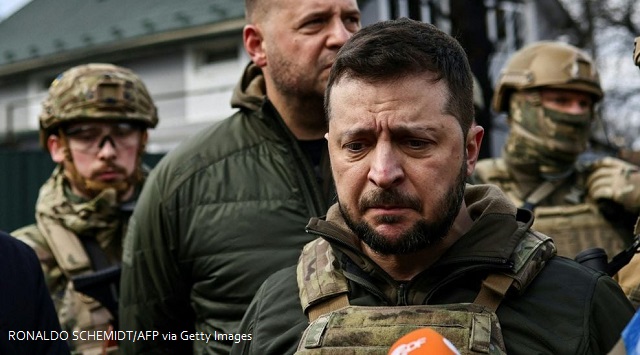
Zelenskyy is lowering broadening conscription standards in a bid to increase mobilization, but it may be too late to make a difference now, even with additional munitions, Michael DiMino, a senior fellow at Defense Priorities and former CIA officer, told the DCNF.
“It’s kind of too little, too late,” DiMino told the DCNF. “Even if you mobilize those people now, you’re 30 points down right now… if you want to do the right thing, Zelenskyy should have made that call two, three years ago at this point.”
Complicating matters further is Russia’s military-industrial complex, which, despite heavy sanctions from the West, is at full operational capacity and producing armaments at a swift rate. Despite sustaining heavy manpower losses, Russia’s military has recovered back to pre-war levels and is growing much faster than Ukraine’s, head of U.S. European Command Gen. Christopher Cavoli warned Congress last week.
“It appears that Russia, with a reputedly sanction-proofed economy, is prepared for a long haul and will continue insisting on territorial concessions from Ukraine,” Bars told the DCNF. “This will put the U.S. on the hook for even more aid down the road as part of protracted conflict.”
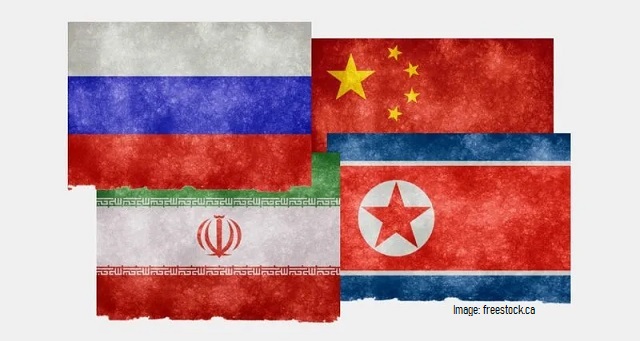
Russia has economically allied itself more closely with Western adversaries such as China, Moscow’s largest trading partner as of 2024, to ease some of the weight of sanctions. Russia has also deepened its military cooperation with Iran and North Korea, both of whom are also burdened by sanctions.
The new Ukraine aid package, if signed into law, will provide Kyiv with approximately $14 billion for the direct purchase of weapons and munitions through the Pentagon’s Ukraine Security Assistance Initiative. At least $13.4 billion will go toward replenishing the U.S.’ weapons stockpile, which can be transferred to foreign allies through the presidential drawdown authority.
Roughly $10 billion will be provided as an economic loan under the package, which the president would eventually be able to waive in its entirety.
“The loan system itself is an innovation and allows for much-needed oversight. Otherwise, it would be a straight grant and no oversight,” Johnson’s office told the DCNF on Monday. “Every single dollar that goes to Ukraine for aid is now a loan. The other money goes to our own national security and replenishes our stockpile.”
“The loan system is split in a tiered system so it cannot all be forgiven immediately or at one time,” Johnson’s office told the DCNF. “The process for congressional review puts heavy oversight on the president’s ability to forgive the loan.”
DiMino told the DCNF he is not opposed to sending Ukraine more military aid so long as it is attached to a cohesive war strategy, which he felt has thus far not been presented by the Biden administration or supporters in Congress.
“Whether people are in favor of the aid or not, I don’t really care about that. What I care about is, what is the theory of victory? I would argue right now that this current administration does not have a theory of victory.” DiMino told the DCNF. “President Biden mentioned Ukraine for two minutes at the top of the State of the Union, and he said, ‘Putin is evil, and democracy is important.’ And that’s great, and we can probably agree on that. But that’s not a strategy to win a war. That doesn’t actually discuss the tactical realities on the ground.”
“$50 billion, $60 billion, $10 billion — it doesn’t matter. It has to be tied to a strategy and to an objective that’s achievable,” DiMino told the DCNF. “It has to be a realistic objective. And I would argue that taking back 100% of Ukraine’s territory is not really a feasible military objective at this juncture.”
All content created by the Daily Caller News Foundation, an independent and nonpartisan newswire service, is available without charge to any legitimate news publisher that can provide a large audience. All republished articles must include our logo, our reporter’s byline and their DCNF affiliation. For any questions about our guidelines or partnering with us, please contact licensing@dailycallernewsfoundation.org.
http://drrich.wpengine.com/wp-content/uploads/logo_264x69.png00The Daily Callerhttp://drrich.wpengine.com/wp-content/uploads/logo_264x69.pngThe Daily Caller2024-04-23 08:21:432024-04-24 06:35:46‘Too Little, Too Late’: Congress’ $60 Billion Aid Package Won’t Get Ukraine Off The Ropes, Experts Say
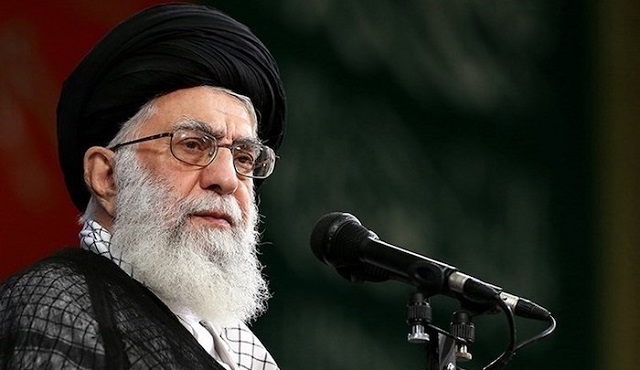
Many factors have combined recently to magnify the strength of Iran and its proxies — from Obama’s disastrous nuclear deal that only benefited Iran to the Islamic Republic’s current alliances with China and Russia, as well as its continuing to be underestimated and misunderstood by the West. The Iranian regime has been emboldened for years. The West’s tendency to ignore or discount this has given Iran an opportunity to become a key player in the global order, while America under Biden declines. As the Ayatollah Khamenei put it in a recent statement:
The United States’ long-standing ambition to dominate the region has been undermined by the resilience of the Axis of Resistance. The United States is now left with no option but to withdraw from the region.
A recent article in the Jerusalem Post discusses how the Middle East, and global politics, has changed since October 7. “Iran’s Khamanei [sic] using Gaza war as step to change world order,” by Seth J. Frantzman, Jerusalem Post, March 24, 2024:
Iran’s Supreme Leader believes the US is in decline in its influence in the Middle East. According to a statement last week, Ayatollah Ali Khamenei claimed that the current war against Israel, which Iran launched using proxies in the wake of the October 7 Hamas attack, has “disrupted” the US goals in the region.
The October 7 attack can be read as a turning point in the world order, in which Iran, Russia, Turkey, China, and others see the attack as a major shift that is taking place and seek to exploit it to achieve their goals.
Both the current weak administration governing America and the October 7 attacks have greatly contributed to a “turning point” in the world order.
Iran’s Islamic Revolutionary Guards Corps Quds Force Commander Esmail Qaani has also threatened that “that the resistance front has yet to exhibit the maximum of its capabilities in terms of military and deterrent power”. Qaani’s reference to the “resistance” includes Hamas, jihadists in “Gaza, the West Bank, Yemen, Lebanon, Iraq, Syria and other places.” Embedded in Qaani’s threat is that the West has seen nothing yet.
Khamenei believes that the US has lost all influence in the region, and that it “is now left with no option but to withdraw” altogether. With Joe Biden in the White House, Khamenei isn’t far off regarding America’s loss of influence. And as for withdrawing from the region, America isn’t adequately standing up for Israel nor even against its own enemies, so it has a weak presence.
The rising world powers increasingly appear to be Russia, China, and even possibly Iran — that is, America’s foremost enemies. Recently, Russia and China managed to broker a safe passage deal with the highly underestimated and Iran-supported Houthis, who now have the Red Sea under siege and have expanded their activities to begin interfering with ships that are heading to the Cape of Good Hope at Africa’s Southern tip. Biden’s Red Sea Coalition continues to struggle ineffectively against the Houthis, as the Yemen-based group has an adverse impact upon Western economic stability. Recently, Hamas and Houthi top dogs met to discuss “expanding their confrontations” with Israel.
Iran has also become a formidable presence within the powerful BRICS alliance (Brazil, Russia, India, China and South Africa), and its influence is growing. According to NASDAQ, discussions about the potential impact of a new BRICS currency are now going on, “with experts debating” this new currency’s “potential to challenge” the dominance of the American dollar. Should this happen, America’s decline would accelerate, since economic clout defines global influence and power. The American dollar is the world’s principal reserve currency for global trade. Simply put: its purchasing power is so influential that when when the American dollar appreciates, other world currencies depreciate. China is now trying to lessen global reliance on the American dollar, which would also be a major victory for Iran. Last year, China was Iran’s main trade partner. According to an Islamic Republic of Iran Customs Administration report in May, Iran’s trade with BRICS member states between March 21, 2022 and Feb. 19, 2023 was worth $34.98 billion USD, “which excludes crude oil exports.”
Iran’s growth has been rapid in BRICS. Last August, Vladimir Putin and Iranian President Ebrahim Raisi discussed Iran’s future membership in BRICS. A similar meeting took place in November; it included dignitaries from Iran and Russia, who discussed Iran’s “active role” in BRICS. Less than two months later, at the turn of the new year, Iran officially joined the China-led BRICS economic organization.
Whether or not America and the West have accepted the fact, America (deemed the “Great Satan” by Iran) and Israel (the “Little Satan”) are currently in a limited war with Iran, which is now likely in possession of nuclear bombs, and which has powerful friends.
The Jerusalem Post states that “the war in Gaza was the first shot by Iran and other countries in a major war for the future of the world order.” One can also see the increase in popularity of the pro-Hamas lobby, which is operating without restraint in America, Canada and other Western nations.
While enemies of America, Canada, Europe and Britain advance politically and economically, America and the West continue to decline under the irresponsible and weak leadership of globalist regimes, while being simultaneously invaded by multitudes of migrants, due to reckless open-door immigration polices. The globalist regimes has never indicated that they care about the fact that most of the migrants do not hold Western values.
Khamenei is correct in stating that “the United States’ long-standing ambition to dominate the region has been undermined by the resilience of the Axis of Resistance.” But whether America under Biden will fully abandon Israel and leave the region altogether, as Khamenei predicts, is another question. As stated earlier, America, in fact, is already increasingly useless to Israel as it issues threats against its traditional ally, while virtually exonerating Hamas’ use of human shields and Egypt’s blocking of Gazan refugees (except those refugees whom Egypt could bribe). The tight relationship between the Organization of Islamic Cooperation and the United Nations, not to mention the China-brokered rapprochement between Iran and Saudi Arabia, are no less sobering as indicators of the nature of the new world order that has begun emerging since October 7.
http://drrich.wpengine.com/wp-content/uploads/logo_264x69.png00Jihad Watchhttp://drrich.wpengine.com/wp-content/uploads/logo_264x69.pngJihad Watch2024-03-26 05:09:222024-03-26 05:16:20Khamenei: U.S. is ‘left with no option but to withdraw from the region’ in changed ‘world order’ after Oct. 7
The rumors are flying on X: the Jews did it, the Americans did it, etc. It seems unlikely that any of that is true, however.
Why would the Americans, who support Ukraine, mount an attack that Russia is almost certain to accuse the Ukrainians of masterminding or aiding? This attack is likely only to intensify Russia’s war against Ukraine, and the U.S. supports Ukraine, so as evil and feckless as the Biden regime is, it seems unlikely that it is behind it.
As for the Israelis, the rumor mongers’ reasoning is that this will enable people to see that jihadis really are evil. That also, however, is unlikely. Neither Israel nor the U.S. acknowledges the reality of Islamic jihad. Few see the Israeli/”Palestinian” conflict as a jihad, although that is what it is. And so few are likely to see any connection between this attack and Hamas’ jihad against Israel.
“Allahu Akbar” is what the terrorists shouted after killing innocent Russians in Moscow. ISIS is getting stronger and stronger again. Today Moscow tomorrow Amsterdam , London, Berlin or Paris unless we stop them. #MoscowAttackpic.twitter.com/gzfdFxaO31
by Patrick Reevell and Tanya Stukalova, ABC News, March 24, 2024:
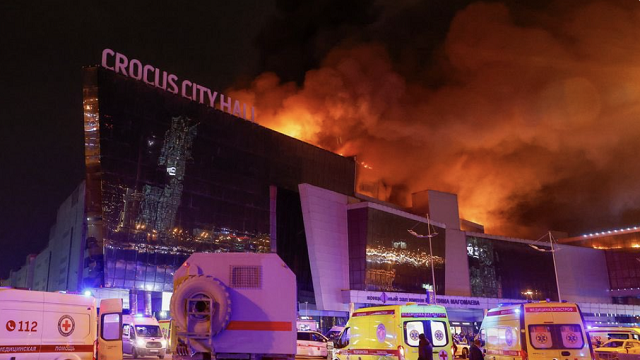
The death toll in the terror attack at Moscow’s Crocus City Hall has risen to 137 people, including three children, Russia’s Investigative Committee said Sunday, as the search operation continues for bodies under the rubble.
Russian President Vladimir Putin was informed Saturday that four suspected gunmen responsible for the attack were arrested near Russia’s western border with Ukraine, Russian news agencies reported.
Seven others have been detained and the search for other accomplices is ongoing, the state news outlets reported.
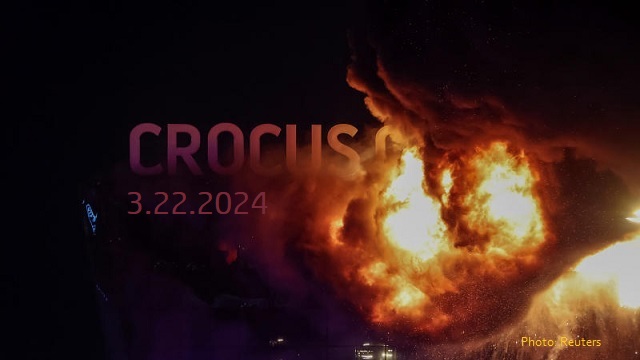
ISIS claimed responsibility for the deadly attack Friday night, in which gunmen opened fire on concertgoers at one of Moscow’s largest entertainment complexes. The attackers then set the complex on fire….
The death toll as a result of the terrorist attack has increased to 137, Russian investigators said Sunday, adding that three of the victims are children….
Investigators said more than 500 rounds of ammunition and 28 magazines, as well as two Kalashnikov assault rifles, were found at the scene….
“The terrorists also used flammable liquid to set fire to the premises of the concert hall, where there were spectators, including the wounded,” the statement said….
Putin did not acknowledge the ISIS claim for the attack, saying Russia was still investigating. But he sought to suggest that Ukraine could bear some responsibility, saying the suspected attackers had been detained while trying to cross the border to Ukraine and claiming they may have received some help from there.
“According to the preliminary data, they had a crossing of the border prepared from the Ukrainian side,” Putin said.
Ukrainian officials vehemently denied any involvement and warned that the Kremlin would try to exploit the attack by falsely blaming Ukraine to drum up greater support for its war….
The U.S. said it shared intelligence with Russia that warned that ISIS was preparing similar attacks on concerts in Moscow just two weeks ago. A U.S. State Department official said Saturday that the U.S. government had shared information on a possible attack with Russian authorities in accordance with its longstanding “duty to warn” policy….
Ambassador to the United States Anatoly Antonov said the U.S. didn’t pass along any “concrete information” prior to the attack….
Trump in an exclusive interview with Israel Hayom: "Only a madman or a fool would not have reacted to the October 7 attack the way Israel did" pic.twitter.com/pjd3AJoKLc
One of the apprehended terrorists responsible for the attack in Moscow had to be wheeled into court with a wheelchair. He was fine when they caught him. pic.twitter.com/5fQ7FPhaO6
http://drrich.wpengine.com/wp-content/uploads/logo_264x69.png00Judicial Watchhttp://drrich.wpengine.com/wp-content/uploads/logo_264x69.pngJudicial Watch2024-03-25 04:58:272024-03-25 13:48:59Moscow jihad murderers screamed ‘Allahu akbar,’ death toll now 137, Russia says U.S. shared no ‘concrete information’
MOSCOW (AP) — Several assailants burst into a large concert hall in Moscow on Friday and sprayed the crowd with gunfire, killing at least 40 people, injuring more than 100 and setting fire to the venue in a brazen attack just days after President Vladimir Putin cemented his grip on power in a highly orchestrated electoral landslide.
The Islamic State group claimed responsibility for the attack in a statement posted on affiliated channels on social media, which couldn’t be independently verified. It wasn’t immediately clear what happened to the attackers after the raid, which Moscow Mayor Sergei Sobyanin described as a “huge tragedy” and state authorities were investigating as terrorism.
The attack, which left the concert hall in flames with a collapsing roof, was the deadliest in Russia in years and came as the country’s war in Ukraine dragged into a third year.
The Kremlin said that Putin was informed about the raid minutes after the assailants burst into he Crocus City Hall, a large music venue on Moscow’s western edge that can accommodate 6,200 people.
The attack took place as crowds gathered for a performance by the famous Russian rock band Picnic. As Russia’s Federal Security Service reported 40 dead and over 100 injured, some Russian news reports suggested that more could have been trapped by the blaze that erupted after the assailants threw explosives. The Health Ministry released a list of 145 injured.
“Allahu Akbar” is what the terrorists shouted after killing innocent Russians in Moscow. ISIS is getting stronger and stronger again. Today Moscow tomorrow Amsterdam , London, Berlin or Paris unless we stop them. #MoscowAttackpic.twitter.com/gzfdFxaO31
A Significant Terrorist Attack has reportedly occurred at the Crocus Concert Hall in the Russian Capital of Moscow, with at least 4 Gunmen armed with Semi-Auto and Automatic Rifles said to have entered the Building while Shooting anyone that can be seen. Shortly after the First… pic.twitter.com/7RRrBYRyRg
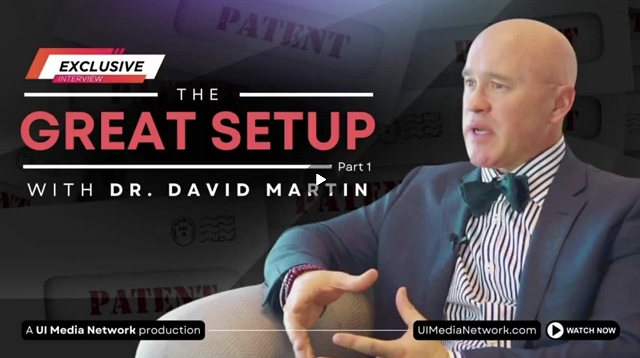
Dr. David Martin is the founder and owner of the company M-CAM International which has provided research and corporate advisory services to over 160 countries and he has personally served as an advisor to the World Bank and many governments. Dr Martin first came to the attention of the world when he featured in the August 2020 documentary by Mikki Willis called Planandemic Indoctornation.
EDITORS NOTE: This Vlad Tepes Blog column with videos posted byEeyore is republished with permission. All rights reserved.
http://drrich.wpengine.com/wp-content/uploads/logo_264x69.png00Vlad Tepes Bloghttp://drrich.wpengine.com/wp-content/uploads/logo_264x69.pngVlad Tepes Blog2024-03-17 06:59:322024-03-17 07:07:16VIDEOS: ‘The Great Setup’ Parts 1 & 2 with Dr. David Martin
Vladimir Putin on Thursday threatened global nuclear war if the West followed through on hints by French president Macron that NATO was contemplating sending troops to Ukraine.
Putin made those comments in his annual “state of the nation” address. Less than 24-hours later, he followed up by test-firing a solid-fuel Yars ICBM, which NATO dubs the SS-29.
The Yars, like its newer cousin, the liquid-fueled Sarmat (Satan-2), can carry nuclear-armed hypersonic glide vehicles that fly at speeds up to Mach 25 and that can defeat any missile defense systems currently deployed or under development. Both missiles, and a variety of hypersonic re-entry vehicles, are part of a $650 billion upgrade to Russia’s nuclear arsenal Putin announced more a decade ago.
As for Macron (or Little Cookie, as I call him in my latest book, Raising Olives in Provence), made his careless comments at a NATO summit in Paris on Monday.
But the one who really let the cat out of the bag was German Chancellor Olaf Scholz, who told the group that Germany was not going to send its Taurus long range cruise missiles to Ukraine because it would require German military personnel on the ground.
Taurus “is a very long-range weapon,” he said, “and what was done on the part of the British and French in terms of target-control and target-control assistance can’t be done in Germany.” That prompted British lawmaker Tobias Elwood to tell London’s Daily Telegraph that Scholz had committed “a flagrant abuse of intelligence.”
That is undoubtedly true. Both comments were picked up by the online service of Russia Today (or RT, as it’s now called), Putin’s megaphone to the West.
The deployment to Ukraine of NATO weaponry that can reach deep into Russia has long been a red line for Putin. “They should eventually realize that we also have weapons that can hit targets on their territory,” he said on Thursday. “Everything that the West comes up with creates the real threat of a conflict with the use of nuclear weapons, and thus the destruction of civilization,” he added.
And if the threat of global nuclear war from Russia wasn’t enough, also on Thursday the commander of U.S. Space Force, General Stephen Whiting, told Congress that China has expanded its military capabilities in space at a “breathtaking pace,” with some 359 satellites currently in orbit, three times the number aloft in 2018.
Whiting testified that some of China’s satellites “could function as weapons that can disrupt” U.S. satellites. Like Russia, China was developing hypersonic glide vehicles capable of defeating U.S. missile defenses.
You could call this week’s events a throwback to the era of Dr. Strangelove, except that they involved real leaders, not Hollywood fictions.
I discuss this and developments in Iran and Israel on this week’s Prophecy Today Weekend. As always, you can listen live on Saturday at 1 PM on 104.9 FM or 550 AM, or by using the Jacksonville Way Radio app. And if you miss it, you can download the podcast here.
http://drrich.wpengine.com/wp-content/uploads/logo_264x69.png00Kenneth R. Timmermanhttp://drrich.wpengine.com/wp-content/uploads/logo_264x69.pngKenneth R. Timmerman2024-03-02 05:15:492024-03-02 05:25:58Dr. Strangelove Returns From The Dead
After the fall of the East-Berlin Wall, in the year 1989, the Western World promised Russian President Boris Yeltsin, that NATO would not expand.
Failed leader President George Bush Senior made many speeches on live TV, in which he stated that Moscow had nothing to fear: NATO would not expand Eastwards.
Boris Yeltsin (First President of the Russian Federation) trusted Washington. He in turn agreed to the reunification of Germany.
Within a year, NATO started expanding to the East: American soldiers were being stationed in East-Germany.
Now NATO wants to encircle Russia and destroy it. But President Putin is not a fool, and he will fight AND win!
There are many warmongers who want to tell a different story.
They say there was no treaty signed that said that NATO would not expand Eastwards. But no treaty was needed. Boris Yeltsin trusted the word of President Bush! There are many fraudulent historians who tell a whole different story. They base their false claims on testimony by former USSR President Gorbachov. You can easily recognize them, as propagandists, for they spell the name of the former Russian dictator wrong: they spell it with an e in the end: Gorbachev. Russian names often end with “ov”,
but never with “ev”.
Mr. Gorbachov hated Yeltsin so much, that he tried to rewrite History. According to Gorbachov, Yeltsin was always drunk (not true) and a communist. Yeltsin had ended his membership of the Communist Party of Moscow, right after the destruction of the Soviet Union. In his heart he had never been a communist. It was very common to become a member of the only legal political party, in order to be able to buy food. Many leaders in Eastern Europe who want their countries to apply for membership of the European Union and/or NATO have been bought. They want to enrich themselves, and therefor cooperate with everything that Biden, Macron, Rutte and Sunak want from them.
True patriots in Eastern Europe know that they are all Slavic peoples, and that their future is under the leadership of President Putin.
The Western World is in a downfall. This is due to the Rise of Islam, Marxists intellectuals and Woke ideology. The Russian Federation and the People’s Republic of China are strong. They are not democratic and free countries, but they will survive the madness that has gotten a hold of the Free World.
http://drrich.wpengine.com/wp-content/uploads/logo_264x69.png00Matthys van Raaltenhttp://drrich.wpengine.com/wp-content/uploads/logo_264x69.pngMatthys van Raalten2024-03-02 04:36:532024-03-02 05:12:46Russia, Russia, Russia
A “Palestinian” state will be a state of the terrorists, by the terrorists and for the terrorists.
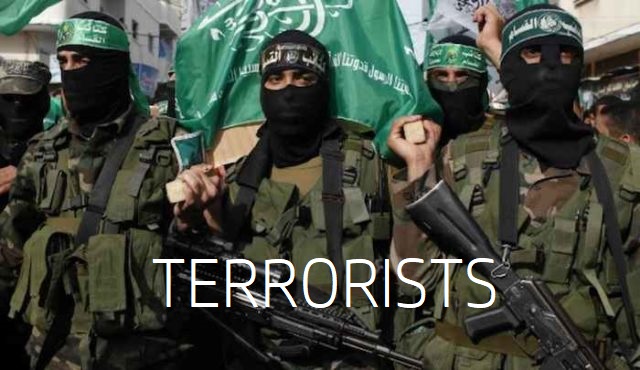
Hamas, Islamic Jihad, the PLO’s Palestinian Authority and the other Islamic terrorist groups who make up the official “Palestinian” leadership have been invited for unity talks in Moscow.
The terrorist unity talks scheduled by the Putin regime for the end of February are a homecoming for a “Palestinian” movement invented by Soviet propagandists. Mahmoud Abbas, the long-serving dictator of the PA, wrote his Holocaust denial thesis while studying at Moscow’s Patrice Lumumba University which had trained a generation of third world terrorists.
The invitation to Moscow comes from Putin’s Deputy Foreign Minister Mikhail Bogdanov. Materials from a KGB defector revealed that Abbas had worked for the KGB under Bogdanov. Back then Abbas had the KGB codename “mole”, these days, his code name is “president”.
Some of the same ex-Soviet operatives who helped set up and fund the PLO, the PFLP and the rest of the “Palestinian” movement are now trying to unite them all under one single banner.
While the State Department in D.C. and British Foreign Secretary Lord Cameron are talking about immediately recognizing a “Palestinian” state as soon as they can force Israel to stop its campaign to destroy Hamas, the Palestinian Authority is trying to bring Hamas into the state.
The media claimed that Abbas had visited Qatar to hold talks with the Islamic tyranny’s leaders on a “ceasefire”. In reality, the Palestinian Authority leader had been meeting with the Qatari regime, another state sponsor of Hamas, to pursue unity talks with the fellow terror group.
Putin’s relationship with Iran makes Moscow, like Doha, home turf for Hamas. Some weeks after Oct 7, top Hamas leaders had flown out to Moscow to meet with Bogdanov after the Russian official had previously chatted with leaders of the terror group in their home base in Qatar.
In 2006, Putin had reacted to the Hamas takeover of Gaza by declaring that “we are maintaining our contacts with Hamas and intend, in the near future, to invite the leadership of this organisation to Moscow” and emphasized that, “we have never called Hamas a terrorist organisation.” Putin invited Hamas leader Khaled Mashal, who recently claimed that “the Russians told us they would study our Oct. 7 attack in their military academies.”
A week after the Oct 7 attacks, Hamas stated, “we in the Islamic Resistance Movement (HAMAS) appreciate Russian President Vladimir Putin’s position on the ongoing Zionist aggression against our people and his opposition to the siege of Gaza”.
After Oct 7, Putin and China’s Xi had blocked a UN condemnation of the Hamas atrocities. Now Russia is working on uniting its old PLO friends and its new Hamas friends. But Russia and Qatar are not alone. The Biden administration and the European Union are all pushing for a “Palestinian” state after they force a ceasefire. And that state will inevitably include Hamas.
“Russia has invited all Palestinian factions who will be meeting on the 26 of this month in Moscow. We will see if Hamas is ready to come to the ground with us,” Palestinian Authority Prime Minister Mohammad Shtayyeh informed the Munich Security Conference. “We are prepared to engage. If Hamas is willing to join us, that’s positive. We need Palestinian unity,”
“One should not continue focusing on October 7,” he warned attendees at the forum.
“Hamas is an essential part of the Palestinian political map. Israel’s talk of eliminating Hamas will not happen and are not acceptable to us,” Shtayyeh had told Qatar’s Doha Forum in December around the same time that the PA was holding unity talks with Hamas in Doha.
After the Oct 7 attacks, Biden claimed that, “the vast majority of Palestinians are not Hamas. Hamas does not represent the Palestinian people.” In reality, polls show that Hamas would easily win any current election, as it won the last set of “Palestinian” elections in 2006, leading Abbas and his Fatah faction to seize total control of the West Bank and reject any future elections. Hamas was able to take over Gaza leading to the two “Palestinian” statelets.
In January, Abbas’ spokesman had promised to “hold general elections, and if Hamas wins, the president will hand over the [Palestinian] Authority.”
With polls showing that Hamas would handily win an election, If Abbas is serious this time, that means recognizing a “Palestinian” state will mean creating a Hamas state inside Israel.
Hamas and the Palestinian Authority had been holding unity talks on and off, including four months before the Oct 7 attacks, and quickly began holding them again afterward.
The current proposal, like previous ones coming out of the unity talks, places Palestinian Authority officials up front, so that terrorists can receive foreign aid from America and the EU, while Hamas officials maintain an official subsidiary role but continue to control Gaza.
In the past, Hamas had been able to siphon foreign aid through UNRWA, but as it now faces the possibility of utter destruction in Gaza, it may be more willing to accept the proposal being advanced by Qatar, Russia, the EU and the Biden administration. While Russia and Qatar may be more publicly supportive of their Hamas allies, all the proposals come down to a government of “technocrats” serving as the public face of the Palestinian Authority and Hamas.
Shtayyeh is an example of one of those “technocrats”, academics with experience in extracting foreign aid and telling foreign diplomats what they want to hear, but with no actual political power, who were put into place to act as a cover for the Arafat and Abbas regimes. A similar puppet regime of technocrats subsidiary to Afghanistan’s warlords had operated in Kabul before it fled the Taliban. The Taliban and the Biden administration have resurrected a version of its “technocrats” to administer the funds going from the United States to Afghanistan.
The current plan is to blame Oct 7 entirely on Yahya Sinwar, the leader of Hamas in Gaza, and a few of his cronies, to demand their expulsion, and then to make a deal with the “moderate” Hamas leaders in Doha before putting the plan for a “Palestinian” state in overdrive. But the Moscow summit is a warning that any such state will never be anything other than a terror state.
The primary difference between the Qatari and Russian positions, and the Biden and EU position, is plausible deniability. Qatar and Russia want Hamas out front, while Biden and the EU prefer it out back. And we already know from Afghanistan how that will end up working out.
The Qataris negotiated our deal with the Taliban that would have made the Islamic terrorist group a part of a multilateral government. Americans died to maintain that State Department fiction as the Taliban were advancing to take over the entire country. Hamas had its chance to be part of a multilateral government with other Islamic terrorists and each time it chose to try and take everything. Biden and the EU may want to keep Hamas in the background, but history tells us that, like the Taliban, it will eventually seize power and dominate any “Palestinian” state.
It’s difficult to know whether Secretary of State Blinken and the State Department personnel who pretended until the last moment that the Taliban were not trying to take over Afghanistan, but only to take a stronger position in the negotiations for a united government really believed that. It’s also difficult to know whether they truly believe that their proposed “Palestinian” state will be anything other than a terrorist state that will eventually fall into the hands of Hamas.
But we know that not only Qatar and Russia, but the Biden administration and the EU, have urgently fought against any Israeli move into Rafah that would finish off Hamas in Gaza.
It’s obvious why Qatar or Russia’s Bogdanov are condemning an attack on Rafah, but the Biden administration has introduced a draft UN resolution calling for a ceasefire, and from Biden on down have warned Israel against going into Rafah. The internal reasoning is probably similar to the one that guided Nixon and Kissinger during another October war 50 years ago.
During the Yom Kippur War, Secretary of State Henry Kissinger had told Soviet Ambassador Anatoly Dobrynin that “my nightmare is a victory for either side.” He warned that without negotiations and a deal, “the Israelis [will] have pushed the Arabs out of every territory and “If we do nothing by Tuesday, Wednesday at the latest, Arabs will have been defeated.”
“I do not mean to imply that he wanted Israel to lose the war, he simply did not want Israel to win decisively. He wanted Israel to bleed just enough to soften it up for the post-war diplomacy he was planning,” Admiral Elmo Zuwalt, the former head of the Navy, wrote in his memoir.
The Biden administration also wanted Israel to defeat Hamas, but not to defeat it too much.
The administration is worried that if Israel wins in Rafah, it will win too much and be much less interested in its diplomatic solution of creating a “Palestinian” state which it believes is the real solution to the conflict. And it needs Hamas to provide pressure on Israel to create such a state.
The same failed idea that has haunted the region for decades is that Islamic terrorism can only be defeated by giving the terrorists some, but not all, of what they want. Much as it did not occur to the State Department that the Taliban would want everything, it refuses to believe that Hamas would want everything. And every time the negotiations fall apart, history is rewritten again.
In an article published in early October, National Security Adviser Jake Sullivan described the negotiations that had brought peace between Hamas and Israel. “We have de-escalated crises in Gaza,” he boasted. The online version of the article has been edited to remove those words.
Since December, Sullivan has taken to warning Israel to “transition” to a new “phase” of the war in which it stops its military campaign and goes back to occasional drone attacks on Hamas leaders. And then he and the rest can get started building their “Palestinian” state. And when Hamas takes over again, more articles will have to be edited and more bodies will be buried.
The Biden administration, the European Union (for now only being held off by Hungary), Russia and the rest of the international community are preparing to reward Oct 7 with a terrorist state. A ‘Palestinian’ state will be a state of the terrorists, by the terrorists and for the terrorists.
The 10/7 attacks reminded Israelis of what Americans had known and forgotten after 9/11.
The Israeli soldiers battling in Gaza are not just fighting for their country, but to remind America and the world that it is possible to defeat Islamic terrorists, instead of negotiating with them. A victory there will show everyone that we can all fight and win, instead of surrendering to Islam.
A lot is riding on that battle for Israel, for America, Europe and the free world. That is why the leaders of the international community and the diplomats of the world are fighting to save Hamas. What happens in the next weeks will hand the Islamic terrorists and their enablers either one of their greatest defeats or their greatest victory: a Hamas ‘Palestinian’ state.
http://drrich.wpengine.com/wp-content/uploads/logo_264x69.png00Jihad Watchhttp://drrich.wpengine.com/wp-content/uploads/logo_264x69.pngJihad Watch2024-02-28 06:40:372024-02-28 06:43:49The World Prepares to Recognize a Hamas Palestinian State
If you still have illusions about Russia, you would never be able to understand a global war against Western civilization and American capitalism, waged by the Terrorist State of Russia since the 20th century. The economic wellbeing of America depends on our knowledge of the danger of global instability, because today, we are copying the Europe of 1939. Yes, the Europe of Hitler’s Germany began WWII to expand FASCISM globally. We won WWII, losing millions of young men and women. We should prevent the next war by all possible ways. It is a Must!
Germany took the process of Denazification very seriously; Russia has missed it. Denazification is the term used to describe the process of removing Nazis and Nazism from public life in Germany and across occupied Europe following the fall of the Third Reich after WWII. The Russian KGB, which Russian people called the Soviet Gestapo, is alive, well, and flourishing in the Russian Federation today.
As a former Soviet defense attorney, I dedicated my life to tell you the truth that you don’t know to save our beloved America the Beautiful. I am writing and warning you about our Chief enemy for the last forty-three years. My major subject is Stalinism and its Intelligence Apparatus. The reason is simple—Stalinist Socialist agenda and objectives have been a destruction of Western civilization and American Capitalism to spread globally his ideology and system of Soviet Socialism, which I called Soviet Fascism. Stalin assigned his Intel to manage the task globally. And his Intel has been very successful by spreading the ideology of Soviet Fascism globally.
In my writing I use the term the KGB, a predecessor of the current FSB as a representative of the entire Russian Intel. Watching it for forty-three years, its activities and tremendous success globally, it was growing up accordingly and becoming the KGB’s Mafia/Army—the Evil Doer. Due to the rise of anti-Semitism globally, I also was driven to use the term, the new “Axis of Evil” –the countries under the Russian umbrella, overturned to the ideology of Soviet Fascism. History has given us a list of countries inverted to Soviet Socialism in the 20th century: Mongolia, North Korea, China, Cuba, Syria, and some Central America’s countries, and Turkey are on the way there. That process has been developed by Putin with double force, speed, and a new strategy for oil: Venezuela and Iran had been added to the new “Axis of Evil ” in 21st century.
Americans have a hundred questions and nobody in the leadership is answering any of them. They don’t know the truth or cover it up. Americans see that the world has dramatically changed, but they don’t know why. They don’t know that the team of Biden’s Socialists of the White House in cahoots with Putin implements the system of Soviet Socialism in America. I have published a book Socialist Revolution in America, XLIBRIS, 2021. But no one on TV, radio or print is discussing it. Nobody in America knows it, knows Russian History, Vladimir Putin and his Intel Apparatus that successfully waged that revolution. Yet, knowledge of all these is the answer to global instability and a current chaos in America.
The first requirement is the awareness of Stalinist Military Doctrine and two his postulates for the generations. The first is Socialist modus operandi: lies, deception, fabrication and fraud. Watch Biden’s team, they are all using Socialist modus operandi, deceiving you. The second is ““Never admit a crime committed, instead accuse your opponent of that exact crime.” Putin is a devoted disciple of the Stalin/Andropov ideology that is alive and well and Stalin is the major hero in Russia. Please, recall the recent eight years of the Dem’s fiasco accusing Trump collusion with Russia. They did it to cover up that exact crime they had committed before and used Stalinist recommendations to cover it up. Watch Democrats in February 2024, they will repeat again accusations of Trump’s collusion with Russia, not having any other arguments, but—Russian election interference…
What an irony of life! Russian election interference has been existing in reality. Actually, Russian election interference was taking place on behalf of Biden’s Democrats since 2018, 2020, and 2022. Yes, and this is the reason I am writing and warning you about the KGB’s Mafia/Army for forty-three years, showing identical patterns. The Evil Doer has successfully pierced the White House, like it did to all other countries of the new “Axis of Evil,” which means Vladimir Putin runs America. Knowing the KGB’s Mafia/Army intent, I’ve told you that the Afghanistan surrender has been designed by Putin and executed by Biden’s White House in 2021.Then in 2021, I had known about Putin/Biden collusion and wrote several columns about their collaboration in suffocating the young Ukrainian democracy in 2014-2015.
Now eight years later, we have more evidence of their collusion. Let’s start with the International Invasion of American soil. First, Mexico is a failed State, infiltrated by Stalin in the 20th century. It was a skillfully concocted operation to provide for the future infiltration to Mexico by the Russian Intel. Read the story of the Spanish orthents brought to Russia after the Spanish Civil War 1936-1939 and trained by the KGB for decades. It is not Mexican Cartels, but Russian Cartels in Mexico, that are directing the army of different gangs, like MS-13 to commit crime in America. I was discussing the story for years, the latest column is following: The Putin/Biden Plot Against America’s Constitutional Republic — Part II January 22, 2024
Yes, this is the Putin/Biden Plot Against America’s Constitutional Republic. The plot has a clear same intent for both sides. As of January 25, 2024, President Joe Biden (D) had signed 128 executive orders, 166 presidential memoranda, 552 proclamations, and 109 notices. Watching and listening to Biden, please, think about it. What objectives does the White House pursue by all mentioned above actions? The answer is clear, Biden demolished American capitalism for the last three years plus the crisis on the border with millions of migrants entering America every day. Isn’t it a clear intent to complete the task of destruction of American capitalism with help of the KGB’s Mafia/Army? Yes, it is! Moreover, be ready for a new danger and outrage—“Migrant Crime,” different gangs like MS-13, a part of the Russian Cartels system of organized crime.
Knowing the new “Axis of Evil” and its activities, we now can confirm a complete identity and unity of both sides. It was a direct duty of the FBI and CIA to expose the actions against the American political system. They failed us. Can you now perceive a negative impact of the Democrats’ foreign policy on the U.S. national security? The Democrat’s collusion with the Russian Intel has a global implication and started decades ago. The KGB’s Mafia/Army is a managing mechanism of the new “Axis of Evil.” The international invasion from 120 countries is also organized by the KGB. As I stated before, the KGB is a Russian terrorist agency, a global terrorist agency and now it is involving the Democrat’s, Biden’s America in its orbit, influencing both foreign and domestic American policies.
Let me give you an example of Stalinist influence on our domestic affairs. “We have been subjected to so many lies, deceptions, disinformation and fraud by agitators and provocateurs for years that most people are disoriented and puzzled. Who is doing that to us? The answer is America’s Socialist Party through its Socialist Charlatans. They are preaching hate to cover-up the crime they have committed for several decades.
Stalinist Political Correctness is a mechanism of preventing the Truth from getting out. It is aimed at hiding or masking the Truth. Political Correctness is a monumental weapon to destroy successful capitalism and the political system left to us by the Founding Fathers. America’s Socialist Party (Democrats) has used PC against the American Republic and conservative Republicans for decades…
The issue of Abortion has a long history which grew as a snowball to the gigantic cultural fraud due to PC. The premise is clear—prevention of pregnancy. Be attentive to the premise—prevention of pregnancy. The Charlatans just moved the time span one bit further and the Republicans, as usual, swallowed the fraudulent hook.
The real pregnancy comes to life by the sexual act and the actual choice is the prevention of that sexual act. The partners, especially a woman, have a choice before a sexual act. It is action taken before the sexual act that prevents pregnancy and not actions after the fact. Using Stalinist PC, Democrat-Charlatans just reprogrammed the human mind, moving the time span and making the choice after the sexual act, which is a fraud. The abortion issue has become a tool for the Democrats to undermine our traditional culture, and our set of values. Just count the disproportional murder of black fetuses and fatherless black families to see the enormous cultural implications of this leftist fraud. Unfortunately, this fraud has affected all ethnic groups in America. “ Abortion and Other Socialist Plans to Destroy America October 3, 2020
I hope Republicans read this column and some of them will awake from hibernation and learn the truth. They should read all my columns to grasp the environment of Socialist Mafia in America. Yes, Socialist Mafia established by the KGB’s Mafia/Army within the Democrat party. I disagree with @NYPOST, it is not a “Nursing home reunion,” but a dangerous creation of Socialist Mafia in America, a-la the Soviet Mafia in Russia.
Follow
Biden, Pelosi clutch hands as they gingerly walk across San Francisco tarmac: ‘Nursing home reunion’.
Biden, Pelosi, and other Dems leaders, Socialist Charlatans of the party are responsible for all troubles America has experienced today. In short: Pelosi as a Speaker of the House saw Biden running for President in 2019 and 2020. She heard his gaffs and saw him mentally unable to focus on the issues and his memory loss. Yet, Socialist Mafia and its Socialist Charlatans have been using the Evil Doer help to make a senile Socialist Biden the U. S. President, who deceives you every day reading a prompter written by his Socialist staff. My columns remind you how Socialist Charlatans were dismantling America’s Law and Order and setting up Soviet Fascism’s system of lawlessness under the supervision of the KGB’s Mafia/Army. Overwhelming heinous crime and a “Migrant Crime” are changing the face of America.
The connection with the past is all over today and Russia is much stronger than fifty years ago. Personal trafficking started by the KGB in Russia under the Warsaw Pact in East Europe, where blond Slovak, Polish, and Czech girls had been sold to the Islamic countries—the friendship with Islam started then, when Stalin married Islam and Communist ideology. Don’t be surprised by the same trafficking on our Southern border, where Russian Cartels attacking America with different trafficking’s—the same patterns. Easer Arafat was recruited by the KGB in 1957. The same Soviet past comes to mind when we recall the Cuban ship Mariel boatlift with criminals and mentally ill people heading to America in October 1980. It was an intentionally designed criminal invasion. Today we have the same, but the intent has changed. The Putin/Biden collusion prepared for a war today that is why we see on the border a lot of young single men from the countries of the “Axis of Evil,” trained for war.
I am warning you again: read my columns or books, learn information you don’t know and be ready for war. War is a very threatening word, but we are now at three wars: Russia on Ukraine, Hamas-Israel war, and Democrats war against Republicans. However, knowing Russian history and its Intel, we can partially solve the problem. Yes, only partially, but it is a beginning to the right direction to solution. In fact, those three wars are inextricably connected to each other, because they are waged against Western civilization by the same aggressor—Soviet Fascism. There is, in fact, one war with the same target—the free world and American capitalism waged by the Socialist/Communist “Axis of Evil” under Russia’s umbrella for years. Read my column: The KGB’s Roots and Pedigrees October 19, 2017, p. 10
Hamas is a terrorist organization. By reading my columns or books, you will learn Stalin’s testament to the world Communists to start a friendship with Muslims of Iran and spread it to the entire Middle East. All Russian leaders have followed his will. Terrorist gangs of Taliban, al-Qaeda, Hamas, Hezbollah and others had been infiltrated by the Russian Intel and supervised by Russia for 60-70 years. Russia has established ISIS and other terror groups in the 21st century. The Hamas-Israel War is the Russian war against Western civilization. For your information: the term “Two States” for Israel and Palestine had been designed by the KGB Chairman Yuri Andropov. Biden’s current policy for cease-fire betraying Israel and helping Hamas and Russia. Listen to Gen Keith Kellogg, he is giving an objective, professional opinion on this war.
The Russia War on Ukraine is a complete repetition of Hamas-Israel War, the Democrat’s policy colluding with Russia. My heart is with Ukraine, but…it will never win the war against Russia. Negotiation, and the sooner the better. Reading my columns, you will learn how the KGB was infiltrating the Dem’s party with the help of the “Squad’ and turning it toward Socialism. We are dealing with the Party of Socialist Charlatans today. Some of them had colluded with Russia personally like the CIA Director, John Brennan, who helped Russia to manage al-Qaeda terrorist group, while Biden gives us the theatrical performances of “climate change,” reading a prompter with the information from Putin. To grasp the Ballot Factor, pleas, read my column: Russian/Chinese Intel: Carousel and COVID-19 in America, December 21, 2020
Dr. Phil is right. Covid has devastated our children, depriving them of schooling for two years. Yes, it has happened in the 21st century, when China joined Russia and Soviet Socialism, which I called Soviet Fascism, had spread across the globe, threatening freedom and democracy. Today is the end of February 2024. It was a spectacular month. We could read my columns and see alive Socialist Charlatans. The parade started with the interview of the Globalist—Socialist Charlatan, Vladimir Putin in Moscow. He propagandized a world community using Socialist modus operandi and presented himself as a savior of the world and Ukraine as a Fascist State. Then, the stage had been taken by Socialist Charlatans of New York, Washington D.C. and Georgia. You saw all of them, their arrogance and condescension deceiving you. There was the entire Prosecutor Office on trial in Georgia. American Patriots hope that the U.S. Supreme Court will stop the American Chaos. I hope, too, despite the information that two Supreme Court Justices have ties with the KGB and their name is not Sotomayor.
My Fellow Americans!
When you hear a name Russia—think Oil, Terror and Fascism.
When you hear a name Putin—think the KGB, Murders, and Assassinations.
When you hear the name Ukraine—think about a largest country in Europe, without which, there will never be the Great Russian Empire.
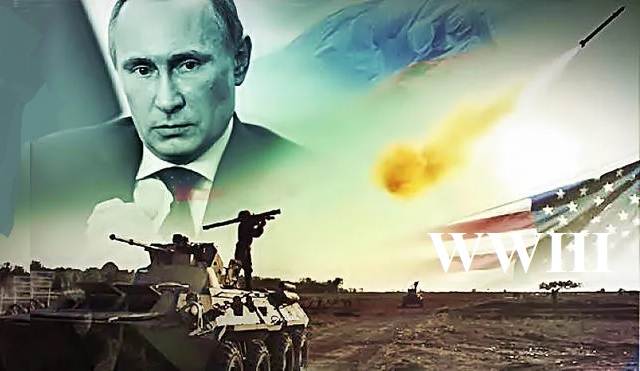
When you hear the term of a new “Axis of Evil” — think WWIII.
You need those four suggestions to grasp the events happening globally in February 2024. They are all connected, calculated, and determine our future. The economic wellbeing of America depends on our knowledge of the danger of global instability.
The Revolutionary Communists of America are forming a party! After the launch rally, we hit the street in downtown Brooklyn to say it loud & clear: the communists are here! #Communismpic.twitter.com/i4xapzQFSC
— Revolutionary Communists of America (@communistsus) February 26, 2024
http://drrich.wpengine.com/wp-content/uploads/logo_264x69.png00Simona Pipkohttp://drrich.wpengine.com/wp-content/uploads/logo_264x69.pngSimona Pipko2024-02-28 04:44:512024-03-03 05:46:39The Roots of Global Instability—Russia’s Fascist Regime
For the first time since the full-scale Russian invasion of Ukraine two years ago, the possibility of negotiations has emerged on the horizon.
Both Putin and Zelenskiiy have indicated in recent interviews that they are now open to negotiations. In his two-hour history lesson to Tucker Carlson, Putin recalled the Istanbul negotiations in March-April 2022. “We were ready to sign it and the war would have been over long ago,” Putin said, but British Prime Minister Boris Johnson swung by and told Zelenskiiy to hold off.
In his interview with FoxNews host Bret Baier that aired on Thursday night, Zelenskiiy poured cold water on the notion that an agreement had been at hand in Istanbul in 2022, but said he was ready to talk with Putin today. Clearly the near-encirclement of Ukrainian forces at Avdiivka, and the heavy losses they took in their hot withdrawal, helped focus his mind. So has the reticence of Republicans in Congress to write Kyiv another blank check.
Exactly how, and under whose auspices those talks take place is another story. Since Zelenskiiy is understandably demanding great power guarantees, that will mean buy-in from the U.S., France, and Germany as well as Russia.
Ironically, the party most reticent to come to the table is Joe Biden. Just this week, he doubled-down yet again on his “Putin the murderer” rhetoric (aided, for sure, by the apparent murder of dissident Alexei Navalny in a Siberian jail). But like the Chekist he is, Putin didn’t take offense at Biden’s words, telling a Russian journalist Russia would deal with anyone the American people elected president, but would prefer Biden because he was more “predictable” than Trump and a known quantity.
Meanwhile, the rumors of expanded war in Europe intensified this week. Putin’s deputy, former president Dmitry Medvedev played bad cop and said that Russia needed to change the government in Kyiv and probably occupy the Ukrainian capital, to prevent “encroachments” on Russian land.
And in Moldova, the Russian breakaway region of Transnistria hinted it would call a referendum to approve Russia’s annexation of the territory, possibly as soon as February 28, with a Putin speech already planned for the next day.
As I explain in this week’s Prophecy Today Weekend, Transnistria is a narrow strip of land on Ukraine’s southwest border with Moldova. If it fell under Russia control, this would add yet another front to the war. But as It is completely landlocked, and not contiguous with the Russian front lines, resupply would be a challenge.
Israeli Prime Minister Benjamin Netanyahu sketched out his vision for the future of Gaza this morning, and it fell pretty much in line with what I previously surmised in my white paper, “Israel’s War of Survival and the End of the Two-State Solution,” released by the America First Policy Institute last month. Gaza must be completely demilitarized, with Israel in control of security, and local Palestinians with no prior ties to Hamas or other terror groups in charge of civilian affairs.
What Netanyahu did not say, however, was how Israel would find such a rare breed of Palestinian. As I write in And the Rest is History: Tales of Hostages, Arms Dealers, Dirty Tricks, and Spies, Israel has been trying for decades to find such Palestinians, and when they do, the other Palestinians (i.e., the PLO or Hamas) murder them.
http://drrich.wpengine.com/wp-content/uploads/logo_264x69.png00Kenneth R. Timmermanhttp://drrich.wpengine.com/wp-content/uploads/logo_264x69.pngKenneth R. Timmerman2024-02-23 14:57:452024-02-23 15:06:34Negotiate, you fools!
This is a repost of an article authored by a priest in the Orthodox Church of America whose wife is Ukrainian and still has family in Ukraine. The article was written two years ago, just as the war broke out, and as I read over it, it struck me how it could have easily been written yesterday. Truth is like that. It ages well.Below is an excerpt from his article, published February 25, 2022, under the titleA Reflection on Ukraine, America, Russia, and War
Few it seems have cared, up until now, that the faithful of Ukraine are being subjected to spiritual violence (which has manifested physically). Few it seems have cared that the Ecumenical Patriarchate is in open and full communion with unrepentant schismatics.
So spiritual violence has been ravaging Ukraine, and few have said much. We value a nominal “peace” above true peace, for true peace cannot be had in communion with false brethren. Now major physical violence is taking place, but what is worse for the soul, spiritual or material violence?
Could it be that the assault on the spiritual peace of Ukraine has affected its physical peace?
How many Americans have been aware that there has been an effective civil war in eastern Ukraine since 2014? How many of us were concerned when Ukrainians were shooting at and killing Ukrainians? Was that okay?
As an American, I will speak to my country. I’m not in Russia. I don’t support the attack. But, we, as Americans, should ask ourselves – is Russia doing anything much different than our own country has done? When in the 21st century alone have we “respected” other nations’ sovereign boards? (Look at our southern border at current!)
At the end of the 20th century, it was a US-led NATO that dismantled Yugoslavia. New borders, created by the US and friends, were established. These borders served US interests. Let us look at the Middle East, when did we respect borders there? The US has stated and acted upon the notion – if a leader is deemed bad and against “freedom and democracy,” it is a duty to overthrow such a leader and carve up the country as the Western powers see fit. When we do it, it is “good.” When Russia does the same thing, it is bad. (Again I’m not justifying anything, I’m making an analogy.) The US government is the epitome of the pot calling the kettle black, as are most of the European powers. Let us as Americans reflect that in this century alone our government waged almost none stop war since 2001. The US government has been in conflict with some countries or states for two decades. If we go back and count the years starting from the end of World War II, the number of years of war or conflict involving the US government is much more than the number of years with no conflict. And we are going to lecture the world on peace? All that to say, we are guilty of the very things we accuse Russia of doing. I guess that is called hypocrisy. The finger we are pointing at Russia is dripping with blood. Maybe we should wash our own hands first.
I’m an American. I honor my country, but I do not support the agenda of war and violence driving much of foreign policy. I’m very grieved by it. Let us take care of our own house first. As in many places, I do not think the government always reflects the people. I think most people want peace and to live their daily lives in calm. Sadly, there are many in power who are hell-bent on stirring up conflict and trouble for the world and people at large. We should also realize that US foreign policy has also played a role in cultivating the current events in Ukraine.
I think that a part of what is transpiring is the typical distraction tactic. The Covid crisis has revealed that the “free” West is not as “free” as it claims. Many Western countries went full dictator mode, thus revealing their true colors. Oh, yes, of course, to keep us all safe because they care for us from their million-dollar mansions. America is in deep crisis and turmoil, much of it fed by certain agendas that are actively seeking to encourage fear, hatred, and division. Our own house is tumbling and corroding away. Oh, but look! That dastardly Putin! He’s a new Hitler. I guess it takes one to know one. In America, the attempt is being made to distract us again. And yes some are insane enough to pursue a war with Russia to do so. I don’t know how far the events will go, but I do know from history that war is a great distraction and even a wonderful tool for “rebuilding” the world.
Of course, one could wander down the labyrinth of geopolitical agendas. I’m familiar with a number of them. I won’t do that right now. The historic discrimination of the Western world against Orthodoxy could be noted as an aspect also. But that is a big subject.
In closing to this my few thoughts, I will return to the spiritual aspect.
What can we as Christians do? Repent. Russia, for all its problems, is not our enemy.
Have we in America repented of the many wars and atrocities perpetrated in the name of our country? Should we not start there? Are we repenting for the “legal” slaughter of babies in their mother’s womb? Are we repenting for the open promotion, in the name of our country, of numerous forms of debauchery and immorality? Are we repenting for the epidemic of drug abuse and suicide in our nation? Are we repenting for being the top exporter of corrosive “culture” and “values?” Are we repenting for the destruction of the family and the explosion of divorce, adultery, fornication, and porn? This list could go on. It seems our own house is full of enemies.
LeoHohmann.com is 100 percent reader supported, not beholden to any corporate ads or sponsorships. If you appreciate the independent analysis you see here and would like to support my work, you may send a donation of any size c/o Leo Hohmann, P.O. Box 291, Newnan, GA 30264, or via credit card HERE.Thank you.
http://drrich.wpengine.com/wp-content/uploads/logo_264x69.png00Leo Hohmannhttp://drrich.wpengine.com/wp-content/uploads/logo_264x69.pngLeo Hohmann2024-02-17 06:48:312024-02-17 06:52:19Reflections on Russia-Ukraine War — 2 Years Later
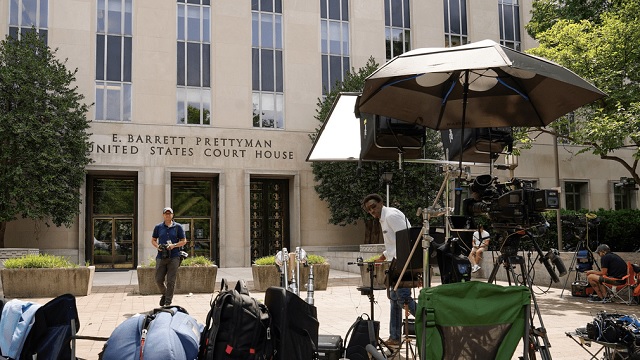
A hot mic caught journalists joking about former President Donald Trump being assassinated as they awaited his appearance at the federal courthouse where his criminal immunity appeal will be held.
The DC Circuit Court of Appeals is set to hear oral arguments on Tuesday, January 9, on the issue of presidential immunity after Judge Tanya Chutkandenied two motions to dismiss based on First Amendment and presidential immunity claims.
The appeal will be heard by a three-judge panel consisting of Judge J. Michelle Childs, who was nominated by President Joe Biden in January 2022 and confirmed in July 2022; Judge Florence Pan, nominated by Biden in May 2022 and confirmed in September 2022; and Judge Karen LeCraft Henderson, who was appointed by then-President George H.W. Bush in 1990.
On Tuesday morning, news cameras were set up at locations between the Trump National Golf Club in Virginia and the E. Barrett Prettyman U.S. Courthouse in anticipation of Trump’s arrival for the proceedings.
One such live feed caught some banter between journalists grousing about the difficulty of getting a good shot of Trump from their vantage point — banter which veered into gallows humor with some references to the late President John F. Kennedy and a convertible:
JOURNO 1: You know what the worst part is? Even if he has his window open and he’s hanging out of it, he will be on the other side of the street.
JOURNO 2: I mean, if he’s driving, we’ve got a good shot!
JOURNO 1: Yeah, if he’s driving with the front window open?
JOURNO 2: Yeah, or if it’s a convertible?
JOURNO 1: Yeah. I wasn’t thinking about that.
JOURNO 2: Yeah. Like if he just pulls up–
JOURNO 1: Like JFK?
JOURNO 2: (laughs)
JOURNO 1: Maybe someone, just like they told JFK. You know what you should do? You should take a convertible! It’s so nice out!
Watch above via AP [Journalists’ comments are at the 53:00 minute mark].
A valuable lesson from my days toiling away in the imperial capital was how little Americans know about what is going on in the rest of the world. Back in the heady days of hegemony, the default American setting was ethnocentric. Wherever we went, there was CNN Headline News, American entertainment, tourist menus, guides and cordial concierges ensuring that our language deficit was not an impediment to spending money.
Joe Biden, the guy presently playing president, said America is an “indispensable nation”. Strictly speaking, we haven’t been a nation since the Civil War. We’re not indispensable either, but believing so is indispensable to imperial hubris. I digress.
Year of the Family
On 22 November, American media ran the usual fare that passes for news: the wars du jour, the JFK murder 60th anniversary, and travellers headed home for Thanksgiving.
Across the globe, something momentous was underway. Western media mostly missed it. The event? Russian President Vladimir Putin signed a decree declaring 2024 the “Year of the Family“.
In order to promote state policy to protect the family and preserve traditional family values, the President has resolved to declare 2024 the Year of the Family in the Russian Federation.
The Year of the Family initiative was kicked off in early November via a motion by Russian Federation Council Speaker Valentina Matviyenko. The mission: “promote state policy in the field of family protection and the preservation of traditional family values.”
The official organising committee will be in place on 27 December, headed by Tatyana Golikova, Deputy Prime Minister for Social Policy, Labour, Health and Pension Provision.
Consider: motion made in early November, decree issued 22 November, implementing committee up and running 27 December. By government standards, that’s moving like greased lightnin’. Guess they remember the glacial pace of things under Communism.
Now, I’m an America first guy, but when countries with fewer resources get things done faster and better, there’s no shame in following their example.
Socially conservative
The custom of dedicating each year to a national cause was inaugurated in 2007 to focus attention on Russian priorities. This is part and parcel of President Putin’s nationalistic approach, designed to conflate patriotism with problem-solving. To a surprising degree, it works. However, President Putin deserves only partial credit. US/NATO sanctions have done more to rally Russians behind him than any big bucks PR campaign or “Ukraine liberation” ever could.
Much has been happening in Russia of late that would be of keen interest to Americans. By US standards, Russia is “right-wing”, aka woefully unwoke. Western elites regard Russia (per the late Senator John McCain) as “a gas station masquerading as a country”. Not so.
But we do have domestic culture wars in common, though the folks ruling the roost in Moscow have quite a different take on things than their Washington counterparts.
In 2013, Russia’s law “For the Purpose of Protecting Children from Information Advocating a Denial of Traditional Family Values” was enacted. Commonly known as the gay propaganda law, it prohibited the dissemination of “propaganda of non-traditional sexual relationships” and materials that could encourage minors to “form non-traditional sexual predispositions”.
In mid-November, the Russian Ministry of Justice filed suit averring that the LGBT movement fomented religious and social strife. On 30 November, the Russian Supreme Court agreed, ruling that the movement was an “extremist organisation”, placing it legally on a par with terrorist groups. The ruling bans public displays and activities supporting LGBT lifestyles.
Right to life
On 3 November, President Putin addressed abortion: “Of course, the problem of abortion is so acute. The question is: what to do about it?”
He cited prospective measures that would “ban the sale of drugs that terminate pregnancy, or improve the socio-economic situation in the country, increase the level of well-being, real wages, social services, [and] assistance to young families in purchasing housing.”
The Russian Orthodox Church is lobbying for more restrictive abortion laws and proposing a package of reforms, including:
Requiring the husband’s “informed consent” for married women to have an abortion; requiring parental approval for underage girls
Mandatory pre-abortion counselling, including an ultrasound scan
Extension of the “contemplation period” from 48 hours to one week
Banning abortion after 8 weeks of pregnancy (current law is 12 weeks)
Allow rape victims 12 weeks to request abortion (current law is 22 weeks)
Prohibiting private clinics from performing abortions
In 2000, there were 2.13 million abortions in Russia. That has decreased to 506,000 in 2022. With a shrinking population, it is likely that further restrictions are in the cards. While that could bump up birth rates a bit, any significant reversal of falling fertility depends on – drumroll – priorities.
History
The first Year of the Family was in 2008, when the government reformed policies on the foreign adoption of Russian orphans. In 2012, Russia banned adoptions by Americans and is considering extending that to countries permitting “gender change”. In 2013, Russia outlawed adoptions by same-sex couples.
Following the dissolution of the USSR in late 1991, Russia’s birthrate collapsed to levels not seen since World War II, when an estimated 27 million Soviet citizens perished. The economy spiralled into depression while crime and a host of social pathologies spread like wildfire. Russia’s estimated fertility rate has since rebounded to between 1.4 and 1.6, but there is no decidedly upward trend.
In a late November address to the World Russian People’s Council, President Putin said:
We will not overcome the daunting demographic challenges facing us solely with money, social benefits, allowances, privileges, or dedicated programmes. True, the amount of the budget’s demographic spending is extremely important, but that is not all there is to it. A person’s points of reference in life matter more. Love, trust, and a solid moral foundation are what the family and the birth of a child are built on. We must never forget this.
Thankfully, many of our ethnic groups have preserved the tradition of having strong multigenerational families with four, five, or even more children. Let us remember that Russian families, many of our grandmothers and great-grandmothers had seven, eight, or even more children.
Let us preserve and revive these excellent traditions. Large families must become the norm, a way of life for all Russia’s peoples. The family is not just the foundation of the state and society; it is a spiritual phenomenon, a source of morality.
Like him or not, give credit where it’s due: President Putin is trying.
Latest legislative initiative
In response to widespread concerns about Russia’s demographic crisis, last week legislators from the Liberal Democratic Party of Russia (LDPR) proposed legislation entitled “On State Benefits for Citizens with Children” that would provide for the award 200,000 rubles (US$2100) per child to women who give birth before age 25.
The average age of a mother at first birth is inching towards 30. On introducing the legislation, LDPR deputies cut to the chase, saying, “Almost 40 percent of Russian women refuse to have children due to unsatisfactory financial situation and living conditions.” All women under age 25, regardless of financial situation, would be eligible for the benefit.
Why write about Russia? Look no further than our Mercator masthead: Mercator is your first stop for news and analysis that places the dignity of the human person at the centre of everything.
There are so many people in Russia, and everywhere else, for that matter, who agree. They are pro-family and our comrades-in-arms on the issues that count.
Today, we’re on the precipice of world war. Russia and America should strive for better understanding and expend more effort trying to get along than on antagonising one another. Direct people-to-people cooperation working for traditional family values can make friends and mitigate the geopolitical tangles contrived by avaricious elites. World peace depends on it.
Louis T. March has a background in government, business, and philanthropy. A former talk show host, author, and public speaker, he is a dedicated student of history and genealogy. Louis lives with his family in the beautiful Shenandoah Valley of Virginia.
http://drrich.wpengine.com/wp-content/uploads/logo_264x69.png00MercatorNet - Navigating Modern Complexitieshttp://drrich.wpengine.com/wp-content/uploads/logo_264x69.pngMercatorNet - Navigating Modern Complexities2023-12-12 05:38:142023-12-12 05:40:30Russia’s Resolve: The Family Comes First
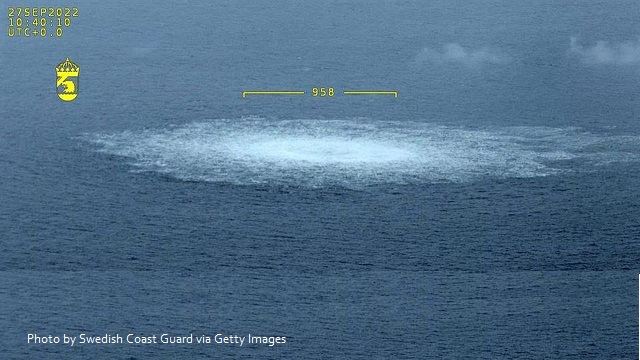
A Ukrainian military officer involved with the country’s intelligence services allegedly played a leading role in the bombing of the Nord Stream pipelines in 2022, sources familiar with the matter told The Washington Post.
Roman Chervinsky, a 48-year-old colonel who served in Ukrainian Special Forces, was the “coordinator” of the operation to blow up the pipeline, according to the Post. Chervinsky’s role allegedly involved managing logistics for the team that rented a sailboat and used diving equipment to plant explosives on the pipelines.
Chervinsky allegedly took orders from senior Ukrainian officials who reported to the Ukrainian Gen. Valery Zaluzhny, sources familiar with the matter told the Post. Chervinsky denied being involved in sabotaging the pipeline.
“All speculations about my involvement in the attack on Nord Stream are being spread by Russian propaganda without any basis,” Chervinsky told the Post.
Chervinsky served in a unit of the Ukrainian Special Forces focused on resistance in Russian-occupied areas earlier in the conflict, sources familiar with the matter told the Post. He reported to Maj. Gen. Viktor Hanushchak who communicated with Zaluzhny.
Chervinsky previously served in the Ukraine’s military intelligence agency as well as Ukraine’s Security Service, the SBU, according to the Post.
Authorities allege that Chervinsky, who was arrested in April, acted without permission and that the operation gave away the coordinates of a Ukrainian airfield, prompting a Russian rocket attack that killed a soldier and injured 17 others. Chervinsky is being held in a Kyiv jail on charges that he abused his power stemming from a plot to lure a Russian pilot to defect to Ukraine in July 2022.
“All of those involved in planning and execution reported directly to [chief of defense] Zaluzhnyy, so Zelensky wouldn’t have known about it,” according to intelligence obtained by the CIA allegedly shared by Jack Teixeira, a member of the Massachusetts Air National Guard. Officials in multiple countries privately said they did not believe Zelensky approved the Nord Stream attack, according to the Post.
Accusations flew following the pipeline explosion, with world leaders blaming a multitude of different actors. Former President Donald Trump hinted that it might have been done by the U.S. and European Parliament representative for Poland Radek Sikorski appeared to cheer on the pipeline explosion. Some pointed to Russia and Vladimir Putin for the bombings, according to The Hill.
All content created by the Daily Caller News Foundation, an independent and nonpartisan newswire service, is available without charge to any legitimate news publisher that can provide a large audience. All republished articles must include our logo, our reporter’s byline and their DCNF affiliation. For any questions about our guidelines or partnering with us, please contact licensing@dailycallernewsfoundation.org.
http://drrich.wpengine.com/wp-content/uploads/logo_264x69.png00The Daily Callerhttp://drrich.wpengine.com/wp-content/uploads/logo_264x69.pngThe Daily Caller2023-11-12 15:05:542023-11-12 15:08:55Senior Ukrainian Military Officer Behind Nord Stream Pipeline Attack: REPORT
The Hamas terrorist attack on Israel was just a recent atrocious assault against Western civilization, a war that started a hundred years ago. In fact, I have been writing about that global cabal, which was waging WWIII against Western civilization for forty-two years. “This global cabal is capable of anything. They are already responsible for the deaths of millions. They use lies as easily as they breathe. Everywhere they have gone, there is death and destruction.” If you read my column: Putin’s Socialist Revolution in America published October 6, 2023, one day prior to the Hamas attack, you will learn about this global cabal—I called them a new “Axis of Evil” under the Russian umbrella.
Yes, this global cabal is the new” Axis of Evil,” under the Russian umbrella: Cuba, China, North Korea, Syria, Iran and Venezuela. But only people who read my columns or books know that. Iran is a Russian proxy and to know Iran you have to know Russia and its Intel. Because there are the patterns of Soviet Socialism, Russia implements into all its proxies, including the terror groups, especially in the Mideast: ISIS, Taliban, al-Qaeda, Hezb’allah, Hamas, and others. That was the essence of Stalin’s legacy: brainwashing Muslims groups, and marring Islam with Communist ideology. That way we got a Fascist-Jihad of Stalinist era in the 20th century. A misleading system of disinformation, an instrument designed by Stalin was executed by all his devoted disciples after his death. To educate America, I have been writing about that system of Stalinist Soviet Socialism, which I called Soviet Fascism, for the last forty-two years…
The new “Axis of Evil—the Evil Doer” has not been known to the vast majority of Americans. Yes, all mentioned above terror groups have the same parents–the Russian Intel. The KGB Chairman Yuri Andropov 1967-1982 has designed two-states solution in the Mideast, when the KGB has begun controlling Hamas—anti-Semitism has united them. The same unity had been achieved for all terror groups in the 20th century. We have dealt with strategic partnerships against Western civilization. Russian expansion of Soviet Socialism, which I called Soviet fascism was the goal for the Mideast region. I have been writing this story of the people’s suffering, griefs, and killings to make you familiar with the KGB’s Mafia/Army—the Evil Doer for forty-two years. You can find the details in my columns…
Forty-two years is a pretty long-time and I am tired, very tired of being alone writing to educate and convince the American people with my poor English. Nobody helped me. I was writing about terrorist Russia and its expansion of terrorism throughout the globe. A devoted disciple of Stalin/Andropov Vladimir Putin was doing that for the last thirty years… I couldn’t believe a word, listening from the actively-destructive Biden’s team, I don’t trust them… Can you imagine how excited I’ve become reading the column with the warning, I was yelling for forty-two years:
“People living in modern civilization—especially in the West—play by the rules, live within their means, love their families, and cherish their children’s future. We get up in the morning, go to our jobs, or to our tasks, not thinking about any threats that may be formulating to destroy our lives. And yet, the threats are there, and they persist. For those of us who do our research and read what these enemies are plotting against us—and we do have enemies—we start to understand how dangerous they really are, these globalist elites. They have told us numerous times, both in print and in speech, what they are planning. And yet they are ignored when all we have to do is take them seriously and act accordingly.” War Is Upon You, By Ray DiLorenzo, Canada Free Press, October 8, 2023
The author described the current events in the world, as if he came from the society of Soviet Socialism. But he didn’t indicate any specific country, only a new foreign predicament in America. He loves America, and is suffering watching how America loses its moral compass. I felt an alarm and pain in his every word. I believe, he read my columns or books and now expressing his sincere warning to Americans and the world:
“Anyone can see that society is changing, and not for the better. The Greatest Generation is long gone. The self-image and desire generation of fifty years ago, especially in government, is hanging on by threads, unwilling to give in to time and poor decisions. We are now witnesses to a society and a generation no longer American, heavily influenced by social media, with narcissism transformed into amorality, hysteria, self-indulgence, and violence.” By Ray DiLorenzo– Friday, October 6, 2023
Meanwhile the killing in Israel is going on… I’d like to remind you of the Vietnam war, because the Russian military Doctrine is active here in the Hamas assaults of Israel. Do you remember the Vietnam War? The North Vietnamese used the tunnels for unexpected access and assaults against the South Vietnamese. You can see exact the same Russian Doctrine used against Israel by Hamas. History is the mother of all sciences and I know who helped the North Vietnamese. I had a client, a Soviet pilot, who participated in the Vietnam War. You can find this story in my books and articles. There is another Stalinist Doctrine: “No lives matter.” Have you heard Hamas tell Palestinians to stay in Gaza and not evacuate: for Hamas “No lives matter,” Stalinist Doctrine is alive and well in the 21st century Mideast. The Russian tentacles are all over the region and the globe.
“Those who don’t know Stalinist legacy of the 20th century will pay a dear price for their ignorance. “I wrote that one day prior to the Hamas invasion: Putin’s Socialist Revolution in America: The Stalinist Mexican Cartels, October 6, 2023. I had in mind Fox News and the firing of two talented men: Dan Bongino and Tucker Carlson. I knew that Putin was preparing something bad. I wrote it purposely to alert the ignorant and remind them about Holocaust of Jews by German-Nazis. It is for a reason I have been writing about Soviet Fascism for decades. Russia is a terrorist, anti-Semitic country with close and long-term relations to all Middle Eastern countries through its KGB, which was implementing Soviet Fascism there, while the FBI didn’t know Russia and the KGB’s Mafia/Army—the Evil Doer, I’ve been writing about for decades. I had to write it–the FBI has not protected us!
Moreover, “According to a White House pool report, President Biden told the two dozen who were in attendance why he decided to run for president in 2020. He mentioned Charlottesville and the events that transpired there in 2017 as his reason for running.” Joe Biden has a meltdown that leaves Democrats sick with worry, The Federalist Wire, September 26, 2023. Reading this information my antenna went up. As a matter of fact, I was writing about Charlottesville in many columns: like Jan.6, on Capitol Hill, Charlottesville was the KGB’s Mafia/Army—Evil Doer operation to build a fascist movement in America.
A Controlled Opposition
Charlottesville happened in August 2017, in Unite the Right, the violent white supremacist rally in Charlottesville, Virginia. In fact, it was the KGB operation in cahoots with the Democrat Party to establish and built a fascist movement in America. The designers and organizers were the Governor of Virginia Terry McAuliffe and the FBI deputy Director Andrew McCabe. I wrote this in my column: Origin of the Washington Spy Ring and the Swamp, March 31, 2018:
“Yes, firing Andrew McCabe was the beginning of a huge international case of conspiracy against the U.S.A, because those two are the accomplices of the crime or even crimes. To investigate the case, you have to know the KGB well and I’ll try to give you some tips. It was Andropov’s idea to invent a “controlled opposition.” The KGB had practiced it in Russia for many years. It is very simple to achieve, just infiltrate the opposition with a couple of people, promote them to the leadership and act in a way that is beneficial for your initial design. That exact move was realized and implanted in America. The result you see in August 2017, in Unite the Right, the violent white supremacist rally in Charlottesville, Virginia.’’
It was the time for the FBI to do their job. But as we found out today the FBI didn’t want to do the job and the Democrat Party had been left not being exposed… I don’t want to impose my opinion and conclusion, I rely on each of you to make your own decision, watching Biden/Obama and their team for many years. We are living in the predicament of global disinformation where truth is hard to find. By the way, the House of Representatives, the only Republican power, has no Speaker for 12 days, because of the same dysfunctional FBI. I hope, sooner or later the truth will shine to disinfect the globe, I hope…You can read my columns for free now.
Don’t be surprised by the large-scale rally at the U.S. Colleges and Universities in defense of Hamas. Just watch TV. Have you heard about the group Students for Justice in Palestine? They are sponsored by Hamas and Iran. And they are not alone, there are a hundred of these organizations around the world. Please, read about one of them:
National Students for JUSTICE IN PALESTINE
Supporting over hundred Palestine solidarity organizations across occupied Turtle Island, we aim to develop a student movement that is connected, disciplined, and equipped with the tools necessary achieve Palestinian liberation
Please, pay attention to the last two words—Palestinian liberation. These words should bring your memory back to Yasser Arafat, President of Palestinian Liberation Organization–PLO. Arafat’s lieutenant Abbas is still there. To make a long story short, read my columns and learn that Yasser Arafat was recruited by the KGB’s Mafia/Army in 1957. The cycle of War Crimes committed by the Russian Government and its KGB’s Mafia/Army—the Evil Doer is in front of the world. Now, as usual I rely on people’s imagination and knowledge…
Today I receive an email from Rep. Chip Roy–This is existential.
The Biden administration is allowing over 10,000+ illegal crossings a day – mostly adult males from 150+ countries, including these latest numbers from CBP:
Syria: 538
Yemen: 139
Iran: 659
Iraq: 123
Afghanistan: 6,386
Lebanon: 164
Egypt: 3,153
Pakistan: 1,613
Mauritania: 15,594
Uzbekistan: 13,624
Turkey: 30,830
As we watch what is going on in Israel right now, how can we be safe in America without securing our border?
My fellow Americans!
The U.S.A. is under an existential threat—we have Hamas and the KGB’s Mafia/Army—the Evil Doer with their deadly activities on our soil! The Killing of Western Civilization is on a progress, before your eyes!
Equip yourselves with knowledge and act decisively! Save the American Constitutional Republic for our children, grandchildren, and the world!
http://drrich.wpengine.com/wp-content/uploads/logo_264x69.png00Simona Pipkohttp://drrich.wpengine.com/wp-content/uploads/logo_264x69.pngSimona Pipko2023-10-16 05:27:302023-10-16 05:31:04The Killing of Western Civilization