State’s Spending on Illegal Immigrants Blows Budget by 611%

Facing a budget pinch, Colorado lawmakers are cutting spending to largely sustain funding for a program subsidizing “pregnant people” regardless of immigration status.

“Cover All Coloradans” is expected to cost 611% more than originally projected this year, according to the state Legislature’s Joint Budget Committee.

The costly program is now a focus of a U.S. House race as the Trump administration’s Centers for Medicare and Medicaid Services investigates Colorado’s spending on health care for illegal immigrants.

Late Tuesday and early into Wednesday, state lawmakers on the Joint Budget Committee drafted a proposal with significant budget cuts, the Colorado Public Radio reported. The cuts included a 2% reduction in Medicaid spending, a $300 million reduction in state tax refunds, cuts to services for adoptive families, reduced funding for law enforcement, and allowing state colleges and universities to hike tuition.

However, Cover All Coloradans was capped to prevent future cost overruns but was not reduced. Future enrollment in the proposal is set at 25,000, and costs are capped at $96 million. The proposal still has to be passed by the full Legislature.

“Democrats are more committed to Cover All Coloradans than most other state programs, but the 611% above estimates is a real headache for them,” Republican state Rep. Carlos Barron told The Daily Signal.

The program covers children and pregnant women who would otherwise qualify for Medicaid but for their immigration status.

When Democrat Gov. Jared Polis signed the bill creating the program in 2022, supporters estimated it would cover about 3,700 people when it took effect in 2025. The program now covers about 28,000 people, and estimated costs have soared from $14.7 million to $104.5 million in the coming fiscal year. This has contributed to the state’s $1.5 billion budget shortfall.

Colorado Department of Health Care Policy and Financing spokeswoman Natalie Coulter told The Daily Signal, “We don’t have anything further to add on this topic.”

The department’s website states, “A new law called ‘Cover All Coloradans’ helps children and pregnant people get health coverage, no matter what their immigration status is.”

The department lists as eligible applicants “pregnant people,” “people whose pregnancy ends on or after Jan. 1, 2025,” and “any child 18 or younger.”

The program encourages illegal immigrants to “stay illegal,” said Barron, whose family legally immigrated from Mexico to the United States when he was a child.

“Taxpayer dollars are being misused for people who are noncitizens in Colorado. These resources should be refocused on the citizens of Colorado with their tax dollars,” Barron said.

Rep. Gabe Evans, R-Colo., who represents the state’s 8th Congressional District, is a former state legislator and said the program is part of an ongoing problem.

“For years, Governor Polis and Colorado’s Democrats have prioritized illegal immigrants over hardworking Colorado families—driving up costs, straining our health care system, and forcing cuts to services Coloradans depend on,” Evans told The Daily Signal in a statement.

The Justice Department has identified Colorado as a “sanctuary state.” The state has spent about $563 million on illegal immigrants since 2021, Fox News reported.

The Republican National Committee notes that two Democrats seeking to challenge Evans in November voted to create the program in 2022.

State Rep. Manny Rutinel and state Rep. Shannon Bird, chairwoman of the Joint Budget Committee, are running in the June Democratic primary for the 8th Congressional District. Bird voted for the program in the original 2022 legislation and, in 2025, co-sponsored legislation that fully funded it. Rutinel voted to fund the program.

Neither campaign responded to inquiries for this story. Rutinel’s legislative office also did not respond.

The Colorado Department of Health Care Policy and Financing issued a statement to The Colorado Sun, saying, “One of the primary drivers in total expenditure in this program has been higher-than-anticipated and growing enrollment.”

This week, the department’s executive director, Kim Bimestefer, announced she would resign amid criticism from lawmakers over management of the department and the budget shortfall.

The governor’s office did not respond to inquiries from The Daily Signal for this story.

Colorado House Speaker Julie McCluskie, a Democrat and one of the authors of the 2022 bill creating the program, told The Colorado Sun, “We made those decisions based on the forecasts in front of us.” She added, “There have been unanticipated impacts.”

AUTHOR

Fred Lucas is chief news correspondent and manager of the Investigative Reporting Project for The Daily Signal. He is the author of “The Myth of Voter Suppression: The Left’s Assault on Clean Elections.” Send an email to Fred. Fred on X: .

US Rescues Second Crew Member From Jet Downed In Iran, Trump Says

The U.S. military rescued the second crew member from a plane shot down over Iran, President Donald Trump and current and former U.S. officials said.

Trump announced the crew member’s rescue Sunday in a Truth Social post. A U.S. Air Force officer whose plane was downed above Iran was retrieved in a daring Saturday night mission using U.S. Special Operations forces deep behind enemy lines, current and former U.S. officials told The New York Times (NYT). He was reportedly a weapons officer.

“WE GOT HIM! My fellow Americans, the United States Military pulled off one of the most daring Search and Rescue Operations in U.S. history, for one of our incredible Crew Member Officers, who also happens to be a highly respected Colonel, and who I am thrilled to let you know is now SAFE and SOUND!” Trump wrote.

“This brave Warrior was behind enemy lines in the treacherous mountains of Iran, being hunted down by our enemies, who were getting closer and closer by the hour, but was never truly alone because his Commander in Chief, Secretary of War, Chairman of the Joint Chiefs of Staff, and fellow Warfighters were monitoring his location 24 hours a day, and diligently planning for his rescue,” the president continued.

Trump said he ordered “dozens of aircraft” to take part in the rescue operation, noting that the officer had suffered injuries but would recover. He wrote that the U.S. government did not confirm the rescue of the other crew member in order not to “jeopardize our second rescue operation.”

The officer’s rescue came after a two-day life-or-death struggle between American and Iranian forces to reach the wounded officer, officials told the NYT. U.S. commandos reportedly retrieved the airman in a large operation involving hundreds of special operations personnel. No U.S. casualties were suffered by the extraction team, according to a senior U.S. official. All special forces and the weapons officer came back safely and planes took the extracted officer to Kuwait for treatment, the NYT reported.

“WE WILL NEVER LEAVE AN AMERICAN WARFIGHTER BEHIND!” Trump wrote, saying all Americans should be proud of the operation. “GOD BLESS AMERICA, GOD BLESS OUR TROOPS, AND HAPPY EASTER TO ALL!”

An F-15E Strike Eagle was first reported shot down over Iran on April 4, citing officials. Officials later said that one of the crew members was recovered. Iranian state media had reported shooting down an aircraft, claiming it was an F-35. Images appeared to match an F-15, Axios reported on April 4. The U.S. and Israel first struck Iran on Feb. 28, marking the beginning of Operation Epic Fury.

The Daily Caller reached out to U.S. Central Command for comment.

This is a developing story.

Editor’s note: Article updated with additional information on the operation.

AUTHOR

Justin Bailey

Associate Editor

RELATED ARTICLE: ‘Time Is Running Out’: Trump Warns Iran To Open Strait Of Hormuz Within 48 Hours

EDITORS NOTE: This Daily Caller column is republished with permission. ©All rights reserved.

Democrats’ HIT LIST: Subpoena Plans If They Win House

This “political” party, and I use the term loosely, exists to destroy. They have no appetite or desire to better the country, help the American worker or defend the homeland. They exist to destroy those that do.

A “party” in name only, bereft of purpose beyond sabotage, indifferent to the country’s welfare, the worker’s prosperity, or the nation’s defense—its defining mission is to cripple and destroy those who still pursue them.

Dems’ hit list: Subpoena plans if they win House

By: Jim VandeHei

If Dems win the House in midterms (likely), expect them to target moguls and major corporations for subpoenas, Axios CEO Jim VandeHei writes in his new newsletter for CEOs.

The target list includes monopolies, AI and social media.

The reality: Dems know the White House will blow off subpoenas, same as during President Trump’s first term.

The strategy: Businesses and billionaires have to answer subpoenas. So paint them as villains to undermine Trump.

Look for the subpoena list to include:

  • Law firms that signed deals with President Trump.
  • Media giants that settled.
  • Donors to the White House ballroom.
  • Top execs who negotiated to give the government a stake in their companies.
  • Profit-enablers of Trump relatives or families of Cabinet members.

Continue reading.

AUTHOR

RELATED ARTICLES:

Ro Khanna Vows Democrats ‘Will Impeach’ Trump If They Win The House

OUTRAGE: Judge Gives Somali Fraudster Who Stole Millions Just ONE YEAR

LEAKED AUDIO: Muslim Democrat Senate Candidate Won’t Touch Khamenei Death—“Dearborn Is Sad”

The Legislative Vanguard: The Sharia-Free America Caucus

Palm Beach International Airport is Now Officially “President Donald J. Trump International Airport!”

Hamas Isn’t Disarming — The Narrative Is

FBI: Muslim Who Attacked Michigan’s Largest Synagogue “Purposely Targeted Jewish Community” In “ACT OF TERRORISM”

EDITORS NOTE: This Geller Report is republished with permission. ©All rights reserved.

NEWSOM’S DEATH FRAUD EMPIRE: $50M Scam Paid People To Pretend They Were Dying

Federal authorities in California have dismantled a sprawling $50 million hospice fraud ring in a coordinated April 2 crackdown dubbed “Operation Never Say Die,” charging 15 individuals and arresting eight tied to sham hospice operations across Southern California.

The scheme allegedly targeted vulnerable individuals—many not terminally ill-paying them kickbacks to pose as patients so operators could fraudulently bill Medicare, with some facilities showing wildly abnormal “non-death” discharge rates as high as 90%. Key suspects are accused of billing millions, using aliases to evade criminal histories, and even running operations from prison, while siphoning taxpayer funds into luxury lifestyles—part of what federal officials describe as a rapidly expanding “kingdom of fraud” in California’s hospice industry.

California has reportedly lost at leat 180 billion dollars to fraud, high ranking official and experts confirm.

This is a historic scandal. Newsom needs to resign in disgrace.

CHRIS RUFO: “Experts from Harvard, from the Department of Health and Human Services, from LexisNexis fraud division, have told us that fraud in California is unprecedented, it represents the largest financial crime in American history, and scammers have been stealing billions of dollars per year.”


Federal authorities in California have announced a massive takedown of a $50 million hospice fraud operation, dubbed “Operation Never Say Die,” with raids and arrests occurring on April 2, 2026.

Key Details of the Bust:
  • Arrests and Charges: Eight individuals were arrested, and a total of 15 people—including nurses, a psychologist, and a chiropractor—were charged in connection with fraudulent schemes.
  • Location: The fraudulent activities were centered in Southern California, with raids and arrests in locations such as Anaheim, Covina, Glendale, and Tarzana.
  • The Scheme: Defendants were accused of running “sham” hospice facilities that targeted vulnerable people—many of whom were not terminally ill—and paying them kickbacks (sometimes $300 a month) to pose as patients to bill Medicare.
  • Key Suspects:
    • Lolita Minerd (Artesia): Accused of billing over $9 million and operating a hospice with an 85% “non-death” rate.
    • Gladwin and Amelou Gill (Covina): Allegedly used their daughter’s name to bypass criminal histories and operate a hospice that billed $5.2 million.
    • Nita Palma (Glendale): Accused of running fraudulent hospices while incarcerated in federal prison for previous fraud charges.
  • Scale of Fraud: Investigators found that one facility had a 90% non-death discharge rate, far exceeding the national average. The fraudulent funds were used for personal expenses, including luxury items and international travel.
    (Los Angeles Daily News)

This investigation is part of a broader crackdown on what federal officials describe as a “kingdom of fraud” in California’s hospice industry, which has seen explosive growth in the Los Angeles area.

AUTHOR

RELATED ARTICLE: EXCLUSIVE: California Schools Can’t Tell Difference Between Jan 6 And KKK

EDITORS NOTE: This Geller Report is republished with permission. ©All rights reserved.

The Special Relationship is Dead

Remember how we used to think of France? “Lafayette, we are here!” are the words attributed to General Pershing on July 4, 1917 at Lafayette’s tomb, not long after the Yanks arrived in Paris.

After World War II, NATO was headquartered in the Paris suburb of Saint Germaine-en-laye, where incidentally my youngest daughter was born. General de Gaulle evicted us in 1966 when he pulled France out of NATO. President Lyndon Johnson reportedly asked him if he also wanted us to take the graveyards full of the American dead who had fallen in Normandy and Bastogne.

That special relationship never fully recovered.

Nixon and Pompidou tried to revive it in 1972, when they signed a (still) secret nuclear weapons assistance pact. I called it a “second marriage” in my book, The French Betrayal of America, and it ended in divorce in 2003 when French president Chirac preferred Saddam Hussein’s oil to his erstwhile American ally.

So yes, Special Relationships can definitely die. So can alliances as big as NATO.

British Prime Minister Keir Starmer has repeatedly huffed and puffed in recent weeks about not joining the war with Iran, initially denying us the right to use the massive US-UK air base on Diego Garcia that was built with US taxpayer dollars.

He ultimately relented, and we moved B-2 Spirit bombers to the Indian Ocean. That shortened their flying time to Iran from thirty-six hours to just under six.

Then on March 20, Iran launched two 4,000 kilometer range missiles toward the Chagos Islands. One of them failed mid-flight, and the other was shot down in the upper atmosphere by a SM-3 Standard missile fired from a US warship.

Those missiles showed not only that Iran could hit Diego Garcia. They could also hit London.

Since then, Prime Minister Starmer has not stopped wetting his pants. Not a day goes by without some slavish pandering aimed at the Iranian mullahs, and Muslims in general.

As I pointed out earlier this week on London’s GB television, Starmer appears to believe that because the Iranians have not yet launched missiles against London, the UK is safe.


He appears to believe that if he slavishly tells the Iranians twice a day that Britain will not send warships to help the United States reopen the Strait of Hormuz, Britain will be safe.

Of the fifteen thousand targets hit in Iran since the war began, not a single one was taken out by the Royal Air Force or the Royal Navy, and Keir Starmer likes to remind the Iranians of this every single day.

He is truly the Mouse that roared.

The US and the UK once extolled our “special relationship.” Not only did we go to war together, repeatedly; we also shared secrets.

At one point, the US and the UK shared intelligence they wouldn’t dream of giving to Israel, even when it related to WMD threats to Israel from the likes of Saddam Hussein. You can ask Jonathan Pollard about that.

The UK and many other NATO allies have helped us in the past to defend international shipping from Somali pirates. As recently as December 2023, in Operation Prosperity Guardian, they helped us keep open the Red Sea by attacking the Houthis in Yemen.

Of course, at the time Donald Trump was not in the White House and Britain had a conservative prime minister, Rishi Sunak.

President Trump is understandingly furious with the UK and our NATO partners. No, the US has never formally requested NATO assistance against Iran, but gee, you’d have thought that some of our NATO “allies” might want to join an effort to free the world of a terrorist threat menacing us all?

Well, you would have thought wrong.

Besides Israel, which is our full partner in this war, our best ally to date has been Nichervan Barzani, president of the Kurdish Regional Government in Iraq.

On March 17, Trump had special envoy Tom Barrack make a special request to Barzani. Would he consider reopening the Kirkuk-Ceyhan pipeline so Iraqi government oil could flow to Turkey and from there to world markets?

That pipeline is a sore subject for the Kurds. They closed it down over three years ago because Baghdad was cheating them out of the oil revenues they were constitutionally pledged to divide between them.

Put simply, Baghdad stole the oil from the Kurds and pocketed the proceeds, without so much as a thank-you. (Kirkuk officially remains a “disputed territory,” claimed by both Baghdad and Erbil, but the Kurds consider it to be historically part of the Kurdish region).

But Barrack told Barzani that the request to reopen the pipeline was coming directly from President Trump, and so Barzani immediately agreed. The very next day, Iraq started sending 250,000 barrels of oil per day through that pipeline to world markets. It was just one of many mitigating acts President Trump has taken to keep oil prices from skyrocketing.

Has the UK increased its oil production in the North Sea? Nope. In fact, they have been shutting down oil platforms, replacing them with wind and solar.

Has the UK considered perhaps a waiver on its renewable energy policies in view of rising oil prices? Or perhaps just to help an ally?

No, again.

The UK and our NATO “allies” have been banging their tin pots for years to get the US to pay for their war in Ukraine.

During his first term, President Trump helped to rearm the Ukrainian army, supplying them with Javelin anti-tank missiles starting in 2018. Thanks to those missiles, the Ukes were able to smash the initial Russian armored column that was heading toward Kyiv in February and March 2022.

Altogether, we spent an estimated $350 billion to help our NATO allies defend Ukraine against the Russians. And they won’t even send us a few minesweepers to help reopen the Strait of Hormuz so NATO can buy oil?

The President is understandably furious with the UK, NATO, and our European “allies,” so much so that he has floated the idea he might unilaterally withdraw from the alliance.

Schumer was quick to tell the media that Democrats would never give the president the 2/3 vote in the Senate he needs to withdraw from a treaty organization. But the president already secured a legal opinion in 2020 arguing that as president, he has executive authority over treaties and can indeed withdraw without Senate approval — and see y’all in court for the next twenty years.

The Special Relationship is dead, and not because of Trump. And yes, alliances can die, too.

I discuss this, and the repercussions for Russia’s war in Ukraine, on this week’s Prophecy Today Weekend. As always, you can listen live at 1 PM on Saturday on 104.9 FM and 550 AM or by using the Jacksonville Way Radio app.

Otherwise, you can listen to the podcast later on.

Yours in freedom — and blessings to you and your family, and to all those deployed defending our freedom this Easter.

©2026 . All rights reserved.

RELATED ARTICLE: “THE USA WILL REMEMBER:” Trump Slams France for Blocking American Military Aircraft


Website: kentimmerman.com

Ken Timmerman’s 14th book of non-fiction, THE IRAN HOUSE: Tales of Revolution, Persecution, War, and Intrigue, can be ordered by clicking here or by viewing my author’s page, here. 

Raising Olives in Provence, can be ordered by clicking here.

Congressional Vote Needed to Expel Florida Congresswoman Indicted for $5 Million Theft

Six members of the U.S. House of Representatives have been expelled in history, with three removed for disloyalty during the Civil War and three for criminal conduct, including fraud. Of those, Michael Myers (D-PA) was expelled in 1980 after being convicted of bribery in the Abscam scandal, and James Traficant (D-OH) was expelled in 2002 following a conviction on charges including bribery, racketeering, and tax evasion, after misusing campaign funds and forcing staff to perform personal labor.

George Santos (R-NY) was expelled in 2023 based on findings by the House Ethics Committee that he committed fraud and misused campaign funds, though he has not yet been criminally convicted. The committee report detailed that Santos fabricated his resume, stole campaign donations, and spent funds on personal luxuries, including Botox and an adult website. While Santos is currently facing 23 felony counts including wire fraud and money laundering, his expulsion was based on ethical violations rather than a criminal conviction.

Other members disciplined for financial misconduct include:

  • George V. Hansen (R-ID), reprimanded in 1984 for false statements on financial disclosures.
  • Charles Rangel (D-NY), censured in 2010 for improper fundraising and tax violations.
  • David Schweikert (R-AZ), reprimanded in 2020 for misusing taxpayer funds and campaign finance violations.

This case highlights the basis for public mistrust in government accountability. While most Americans live from day to day, paycheck to paycheck, just check out how Rep. McCormick lived!

Congressman Greg Steube filed H. RES. 901 to expel McCormick from Congress

Indicted Dem Rep Sheila Cherfilus-McCormick Spent $200,000 in Taxpayer Funds on Luxury Chauffeur Service

Florida congresswoman doled out taxpayer funds to Easy Way Luxury, which offers the ‘pinnacle of luxury and sophistication.’

Case Number: The case is under the District Court for the Southern District of Florida, case number 25-cr-20500.

House Ethics Report: The House Committee on Ethics released a statement of alleged violations in January 2026, stemming from a 59-page investigation that noted a $6M+ increase in her 2021 income driven by the funds in question.

Excerpt from the Indictment:

From on or about August 11, 2021, through on or about August 18, 2021, in the Southern District of Florida, and elsewhere, the defendants, SHEILA CHERFILUS-MCCORMICK and EDWIN CHERFILUS, did knowingly and willfully embezzle, steal, purloin, and convert to their own use money and a thing of value of the United States and of any department and agency thereof, that is, FEMA, the aggregate value of which exceeded $1,000, that is, $5,007,271.50, to which the defendants were not entitled, in violation of Title 18, United States Code, Sections 641 and 2. COUNT3 Conspiracy to Commit Money Laundering (18 U.S.C. § 1956(h))

Sheila Cherfilus-McCormick, serving Florida’s 20th Congressional District, has highlighted her alignment as a “strong Democrat” and has garnered support from several high-profile Democratic leaders and organizations.

Key Endorsements and Support

Nancy Pelosi: Former Speaker of the House endorsed Cherfilus-McCormick, praising her as “masterful at bringing people together” and focused on shared values.

Democratic Leaders: Cherfilus-McCormick has noted support and positive recognition from leaders such as Frederica Wilson, Val Demings, Lois Frankel, and Debbie Wasserman Schultz.

Emgage PAC: Endorsed her, citing her commitment to healthcare access and economic opportunity. Emgage PAC +1

Self-Described “Strong Democrat” Platform

Cherfilus-McCormick describes herself as a “strong lifelong democrat” focused on working with President Joe Biden and democratic leadership on issues such as: Emgage PAC +1

Fixing the housing crisis

Tackling inflation

Growing the local economy

Expanding affordable healthcare

She has emphasized her efforts in Congress to fight for these issues. Sun Sentinel

Our American youths deserve a country and a Congress that uphold the law as families struggle to live within their means. Examples of Congressional excesses and egregious criminal greed by our leaders are breaking the hearts of our children, desperate for worthy role models and despondent when they see avarice rewarded.

Our Congress has thus far failed and refused – in the face of mountains of material evidence – to hold one of its own accountable for alleged self-aggrandizement in excess of $5,000,000 of taxpayer crisis relief funds.

How many, many, many suffering crisis-stricken American families could have been helped with their shares of $5,000,000?

How many, many, many American youths are left without worthy role models whenever leaders are not held accountable?

How many more disillusioned American children will give up their trust in their government and turn their allegiance away from this nation?

©2026 All rights reserved.

NEWSOM’S EMPIRE OF FRAUD: 25% of California Medicaid Looted as Billions Vanish Under Newsom

Multiple senior HHS officials estimate that, under Gavin Newsom, California’s state Medicaid program has lost 25 percent of its budget to fraud. This would mean it is currently losing $50 billion a year to scammers, fraudsters, and organized crime rings.

The scale is staggering: more lost to fraud than many states spend in total.

City Journal: Gavin Newsom wants California to be a model for the country. City Journal: Californians are beginning to ask: Where is all this money going? On paper, it funds hospitals, universities, schools, prisons, infrastructure, and other public services. But beneath the surface, something else is happening that California Governor Gavin Newsom does not want you to see: massive, systematic, brazen fraud. We conducted interviews with public officials, fraud experts, and political figures, and reviewed hundreds of pages of government reports, state audits, criminal indictments, and other public records on California fraud. From unemployment insurance and Medicaid to failed homeless initiatives and welfare programs, seemingly every state program has been compromised by criminals. The best estimates suggest that, on the governor’s watch, fraudsters, scammers, and organized crime rings have stolen at least $180 billion from taxpayers. Welcome to Gavin Newsom’s empire of fraud.

The scale of the fraud reported here is staggering. California is losing $50 billion a year to Medi-Cal fraud alone.

That’s more than 29 states spend on their entire budgets.

AUTHOR

POSTS ON X:

EDITORS NOTE: This Geller Report is republished with permission. ©All rights reserved.

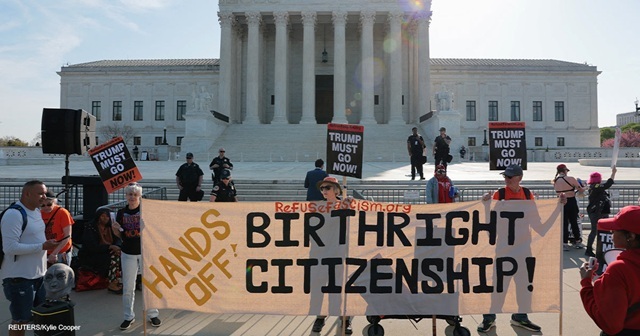
‘RENT-A-WOMB”: Birthright Citizenship Case Argued Before the Supreme Court

Most Americans have no idea how birthright citizenship is being wildy abused by adversarial nations and actors — turning it into a loophole, a weapon, and a pipeline.

A Chinese billionaire had over a hundred babies via U.S. multiple surrogates. These babies were send back to China, indoctrinated by CCP. After 18, they will come to America to live and vote. Supreme Court should end birthright citizenship. Stop the soft power invasion.

President Trump called on the Supreme Court to do the right thing and abolish birthright citizenship for illegals and migrants

“Birthright Citizenship has to do with the babies of slaves, not Chinese Billionaires who have 56 kids, all of whom “become” American Citizens. One of the many Great Scams of our time!”

“This is a glaring red line for the Supreme Court justices that they don’t get to give away citizenship. They don’t have that power,” Mike Davis,founder of judicial advocacy group Article III Project, told The NY Post. “We the people never agreed to give this away.”
“These justices need to follow the law or they’re going to lose their legitimacy,” he added. “There’s no more important of a case before the Supreme Court.”

POLITICO: Supreme Court justices today seemed skeptical of President Donald Trump’s push to end birthright citizenship, a seismic case with the potential to upend life for immigrant communities in California and across the country. In a precedent-busting move, Trump, himself, sat in the courtroom as Solicitor General John Sauer defended the president’s executive order that would deny U.S. citizenship to children of undocumented immigrants and foreigners on temporary visas, Josh Gerstein reports. The case could have an outsized effect on California, where more than one-quarter of residents are foreign-born — the biggest population of immigrants in the nation. Despite Trump’s presence, the justices lobbed pointed questions at Sauer and took issue with some of the Trump administration’s arguments. Chief Justice John Roberts called the examples it gave to support its claims “quirky.” “I’m not quite sure how you get to that big group from such tiny and idiosyncratic examples,” Roberts said. Even Justice Samuel Alito, one of the court’s most conservative members, expressed some concern about the order’s implications. “We have an unusual situation here because our immigration laws have been ineffectively and in some instances unenthusiastically enforced by federal officials,” Alito said. “So, there are people who are subject to removal at any time … but they have, in their minds, made a permanent home here and have established roots and that raises a humanitarian problem.” Birthright citizenship was established with an 1898 case involving a San Francisco man, Wong Kim Ark, who was born in California to Chinese parents and later had to fight to come back to the United States after leaving to visit his family.

Trump admin faces tough questions from skeptical Supreme Court over ‘quirky’ birthright citizenship arguments

By Ryan King and Josh Christenson, NY Post, April 1, 2026:

WASHINGTON — Supreme Court Justices from across the ideological spectrum pummeled a lawyer for the Trump administration with biting questions during oral arguments Wednesday over the president’s executive order on birthright citizenship.

While it wasn’t fully clear which way the high court will go in the landmark case, Republican-appointed justices made clear they were far from a lock for the administration — all while President Trump was in the room as the first sitting president in US history to observe oral arguments in person.

“You obviously put a lot of weight on ‘subject to the jurisdiction thereof.’ But the examples you give to support that strike me as very quirky,” Chief Justice John Roberts asked US Solicitor General John Sauer early on.

Existing birthright citizenship policy largely stems from the 14th Amendment, which stipulates that “all persons born or naturalized in the United States, and subject to the jurisdiction thereof, are citizens of the United States and of the State wherein they reside.”

Trump’s executive order, signed on Jan. 20, 2025, his first day back in the White House, attempts to eliminate birthright citizenship for children of illegal immigrants and temporary visitors to the US. That order has been blocked by the lower courts, which universally ruled against him on the matter.

Before the Supreme Court, a question was raised on Wednesday about whether Trump can do that based on the 14th Amendment and statutory law, namely the Nationality Act of 1940. GOP-appointed Justice Brett Kavanaugh repeatedly questioned why the high court should even get to the constitutional question when there’s a statute involved.

“Our usual practice, as you’re well aware, of course, is to resolve things on statutory grounds and not to do a constitutional ground,” Kavanaugh noted at one point.

Trump, who was joined by Attorney General Pam Bondi during his historic appearance, left the Supreme Court partway through oral arguments. However, it wasn’t fully clear whether that was because of frustrations with how arguments were going or his busy schedule.

All three of the Democrat-appointed justices sounded skeptical of the Trump administration’s arguments in defense of the executive order. The six Republican-appointed justices were very mixed, with Justices Samuel Alito and Clarence Thomas appearing sympathetic to the administration and the others asking tough questions of both sides.

Roberts, seen as a crucial swing vote, is often one of the more reserved justices, who typically asks just a few questions, though it varies from case to case. So his tough questions of Sauer were notable, though the chief justice did grill American Civil Liberties Union attorney Cecilia Wang aggressively as well.

Sauer had zeroed in on that language in his briefs to argue that illegal immigrants aren’t subject to the jurisdiction of the US, therefore their children aren’t guaranteed birthright citizenship. The solicitor general also pointed to exceptions in the existing birthright citizenship policy, such as foreign invaders, in his briefs. But Roberts seemed uneasy with that.

“You know, children, of ambassadors, children of enemies during a hostile invasion, children on warships. And then you expand it to the whole class of illegal aliens who are here in the country,” Roberts went on. “I’m not quite sure how you can get to that big group from such tiny and sort of idiosyncratic examples.”

Later, Roberts asked Sauer about how common so-called birth tourism is in the US, seizing on a key aspect of the Trump administration’s justification for the executive order.

“We’re in a new world now,” Sauer said, suggesting the framers of the 14th Amendment didn’t have to deal with that at the time.

“It’s a new world. It’s the same Constitution,” Roberts shot back.

Looming over the Supreme Court’s decision is precedent from the 19th century, namely the Supreme Court’s 1898 decision in US v. Wong Kim Ark, in which the high court held that a man born to Chinese immigrants was guaranteed automatic citizenship. As the Trump administration pointed out, that case involved legal, domiciled immigrants, rather than illegal aliens.

Fellow Republican-appointed Justice Neil Gorsuch, who like Roberts, bucked Trump in the tariff case, underscored that the US now has “laws against immigration that are much more restrictive than they were in 1880,” when the Supreme Court last decided major cases on birthright citizenship.

“Why wouldn’t we, even if we were to apply your own test, come to the conclusion that the fact that someone might be illegal is immaterial?” he asked Sauer.

“I’m not sure how much you want to rely on Wong Kim Ark,” he then chided after Sauer began to cite that precedent.

Another key precedent at play is the Supreme Court’s ruling in the 1884 case Elk v. Wilkins, which held that the children of Native Americans aren’t guaranteed birthright citizenship, something Congress later changed in statutory law. Gorsuch needled at one point Wang that “There’s a lot in Elk, and some of it’s not terribly helpful for you.”

AUTHOR

POSTS ON X:

EDITORS NOTE: This Geller Report is republished with permission. ©All rights reserved.

Trump Wants Rich Gulf States to Help Pay for the War

The Islamic Republic of Iran is, for the moment, a mid-range military threat to the United States, and will remain so until it can manufacture both nuclear warheads and the ballistic missiles capable of carrying them all the way to the east coast of America. It is a major threat to Israel, and the Israelis are fighting with everything they have got to limit Iran’s ability to hurt the Jewish state. Both Israel and the United States, in fighting Iran, are also helping to limit the damage Iran can do to the Gulf Arab states. Iranian missiles and drones have attacked seven of those states —Qatar, the UAE, Saudi Arabia, Kuwait, Bahrain, Iraq, and Oman. Those missiles and drones have hit oil and gas facilities, airports, desalination plants, power plans, anti-missile batteries, and much more.

Since February 28, when the war began, the American government has spent about $30 billion, and is now adding to that amount by about $1.2 billion a day. Trump, who frequently has bad ideas, has just had a good one. To wit, he believes that the fabulously rich oil states of the Gulf should be asked to contribute to the war effort. These states cannot fight, but they have plenty of money; collectively they have trillions of dollars, a small part of which should help pay the Americans for all the expenses they have incurred as they continue to do battle with the mad dogs of Tehran. More on Trump’s desire to be repaid in large part by the Gulf Arabs can be found here: “Trump interested in calling on Arab states to help pay for Iran war, White House says,” Reuters, March 30, 2026:

US President Donald Trump would be interested in calling on Arab countries to pay for the cost of the Iran war, White House Press Secretary Karoline Leavitt told reporters on Monday, adding that she thinks Trump would have more to say on the issue….”I think it’s something the President would be quite interested in calling them to do,” Leavitt said.”It’s an idea that I know that he has and something that I think you’ll hear more from him on.”…“Despite all of the public posturing you hear from the regime and false reporting, talks are continuing and going well. What is said publicly is, of course, much different than what’s being communicated to us privately,” Leavitt said.

The Iran war is not popular in the United States. A majority of the population fears that this war could become an expensive quagmire, as were the wars in Iran and Afghanistan. But Trump has no intention of getting bogged down in Iran, as the U.S. did in those previous two wars, by trying to remake the country. Trump does not plan to leave in situ an American army of occupation to remake the country, but rather, shares Israel’s goal of weakening Iran’s organs of oppression, the Islamic Revolutionary Guard Corps and the Basij, so severely that the people of Iran, 90% of whom are opposed to the present regime, can again rise up without fear of being immediately cut down. It is not only that the IRGC and Basij have lost men and materiel, but there is a serious drop in morale, with reports coming in of IRGC men leaving their units and refusing to return.

Another worry is the expense. People remember that in both Iraq and Afghanistan, the Americans ended up spending trillions of dollars. The former cost us $3 trillion, while he latter cost America $2.3 trillion. Trump can reassure Americans that he has no intention of spending anything like that sum and furthermore, unlike his predecessors, he will demand that the rich Arabs help out, for it is they who will benefit if the source of their trouble, the Islamic Republic, is so weakened militarily that it can no longer threaten any of its neighbors, or, in the best case, is even overthrown by a populace that has nothing left to lose.

Once the soothing news has spread that the Gulf Arabs will be contributing tens of billions of dollars to the United States Treasury, opposition to the war against Iran will lessen. Iran’s hope that domestic opposition in America to the war will bring it to a speedy close on Iran’s terms will disappear. And what is $25 billion, or $50 billion, or even $100 billion to such deep-pocketed states as Saudi Arabia, the UAE, and Kuwait, each of which possesses a sovereign wealth fund of more than $1 trillion?

AUTHOR

RELATED ARTICLES:

Anti-Israel Democrats Demand the Party Condemn AIPAC

Minnesota: Somalis Demand Schools Teach in Somali So Their Kids Don’t Learn English

UK’s Green Party Greenlights Antisemitism

In 1977, France Used a Guillotine to Execute a Muslim Pimp Running a Sex Grooming Gang

‘Pennsylvania men,’ Muhammed, Omar, Ibrahim, Emirhan, Ali, and Adeel, attack Jewish man, cover up the crime

Muslim Georgetown prof who justified slavery and rape now tells UK Muslim rape gang victims to ‘get over it’

Texas cities approved Ramadan proclamations recognizing ‘Islamic season,’ approved by city councils and mayors

EDITORS NOTE: This Jihad Watch column is republished with permission. ©All rights reserved.

Trump Claims Gold Star Families Told Him to ‘Finish the Job’ in Iran

President Donald Trump said the families of fallen soldiers told him to “finish the job” in Iran.

“Every single one of the people their loved ones said, ‘Please sir, please finish the job,’” Trump said in a primetime address to the nation on Wednesday night.

The address marked one month since the United States launched Operation Epic Fury against Iran.

Trump drew special attention to the American soldiers who lost their lives in the campaign.

“As we celebrate this progress, we think especially of the 13 American warriors who have laid down their lives to prevent our children from ever having to face nuclear Iran,” Trump said.

Trump recalled why he has traveled to Dover Air Force Base twice in the past month to witness dignified transfers.

“I wanted to be with those heroes as they returned to American soil,” he said. “We salute them and now we must honor them by completing the mission for which they gave their lives.”

The president also claimed the American mission has been successful.

“Tonight, Iran’s navy is gone. Their air force is in ruins. Their leaders, most of them… are now dead,” he said. “Their command and control of the Islamic Revolutionary Guard Corps is being decimated as we speak. Their ability to launch missiles and drones is dramatically curtailed, and their weapons, factories, and rocket launchers are being blown to pieces.”

“Our enemies are losing, and America, as it has been for five years under my presidency, is winning, and now, winning bigger than ever before,” Trump continued.

AUTHOR

Elizabeth Troutman Mitchell is the White House Correspondent for “The Daily Signal.” Send her an email. Elizabeth on X: .

RELATED POSTS:

‘MAJOR COMBAT OPERATIONS’: Trump Announces Joint US-Israel Operation Against Iran

4 Big Takeaways From Tulsi Gabbard’s Testimony on Capitol Hill

Heartland Polling: Iran War Is Unpopular, But Not Hurting Trump

RELATED VIDEO: Iran WAS the cancer of the Middle East: Sen Lindsey Graham

EDITORS NOTE: This Daily Signal column is republished with permission. ©All rights reserved.


The Daily Signal depends on the support of readers like you. Donate now

What to Make of the ‘Birthright Citizenship’ Case before SCOTUS

The U.S. Supreme Court on Wednesday heard oral arguments in what may be the most consequential case to come before the court in decades. At issue in Trump v. Barbara is an executive order President Donald Trump signed on his first day back in office, over one year ago, terminating automatic birthright citizenship. While the 14th Amendment states, “All persons born or naturalized in the United States, and subject to the jurisdiction thereof, are citizens of the United States and of the State wherein they reside,” the president laid particular emphasis on the clause “subject to the jurisdiction thereof,” arguing that illegal immigrants and those in the U.S. on temporary or short-term visas (such as tourism visas, student visas, H-1B work visas, etc.) are not “subject to the jurisdiction” of the U.S., and neither therefore are their children.

The Argument

“When Congress used the term ‘not subject to any foreign power’ in the Civil Rights Act of 1866, it rejected the British conception of allegiance. Senator Trumbull explained that ‘subject to the jurisdiction thereof’ in the clause means not owing allegiance to anybody else,” U.S. Solicitor General D. John Sauer explained before the Supreme Court on Wednesday. “The clause thus does not extend citizenship to the children of temporary visa holders or illegal aliens,” he added. “The Citizenship Clause was adopted just after the Civil War to grant citizenship to the newly freed slaves and their children, whose allegiance to the United States had been established by generations of domicile here. It did not grant citizenship to the children of temporary visitors or illegal aliens, who have no such allegiance.”

The automatic granting of birthright citizenship renders U.S. citizenship effectively meaningless, the president and Sauer charged, incentivizing illegal immigration by affording the children of illegal immigrants a U.S. citizen child to “anchor” them in the U.S. The practice further poses potential national security risks and opens the U.S. to foreign and even hostile influence. “It demeans the priceless and profound gift of American citizenship,” Sauer observed. “It has spawned a sprawling industry of birth tourism as uncounted thousands of foreigners from potentially hostile nations have flocked to give birth in the United States in recent decades, creating a whole generation of American citizens abroad with no meaningful ties to the United States.”

The Supreme Court’s most stalwart conservative jurists — namely, Justices Clarence Thomas and Samuel Alito — seemed inclined to agree with the Trump administration’s reasoning. Thomas, who typically asks the first question during oral arguments, suggested that the Citizenship Clause was intended as a direct response to the Supreme Court’s 1857 decision in Dred Scott v. Sandford, which ruled that the children of black slaves were not U.S. citizens. “How does the Citizenship Clause respond specifically to Dred Scott and answers, or changes, or corrects its answer as to citizens?” Thomas asked. “I’d like you to go back [to] the beginning and be more specific about the answer.”

Sauer recounted that the Supreme Court itself had clarified that “the one pervading purpose, the main object of the Citizenship Clause, is to overrule Dred Scott and establish the citizenship of the freed slaves.” The congressional record of the time, he said, evinces “a very clear understanding that the newly freed slaves and their children have a relationship of domicile. They do not have a relationship to any foreign power.” He continued, “That reinforces our point that ‘allegiance’ is what the word ‘jurisdiction’ means. It doesn’t mean regulatory jurisdiction or sort of being subject, merely subject to the laws. They’re talking, and they’re thinking about it in those debates, about allegiance.”

Other Supreme Court justices seemed more hesitant to embrace the Trump administration’s interpretation of the Citizenship Clause. Chief Justice John Roberts suggested that Sauer laid too much emphasis on the phrase “subject to the jurisdiction thereof” and offered “quirky” examples to prove his point. “Children of ambassadors, children of enemies during a hostile invasion, children on warships, and then you expand it to a whole class of illegal aliens [who] are here in the country,” he said. “I’m not quite sure how you can get to that big group from such tiny and sort of idiosyncratic examples.”

Democrat-appointed Justices Sonia Sotomayor and Elena Kagan, predictably, took issue with Sauer’s argument, countering that the historical principle upon which his argument rests was applicable to “sojourners,” those who were not domiciled in the U.S. but were temporary visitors or merely passing through. The argument would not, they suggested, be applicable to illegal immigrants, who have largely come to the U.S. to live and have no intention of returning to their home countries. Justice Ketanji Brown Jackson, appointed by former President Joe Biden, also seemed prepared to reject the Trump administration’s arguments. “If I steal someone’s wallet in Japan, the Japanese authorities can arrest me and prosecute me,” she said, describing “allegiance” as “a matter of law.” She added, “Even though I’m a traveler, I’m just temporarily on vacation in Japan, I’m still locally owing allegiance in that sense.”

Justice Samuel Alito indicated that he would likely accept the Trump administration’s arguments, despite some lingering questions. Like others, he acknowledged that the language of the Civil Rights Act of 1866 — “not subject to any foreign power” — was far less vague than the 14th Amendment’s phrase “subject to the jurisdiction” of the U.S. “‘Not subject to any foreign power’ is pretty straightforward,” he said in questioning American Civil Liberties Union (ACLU) attorney Cecelia Wang. “A boy is born here to an Iranian father who has entered the country illegally. That boy is automatically an Iranian national at birth, and he has a duty to provide military service to the Iranian government. Is he not subject to any foreign power?” Alito asked. “What I said about a boy born to an Iranian father is true of children born here to parents who are nationals of other countries,” he observed. “If I’m correct, it’s true to a child who’s born here to Russian parents. It’s true [for] a child who’s born here to Mexican parents. They’re automatically citizens or nationals of those countries and have a duty of military service. It sure seems like that makes them subject to a foreign power.”

In an appearance on “Washington Watch” Wednesday night, Ken Cuccinelli, senior fellow for Immigration Security at the Center for Renewing America and both a former Homeland Security official under the first Trump administration and the former attorney general of Virginia, summarized the arguments. “The basic principle … that the president advanced is: it is not enough to just be born in our territory,” he said. “The parents need to have allegiance and obedience to the sovereign, to use common law language,” with the “sovereign” being the U.S. “People who are here illegally cannot possibly fulfill that requirement. The citizenship clause requires not only presence in the United States, but that the person born is subject to the jurisdiction of the United States,” Cuccinelli stressed. “What that meant in 1868 included allegiance and obedience to the sovereign. And, again, illegal aliens are illegal because they are not being obedient to the sovereign. They’re not obeying our laws.”

U.S. v. Wong Kim Ark

Justice Neil Gorsuch, who was appointed by Trump and frequently sides with Thomas and Alito, also expressed skepticism. He suggested that if the interpretation of the Citizenship Clause prevalent at the time of its enactment in the 1860s were to be adhered to today, then the legal status of an immigrant would likely make no difference to whether or not he could be considered domiciled in the U.S. (i.e. living in the U.S. on a permanent basis), since there were very few immigration laws on the books at the time. “So why wouldn’t we, even if we were to apply your own test, come to the conclusion that the fact that someone might be illegal is immaterial?” he asked. Sauer replied, “I would first cite [U.S. v.] Wong Kim Ark on that point because Wong Kim Ark says you’re —” Gorsuch interrupted, “Well, I’m not sure how much you want to rely on Wong Kim Ark.”

U.S. v. Wong Kim Ark was the first Supreme Court decision, issued in 1898, to address the citizenship of children born in the U.S. to alien parents. Wong Kim Ark was born in San Francisco to Chinese nationals domiciled in the U.S. After a trip abroad, Wong was denied re-entry into the U.S. under the Chinese Exclusion Act of 1882, which barred nearly all immigration from Chinese and the naturalization of most Chinese nationals domiciled in the U.S. One of the chief disputes among the Supreme Court justices of the time was the meaning of the phrase “subject to the jurisdiction” of the U.S. The court’s majority ruled that “subject to the jurisdiction thereof” ought to be interpreted “in the light of the common law” of Britain, which held that children born even to foreigners on British soil were subjects of the British king, with the exceptions of the children of foreign rulers or emissaries, children born on foreign ships, and the children of enemies or invaders.

The dissent in the case, led by Chief Justice Melville Fuller, asserted that the U.S. had broken from British common law tradition when it declared its independence and established for itself its own set of laws, its own constitution, and its own distinct government. Fuller argued that the U.S. had more readily embraced the concept of jus sanguinis, which held that a child inherited his parent’s citizenship regardless of birthplace, over the British notion of jus soli. Noting that the U.S. had signed and issued numerous treaties and statutes restricting immigration from China and barring Chinese nationals from becoming U.S. citizens, Fuller concluded that “the children of Chinese born in this country do not, ipso facto, become citizens of the United States unless the 14th Amendment overrides both treaty and statute.”

He further cited, as did Sauer, the Civil Rights Act of 1866, which stipulates that “all persons born in the United States and not subject to any foreign power” are afforded U.S. citizenship. (Emphasis added.) Fuller warned that the adoption of jus soli over jus sanguinis would result in a situation where “the children of foreigners, happening to be born to them while passing through the country, whether of royal parentage or not, or whether of the Mongolian, Malay or other race, were eligible to the presidency, while children of our citizens, born abroad, were not.”

“So there were actually two separate parts of Wong Kim Ark. One was with respect to Wong Kim Ark, who was born in San Francisco, who was born to two parents who were lawfully domiciled in San Francisco, engaging in commerce, not representing the Empire of China,” explained Andrew R. Arthur, resident fellow in Law and Policy at the Center for Immigration Studies, in comments to The Washington Stand. While the court ultimately ruled that Wong was a U.S. citizen, they explained, in dicta, that there are exceptions to birthright citizenship, including the children of foreign diplomats, children born on foreign ships harbored in U.S. waters, children born in U.S. territory occupied by enemies, and Indians. Gorsuch and Justice Amy Coney Barrett, another Trump appointee, focused much of their questioning on that fourth exception. Arthur anticipated, “If there is any acceptance of Sauer’s arguments, it’s going to be in some way distinguishing those members of Indian tribes from other foreign nationals who were present in the United States, but not lawfully domiciled here.”

“Barrett asked do these Indians carry a bubble around them, so that if they leave tribal lands and they go and give birth outside of the tribal lands, are their children citizens? That indicated at least a willingness to consider Sauer’s arguments,” Arthur suggested, “because his point is temporary sojourners, which would be non-immigrants and those here unlawfully, cannot be lawfully domiciled in the United States.” The term “non-immigrants” is applied to those who come to the U.S. legally but only temporarily, such as those on work, student, or tourist visas, as opposed to those who come to the U.S. legally in order to live permanently, such as the spouses of U.S. citizens.

“I think this is the part that people really aren’t focused on because it’s probably the most complicated part of this. Many of the principles that the majority in Wong Kim Ark relied upon, in fact, they relied almost exclusively on English common law in order to interpret the citizenship clause of the 14th Amendment,” Arthur observed. “You know, ideas of fealty to the king. You were born in the King’s territory, therefore you owe subjection to the king, and because you owe subjection to the king, the king owes you protection,” he continued. “These truly are feudal principles.”

Fuller, who was joined by Justice John Marshall Harlan, rejected that idea. “They’re like, ‘English common law is not what we should be using because the Founders rejected all of those English concepts when they overthrew the crown. There is no king in this country, and therefore, it’s not appropriate to use those ideas,’” Arthur recounted. “Because birthright citizenship under English common law was very expansive. Anybody born in England was considered to be an English subject.”

The End of America?

Regardless of various interpretations of how oral arguments proceeded, legal scholars agreed that the issue of birthright citizenship before the Supreme Court is of paramount importance for the U.S. and the nation’s future. “On this 250th anniversary of the birth of our nation, the issue remains salient because the whole point was that we meant to create a new polity, a new citizenry,” Arthur told TWS. “It’s an abuse of the generosity of the American legal system for people to come here and give birth, to hire a surrogate in the United States, send over eggs and plant them and have a child born here.”

“If there is a civic institution that is sacred, it is American citizenship, and yet for some reason, the extent of birthright citizenship, the breadth of birthright citizenship has largely gone unexamined,” Arthur added. “As Sauer makes clear in his briefs, we’re basically utilizing an interpretation of birthright citizenship that the Franklin Roosevelt administration simply created almost out of whole cloth. Consequently, it is appropriate to have the highest court issue a decision that clarifies for everybody how expansive birthright citizenship is.”

Cuccinelli observed, “We have vulnerabilities in our society. The president is trying to close this one. He’s obviously already closed the border, everybody knows that.” He continued, “I would not say this is a change in law the president is seeking. This is a return to the original understanding of the citizenship clause of the 14th Amendment, and the main reason that clause needed to be put in the 14th Amendment was to overturn the horrendous Dred Scott decision by the Supreme Court from 1857, part of what led to the Civil War.” Cuccinelli also observed that the British common law understanding adopted by the Supreme Court in U.S. v. Wong Kim Ark could never have anticipated or provided for the modern phenomenon of mass immigration. “The whole question of mass illegal immigration is really unknown to the common law. This was not a problem in the United States in 1868, when the 14th Amendment was passed. And that was part of what the discussion in the oral argument today wandered around, because everyone agreed this wasn’t a problem then. So what do you do about it?”

Experts were less unanimous in their opinion of how the Supreme Court would ultimately rule in the case, although most anticipate that the ruling will be one of the last to be published in late June, so that the justices could end the term and retreat from the resulting controversy. Josh Hammer, senior counsel at the Article III Project, told TWS that he expects a majority — possibly even a 7-2 majority — to rule against the Trump administration. “John Sauer is a man who knows his legal history and, just as important, knows his audience. He answered every question tossed his way with confidence, skill, and ease. His argument about the all-important ‘subject to the jurisdiction thereof’ 14th Amendment language and his emphasis on ‘domicile’ is correct as an original matter,” Hammer said. “Regardless, I predict the votes will not be there to sustain the argument. … But I very much hope I am wrong.”

Cuccinelli anticipated a narrower margin. “This is definitely going to be one of those opinions that isn’t going to issue until the end of June, and I think it could be a very close vote,” he said. “It is very clear that if the administration wins this, I think it will be five-four, and if you were a betting man, which I’m not at this point, you’d probably bet against the administration just going by the oral argument today.”

Arthur suggested a more complicated approach, predicting that the justices would likely find the “subject to the jurisdiction thereof” phrase sufficiently vague to pass the matter to Congress to clarify. “This is an originalist court. They don’t really care about the practicalities of any of this,” he opined. Arthur deduced that Thomas and Alito were almost certain to side with the Trump administration and that Barrett and Gorsuch were likely open to accepting Sauer’s arguments but warned that Roberts and Justice Brett Kavanaugh were more difficult to read and could either bolster a majority decision or else take a third approach altogether.

“A lot of observers … think that the government has a tough row to hoe, and I don’t necessarily disagree with them, but I think that the key point that they’re going to make is that the ‘subject to the jurisdiction thereof’ clause is more vague than the ACLU argues that it is open to interpretation,” Arthur said. “I think that what they’re going to find is that it is vague and it could be interpreted, but Congress is the one to do the interpretation to make any limitations — again, subject to judicial review — not the executive branch.”

Cuccinelli pointed out that even if the Supreme Court were to rule against the Trump administration’s executive order, Congress could still act. “Then it’s in Congress’s hands. They can pass statutes just like they did with respect to the American Indians in 1924,” he said. “Only the U.S. and Canada have this foolish, self-destructive rule of territorial birth, and it can be gotten rid of by Congress.”

AUTHOR

S.A. McCarthy

S.A. McCarthy serves as a news writer at The Washington Stand.

RELATED ARTICLES:

Trump Signs Election Integrity Order to Enforce U.S. Citizenship Requirement for Voting

Democrat Candidate Leaves Party To ‘Put Country First’

EDITORS NOTE: This Washington Stand column is republished with permission. All rights reserved. ©2026 Family Research Council.


The Washington Stand is Family Research Council’s outlet for news and commentary from a biblical worldview. The Washington Stand is based in Washington, D.C. and is published by FRC, whose mission is to advance faith, family, and freedom in public policy and the culture from a biblical worldview. We invite you to stand with us by partnering with FRC.

What I Saw Inside The Supreme Court During Trump’s Historic Visit

WASHINGTON — It was impossible for any member of the press or public to stop their eyes from drifting time to time from the bench to the middle of the nation’s highest court, where the president was quietly making history.

The nine Supreme Court justices carried on completely unfazed by the president’s first-time presence in their courtroom for oral arguments on birthright citizenship. Justices Brett Kavanaugh and Elena Kagan still exchanged a few laughs. Justice Samuel Alito periodically shut his eyes and reclined as far back as his chair would allow as attorneys spoke. Chief Justice John Roberts held to the strictest decorum.

While taking a second glance over the briefs in preparation, I somehow missed the president take his seat. But I immediately heard the murmurs around me as the whole morning’s anticipation reached its peak.

As the chief justice recently reminded a crowd in March, justices are not obligated to carry forward the views of those who appoint them. They’re used to criticism, and there’s no reason to be moved by a president’s attendance, though his criticism has been especially sharp since the majority struck down his tariff policy in February. 

Still, nobody was quite sure how the president’s attendance was going to play out.

Birthright citizenship is a major constitutional question with wide-ranging ramifications. The president has made his views clear about the damage “dumb judges and justices” could do by striking down his executive order and maintaining a policy that incentivises illegal immigration and birth tourism.

Aside from increased security, the president’s morning plans didn’t actually change much as the coequal third branch of government went about its business. Staff started retrieving reporters from the press room and seating them in the courtroom at 9:15 a.m., part of the usual routine. No official word came on the prior night’s Oval Office announcement.

“Is the president in group A, B, or C?” one reporter loudly asked.

The court staff member laughed and paused. “No response,” she replied.

Rumors swirled online the night before about a special seat reserved for the president.

“There’s literally a chair set up at SCOTUS for our presidents to sit in for oral argument,” Assistant Attorney General Harmeet Dhillon wrote in response to a reporter on X. “Your separation of powers nonsense is more imitation pearl-clutching hauteur.”

A National Park Service document does reference a black chair for the president in front of the bench, though the president’s attendance is “rare and limited to important ceremonial occasions.”

As previous presidents have done, President Donald Trump attended swearing-in ceremonies during his first term for Kavanaugh and Justice Neil Gorsuch, two of his appointees. Trump floated attending oral arguments for the tariff case in December but ultimately did not.

As reporters lined up before entering the courtroom, a staff member finally acknowledged we “may have heard” of the president’s plans to attend. If he stayed the entire argument, reporters were instructed to remain seated until he left.

When the chief justice announces “the case is submitted” and the buzzer sounds, press typically rush out to start writing, updating editors and appearing on-camera. While the court allows an audio livestream of oral arguments, a COVID-19 protocol that became permanent, it remains a rare institution in Washington where no cameras or electronics are allowed.

Seated in the courtroom, reporters without details of the president’s potential entrance craned their necks to scope out the room. Many of the press seats offer partial visibility into the courtroom, with parts of the bench obstructed by columns. On the busiest days of big cases, reporters seated in the back row behind the curtains are lucky if they can see one or two justices.

Reporters in the first rows whispered who they spotted to those behind. Secretary of Commerce Howard Lutnick. Attorney General Pam Bondi. In the public section nearest to the press, I spotted John Eastman.

Ten minutes before arguments began, a court staff member offered some details: Trump would be sitting in the front row of the public section. Between the bench and public seating, there are about five rows of chairs reserved for Supreme Court bar attorneys.

A law enforcement official stopped by next to warn members of the press, once again, that we would be kicked out if we stood up during the arguments. The officer declined to share any more about the president’s seat. Court staff can share those details, she said, though she couldn’t.

Just before the court was called into session, the president entered.

“Can she see the president?” another reporter in the neighboring alcove asked, gesturing to the courtroom artist to my right.

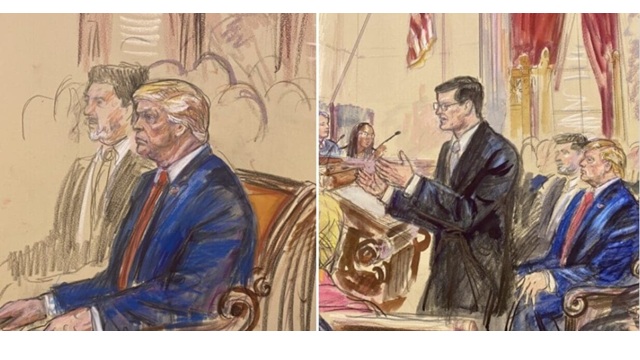
I shook my head. Her view of the president’s seat wasn’t ideal, but the artist was managing by leaning to the right with a small pair of theater binoculars. The only problem with the binoculars is that they can’t see through heads, she said.

“The Honorable, the Chief Justice and the Associate Justices of the Supreme Court of the United States,” the marshall called out as the room rose from their seats. “Oyez! Oyez! Oyez! All persons having business before the Honorable, the Supreme Court of the United States, are admonished to draw near and give their attention, for the Court is now sitting. God save the United States and this Honorable Court!”

Reporters lingered just a second longer than usual, milking every moment it was permissible to stand without getting called out by court police. I still couldn’t catch a view of Trump’s face.

At 10 o’clock, the Chief Justice began the usual swearing-in of new attorneys to the bar, and oral arguments began promptly after. A court spokesperson confirmed to the New York Times then that Trump was indeed seated in the courtroom, where reporters had no contact with those outside.

For a rare hour and 20 minutes, the president sat quietly and listened as the justices pressed his solicitor general, John Sauer, with questions. No White House press pool. No cameras. Only the regular Supreme Court pool and a courtroom artist.

Shortly after Sauer concluded, the president stood to leave.

The justices continued, never acknowledging their special guest. But now I could finally catch a glimpse as the president headed for a right side exit between two columns, his silhouette clear against the window as he left.

AUTHOR

Katelynn Richardson

Investigative Reporter

RELATED ARTICLE: Trump Might Lose Historic First SCOTUS Case President Has Ever Attended

EDITORS NOTE: This Daily Caller column is republished with permission. ©All rights reserved.


All content created by the Daily Caller News Foundation, an independent and nonpartisan newswire service, is available without charge to any legitimate news publisher that can provide a large audience. All republished articles must include our logo, our reporter’s byline and their DCNF affiliation. For any questions about our guidelines or partnering with us, please contact licensing@dailycallernewsfoundation.org.

Johnson, Thune Hatch Plan to End DHS Shutdown and Launch Second Reconciliation Push

As the almost 50-day partial shutdown drags on, travelers have definitely found some creative coping mechanisms for their long waits at U.S. airports. In Houston, one man went viral for walking up and down the security line with a vodka bottle, pouring shots for annoyed adults. Atlanta’s Hartsfield-Jackson brought in live entertainment, a violinist who was supposed to ease some of the tension. “[A] violin playing like on the deck of the Titanic. Is it that bad?” one passenger joked. And in Baltimore, volunteers passed out “pick-me-up snacks.” Now that TSA workers are finally getting paid, Americans’ aggravation is starting to subside — just not where Congress is concerned.

What was a four-hour checkpoint in Houston had dwindled to just 10 minutes on Monday, PBS reported — a world of difference from the endless nightmare passengers were experiencing just 48 hours earlier. After weeks of maddening scenes across the country, there are signs that things may slowly be returning to normal. On Capitol Hill, though, there’s been no reprieve from the biggest standstill: Homeland Security funding. But that’s about to change.

While the president found a workaround for TSA agents, the two chambers have been logging long phone calls in search of a solution to turn the lights on across DHS. As Politico points out, “While about 50,000 airport security officers are now getting paid under Trump’s executive action, thousands more workers remain furloughed or working without pay. Those include more than 2,000 employees of the premier federal cybersecurity agency, more than 4,000 FEMA workers as well as more than 1,000 Coast Guard civilians.”

On Wednesday afternoon, the situation took a dramatic turn when the two GOP leaders — who were at odds on strategy before the Easter recess — released a joint statement agreeing to compromise on their differences. In it, House Speaker Mike Johnson (R-La.) and Senate Majority Leader John Thune (R-S.D.) both agreed to swallow pieces of the other chamber’s proposal in an effort to get all of Homeland Security funded.

“In the coming days, Republicans in the Senate and House will be following through on the President’s directive by fully funding the entire Department of Homeland Security on two parallel tracks: through the appropriations process and through the reconciliation process,” they explained. “We appreciate,” they continued, “that Senator [Lindsey] Graham (R-S.C.) and the Senate Budget Committee have already initiated the process of developing a budget resolution that will ensure border security and immigration enforcement will be funded for the balance of the Trump Administration and insulated from future attempts by the Democrats to defund those agencies.”

Translation: House Republicans will be pressured to accept the Senate’s proposal to partially fund Homeland Security in exchange for Thune’s help in passing another reconciliation bill (which would presumably finance ICE and Customs and Border Patrol). Of course, the advantage of reconciliation, that tricky budgetary process the GOP used to move the One Big Beautiful Bill, is that it lets conservatives bypass the Senate’s 60-vote threshold and get legislation over the finish line with a simple majority — an absolute necessity in the era of absurd Democratic obstruction.

Last Friday, House Minority Leader Hakeem Jeffries (D-N.Y.) pushed hard to bring the Senate-passed proposal to the floor — to no avail. Wednesday afternoon, he reiterated that position, posting that it was “time to pay TSA agents, end the airport chaos and fully fund every part of the Department of Homeland Security that does not relate to Donald Trump’s violent mass deportation scheme.”

Assuming that position holds, the Democrats’ help will be crucial in getting the Senate bill over the hump in Johnson’s chamber, where some conservatives were already grumbling about the new, two-track plan. But even they must recognize the quandary leadership is in when Minority Leader Chuck Schumer’s (D-N.Y.) party is determined to put political messaging above American safety.

“We operated under a belief that while our country is in the midst of an international armed conflict, Democrats might finally come to their senses and understand that defunding our homeland security agencies is beyond reckless and very dangerous,” the two leaders pointed out. “[But] it is now abundantly clear that Democrats place allegiance to their radical left-wing base above all else — including their own power of the purse — which means open borders and protecting criminal illegal aliens. That is not acceptable to Republicans in Congress, nor is it to the American people. We cannot allow Democrats to any longer put the safety of the American public at risk through their open border policies, so we are taking that off the table.”

By early Thursday morning, the new plan was already moving. In its pro-forma session, the Senate sent its partial funding bill back to the House, where action will likely be taken early next week. Meanwhile, conservatives are bracing for the wild race toward reconciliation.

The challenge, most people agree, will be political discipline. There’s always a temptation for the party chasing reconciliation to throw every possible thing at the wall and see if it sticks. But this cannot be a catch-all, conservatives warn. “I would keep it as simple as possible so it could pass,” Johnson reiterated. While some Republicans will want to slip in Iran funding, pieces of the SAVE America Act, or other logjammed bills, an injection of too many priorities could “kill the whole thing,” one senator acknowledged anonymously.

“If you want to keep all of our members tight,” outgoing Senator Thom Tillis (R-N.C.) insisted, “… we need to agree to parameters and not allow scope creep.” The majority leader echoed the sentiment. “We’re just trying to make sure we keep our expectations realistic,” Thune said.

One advantage of the idea is that Republicans could fund all of DHS for multiple years — sparing them (and the country) this headache every time Homeland Security appropriations comes up. On that, both chambers agree. “We’re going to send [the House something] that actually funds DHS for the next three years. We’re not going through this again with the Dems, okay?” Senator John Hoeven (R-N.D.) emphasized.

Rep. Kevin Hern (R-Okla.) wonders if the House can find a sweet spot on reconciliation the second time around. “The reality is, we will be fine in the Senate,” he explained, recognizing that Thune can still lose three Republicans on reconciliation and still pass the bill. “The House is where we’re going to have the problem,” he cautioned on Tuesday’s “Washington Watch.” But we’re going to have people in swing districts [who] are going to have a real problem with it. The speaker knows that. We all know that, and we’re working hard to try to figure out a way forward.”

Singling out the perpetual thorn in Johnson’s side, Rep. Thomas Massie (R-Ky.), Hern acknowledged, “… There are a lot of reasons why we don’t have the full vote margins that we need. … And we know that we have one member [who’s] going to vote against everything that we do going forward. So we can’t lose any[one]. And that’s a very difficult situation when you’re trying to pass something as monumental as a second reconciliation bill.” Especially when the president throws down this timeline: “I am asking that the Bill be on my desk NO LATER than June 1st,” he posted Wednesday.

But the current situation isn’t just unsustainable, it’s historic. “Listen, not every single Democrat is against funding the security of our border and ICE,” Hern wanted people to know, “but the stranglehold by the Democrat[ic] leadership is making it such [that] if you vote to do the right thing for America, you’re a bad person. [And] I do think that it’s unprecedented.”

AUTHOR

Suzanne Bowdey

Suzanne Bowdey serves as editorial director and senior writer at The Washington Stand.

EDITORS NOTE: This Washington Stand column is republished with permission. All rights reserved. ©2026 Family Research Council.


The Washington Stand is Family Research Council’s outlet for news and commentary from a biblical worldview. The Washington Stand is based in Washington, D.C. and is published by FRC, whose mission is to advance faith, family, and freedom in public policy and the culture from a biblical worldview. We invite you to stand with us by partnering with FRC.
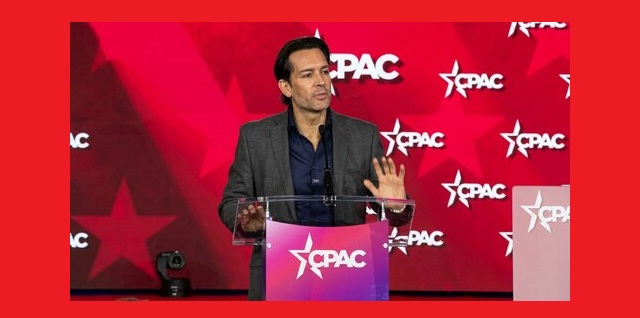
WalkAway Founder Brandon Straka Addresses Conservative Movement and Youth Voter Engagement at CPAC

DALLAS, Texas /PRNewswire/ — Brandon Straka, founder of the #WalkAway Campaign, delivered a speech at CPAC last week, addressing what he described as growing divisions within the conservative movement and the urgent need to reconnect with younger voters ahead of the upcoming midterm elections.

Speaking before a national audience, Straka emphasized that while the movement continues to show energy and momentum, it is also facing internal challenges that must be addressed openly.

“This is not an easy moment for our movement,” Straka said. “There’s energy, there’s passion, there’s momentum, but there’s also frustration, division, and a growing sense that something doesn’t feel right.”

Straka, who founded the #WalkAway Campaign after leaving the Democratic Party, has become a prominent voice encouraging Americans to rethink political assumptions and engage in open dialogue. He noted that more than one million people have joined the movement, with over 100,000 individuals sharing personal testimonials about their political journeys.

In his remarks, Straka warned that ideological divisions within the conservative movement are becoming increasingly pronounced, describing them as political, generational, and personal.

“A great divide has taken place,” he said. “And if we don’t address it honestly, we risk losing the very principles that brought people into this movement in the first place.”

Straka pointed to growing tensions over foreign policy, including debates surrounding U.S. involvement abroad, as one example of the divide. He noted that younger voters often approach these issues differently than older generations, highlighting the need for greater understanding and dialogue.

“There is a real generational divide,” Straka said. “Younger Americans are asking different questions, and if we are not willing to listen, we will lose them.”

Throughout the speech, Straka stressed the importance of free speech, open debate, and rejecting what he described as “cancel culture” within political movements.

“When did we decide that disagreement requires destruction?” he asked. “A movement that silences its own people is a movement that cannot grow.”

Straka also called on conservatives to remain committed to accountability and transparency in government, regardless of political affiliation.

“It is your duty as a citizen to question your government,” he said. “Blind loyalty is not patriotism. Engagement is.”

In addition to addressing internal divisions, Straka highlighted key issues he believes are critical to younger Americans, including affordability, housing, and economic opportunity. He emphasized that addressing these concerns is essential to building broader engagement ahead of the midterms.

The speech also touched on the importance of justice, election integrity, and ongoing debates around free speech and censorship, which Straka described as central to the future of the country.

Looking ahead, Straka announced that the #WalkAway Campaign will launch a new series of panel discussions aimed at bridging divides within the conservative movement, including conversations between different generations of voters.

“Our goal is not to walk away from the right,” Straka said. “It’s to stay and fight to fix it by bringing people back together through honest conversation.”

The #WalkAway Campaign continues to expand its national outreach through events, digital storytelling initiatives, and efforts aimed at encouraging Americans to engage in independent thinking and civic participation.

For more information about the #WalkAway Campaign, visit www.walkawaycampaign.com

©2026 . All rights reserved.

President Trump Addresses the Nation After Decisive U.S. Success in Iran

One month ago, President Donald J. Trump launched Operation Epic Fury against the world’s number one state sponsor of terror. Last night, he stood before the American people and delivered a message of victory that should make every American swell with pride. Iran’s navy is gone. Its air force lies in ruins. Its terrorist leaders are dead. Its command centers are decimated. In just thirty-two days, the United States military has achieved what weak-kneed administrations only talked about for forty-seven years.

“Never in the history of warfare has an enemy suffered such clear and devastating large-scale losses in a matter of weeks,” the President declared. He is right. This is not just military success—it is moral clarity in action. For decades, Iran chanted “Death to America” and “Death to Israel” while its proxies murdered our Marines in Beirut, bombed the USS Cole, and orchestrated the October 7th slaughter. They killed 45,000 of their own citizens for daring to protest. This fanatical regime was racing toward nuclear weapons, and only one leader had the courage to stop them cold.

President Trump has been addressing Iran’s terror network since his first term. He eliminated the evil genius Qasem Soleimani—the father of the roadside bomb. He tore up Barack Obama’s catastrophic Iran nuclear deal that funneled $1.7 billion in cash to the mullahs and would have handed them a nuclear arsenal years ago. As the President rightly said, “His Iran deal would have led to a colossal arsenal of massive nuclear weapons for Iran… There would have been no Middle East and no Israel right now.”

When diplomacy failed and Iran rebuilt its nuclear sites, Trump ordered Operation Midnight Hammer. Those magnificent B-2 bombers obliterated the facilities. Then came Epic Fury. In four short weeks, our warriors dismantled Iran’s missile program, crushed its defense industry, and severed its ability to arm Hezbollah, Hamas, and the Houthis. The Islamic Revolutionary Guard Corps is being decimated as we speak. The bully of the Middle East is a bully no more.

This President rebuilt our military after years of neglect. For this, he deserves much credit. He proved it again in Venezuela, where American forces took the country “in a matter of minutes” and turned it into a joint-venture partner producing massive amounts of oil and gas. America is now the undisputed energy superpower—number one in oil and gas, independent of the Middle East, and drilling like never before. That position of strength gave Trump the freedom to act in Iran without hesitation.

Even as gas prices ticked up because Iran attacked commercial tankers in a final act of deranged spite, Americans do not need to fear long-term price hikes. “Because of our drill baby drill program, America has plenty of gas,” the President reminded us. We produce more oil than Saudi Arabia and Russia combined. Our economy—rebuilt from the dead and crippled mess left by the Biden administration—is on the right path posting multiple record highs on the stock market and taking in trillions of dollars in investments. We entered this fight from a position of unmatched power.

President Trump rightly recognized the thirteen American heroes who gave their lives to ensure our children never face a nuclear Iran. The President traveled twice to Dover Air Force Base to honor them and their families. Every one of those families told him the same thing: “Please, sir, please finish the job.” And finish it we will.

“We are on track to complete all of America’s military objectives shortly,” he announced. If the new, less radical leadership in Tehran does not make a deal, America still has cards left to play—electric generating plants, precision strikes, and total dominance from the skies. Iran’s radar is annihilated. Its anti-aircraft systems are gone. They should not test us.

Regime change, according to the president, was never our stated goal, yet it has happened. The original terrorist leaders are dead. Iran’s ability to threaten America or project terror beyond its borders has been systematically dismantled. The Strait of Hormuz will reopen naturally once the mullahs realize they must sell oil to survive. Gas prices will drop. Stock markets will roar back higher than ever.

President Trump has delivered what previous presidents only promised: a safer America, a stronger America, a more prosperous America. He has ended the specter of nuclear blackmail from the most violent regime on Earth. Because of his courage, clarity, and unmatched leadership, the free world can breathe easier tonight.

Every American should stand in gratitude. Our warriors have performed magnificently. Our President has kept his word. The cancer of a nuclear Iran has been cut out. The mission is nearly complete, and victory—total, decisive, and historic—is at hand.

AUTHOR

Act for America

EDITORS NOTE: This Act for America column is republished with permission. ©All rights reserved.

RELATED ARTICLE: Defense Secretary Hegseth: The Next Few Days Will Be Decisive


Please visit the Act for America substack.